From Ratnākara to Vālmīki
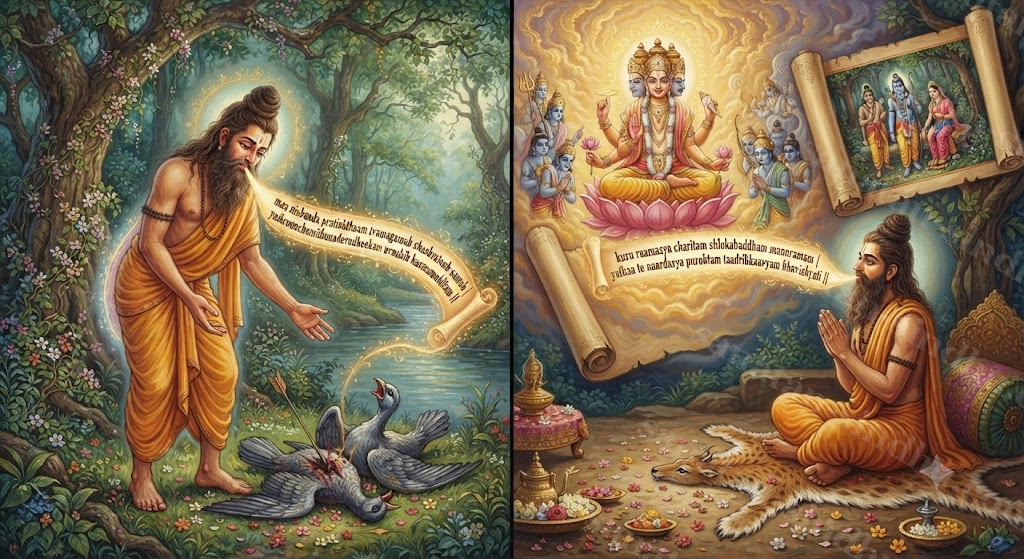
Tradition holds that Vālmīki was not born a sage but transformed into one — earlier in life known as Ratnākara, living outside dharma, until an encounter with the sage Nārada set him on a path of penance. A well-known telling has him repeating the syllables of Rāma's name in reverse ('mara, mara') for so long, in unbroken meditation, that an anthill (valmīka) grew over his motionless body — the origin of the name Vālmīki.
Grief becomes verse — the birth of the śloka
The Rāmāyaṇa itself preserves a story about its own origin: Vālmīki, witnessing a hunter kill one of a pair of krauñca birds, is overcome with spontaneous grief (śoka) that emerges, without his conscious intention, as perfectly metred verse (śloka) — the anuṣṭubh metre that would go on to become the standard verse form of an enormous share of later Sanskrit literature. The pun between śoka and śloka is treated in the tradition as the literal moment poetry entered the world through grief transmuted into form.
24,000 verses, and a life inside the story he told
The Rāmāyaṇa runs to roughly 24,000 ślokas across seven Kāṇḍas, making it one of the two great Sanskrit epics (alongside the Mahābhārata) and the foundational mahākāvya — the first work of literary Sanskrit poetry in the fullest sense, as opposed to Vedic hymn or ritual text. Vālmīki appears as a character within his own narrative's later stretch: he shelters the exiled Sītā at his forest āśrama, raises her twin sons Lava and Kuśa, and teaches them the very epic he composed, which they in turn recite before Rāma's own court.
The first poet, and the template that followed him
Vālmīki's title Ādi Kavi — 'the first poet' — reflects the Rāmāyaṇa's foundational status for the entire later tradition of Sanskrit and vernacular Indian poetry: virtually every subsequent regional retelling of Rāma's story, from Kamban's Tamil version to Tulsidas's Awadhi Rāmcaritmānas, works in explicit relationship to Vālmīki's original. The story's core structure — exile, trial, and the restoration of rightful order — became one of the most widely retold moral templates in Indian civilisation.