
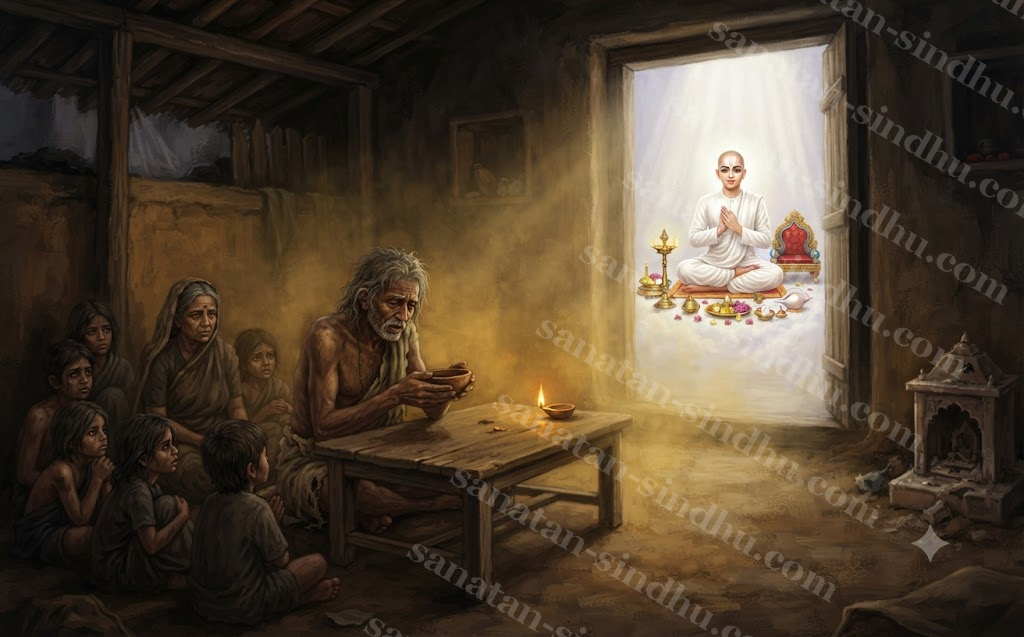
A Good Man Falls
In the city of Kānyakubja there lived a young brāhmaṇa named Ajāmila, and in the beginning he was everything a brāhmaṇa should be. He had mastered the Vedas. He was gentle, truthful, self-controlled, pure in his habits, devoted to his parents and his teachers. His father had trained him well, and the whole town pointed to him as an example. One day his father sent him to the forest to gather fruit, flowers and sacred grass for the daily worship. Ajāmila went gladly. But on his way home he passed a place he should not have looked at, and saw what he should not have seen: a śūdra man, drunk, laughing and sporting with a servant woman in public, her clothing loosened, both of them shameless in their abandon. Ajāmila had studied all his life, but he had never truly mastered his mind. At that sight, desire pierced him like an arrow smeared with poison. The Bhāgavata is unsparing: as the sun and moon are seized by eclipse, so his reason was seized by lust. He forgot his training, his family, his scripture, his shame. He took the woman into his life. When money ran short, he took to gambling, then to cheating, then to theft, and worse. The boy who had been the town's pride became its quiet scandal. He abandoned his lawfully wedded wife and his aged parents. Years passed. He lived with the servant woman, and she bore him ten sons. And the youngest of those sons — the last child of his old age, the one he loved more than his own life — he named Nārāyaṇa. The name had come down in the family, a grandfather's name, an honoured name. Ajāmila did not think of God when he used it. But God, the Bhāgavata says, thinks of us.
✦ Visual cue — A once-noble brahmin, now ragged and aged, in a dim dwelling with a servant woman and many children; through the doorway a memory-vision of his pure youth in white.