A Mother's Question
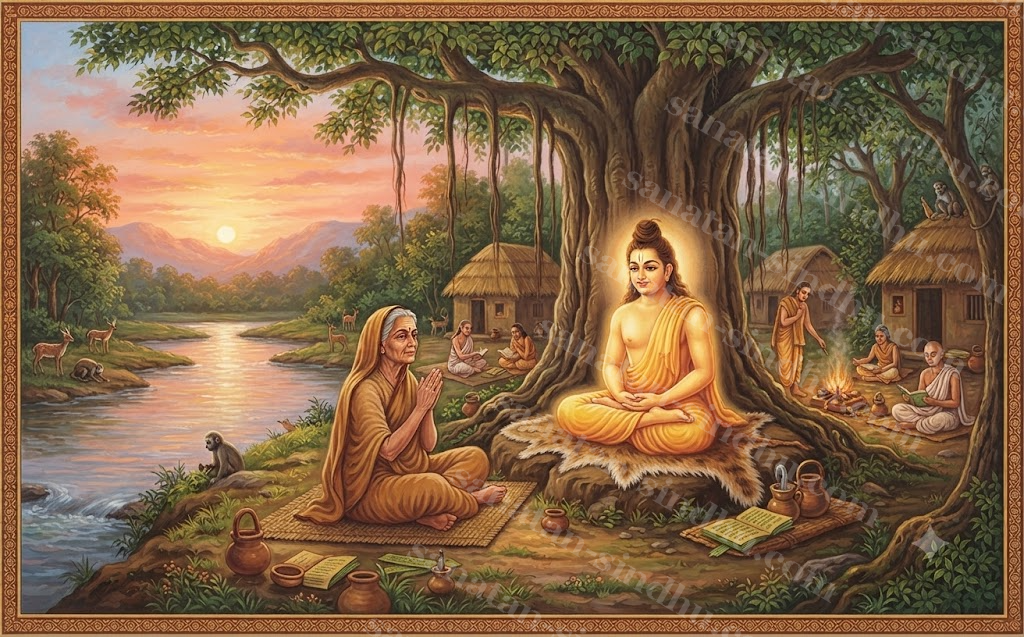
Devahūti was no ordinary woman. She was the daughter of Svāyambhuva Manu, the first lawgiver of mankind, and the wife of the great sage Kardama. In her youth she had lived in her father's palace, served by attendants, clothed in silk. Then she chose the forest life with her husband, and for years she served him in a hermitage on the banks of the Sarasvatī, until her body grew thin with austerity. Kardama, by his mystic power, gave her nine daughters, and then, as the sages had foretold, the Lord Himself agreed to be born as her son. That son was Kapila — Kapila Muni, whom the tradition honours as an avatāra of Viṣṇu come to restore the knowledge of Sāṅkhya, the science of the soul and matter. When Kardama departed for the forest to take his final leave of the world, Devahūti remained with her son. Her daughters had married great sages and gone to their husbands' homes. The palace days were a dream behind her. She looked at Kapila, radiant as the morning sun, seated in meditation beneath the trees, and she understood that the time had come to ask the one question that mattered. She approached him with folded hands. 'O my Lord,' she said, 'I am weary. The senses are like roads that never end — I have travelled them all and found no rest. You are the eye by which the blind world may see. Cut the knot of my ignorance. Tell me: what is the truth about spirit and matter, and how may a soul like mine be freed from this endless wheel of birth and death?' Kapila opened his eyes. The scriptures say he smiled, for this was the very purpose of his birth. 'O mother,' he replied, 'the yoga I shall teach you is the ancient path by which the sages crossed over death. Listen with a steady mind.'
✦ Visual cue — An elderly queenly woman in simple hermit's cloth, hands folded, seated before a radiant young sage under a great tree at sunrise; forest hermitage by a river.