Deities · Vedic Devas
Lord Agni
अग्नि
Agni
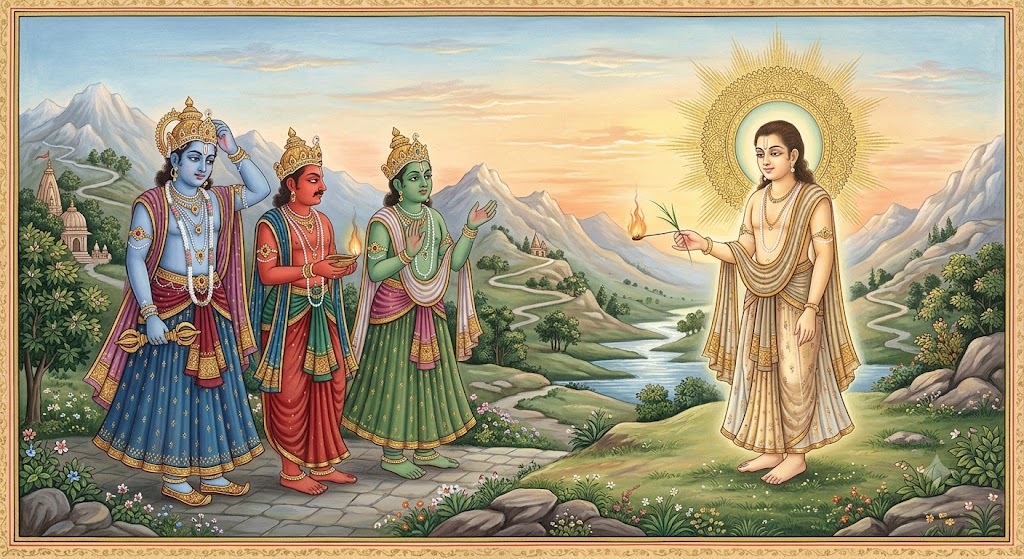
The first word of the Ṛgveda — 'agnim īḷe purohitam' — invokes Agni as the household priest of the cosmos. As the divine fire he carries every sacrificial offering (havana) from the human world to the devas. He is a threefold deity: the terrestrial fire of ritual, the atmospheric fire of lightning, and the celestial fire of the sun. In the Kena Upaniṣad, though called Jātavedas ('knower of all born beings'), he cannot burn a single blade of grass without Brahman's power.
Quick facts
- Era
- Vedic / Sanatana
- vahana
- Ram
- consort
- Svāhā
- Abode
- Every consecrated fire; the digestive fire (jāṭharāgni) in every living body
Attributes & symbols
Emblems most often depicted with Lord Agni. Hover for gloss · click to search.
Epithets
Names and titles by which Lord Agni is invoked across the śāstras.
Essays
Related essays
Before the Trimūrti — the Brāhmaṇa Prelude
Before Brahmā, Viṣṇu and Śiva became a coordinated trio, the Brāhmaṇa texts already told stories of one god's injury, rivalry and repair during sacrifice — Viṣṇu as a dwarf and as the beheaded Makha, and Rudra's arrow against Prajāpati.
Essay · Vedic & Vedāntic CosmologyThe Devas and the Trimūrti — a stratified cosmology
Indra, Agni, Varuṇa, Sūrya, Vāyu and the other Vedic devas were once celestial sovereigns; in the Purāṇic era they appear subordinate to Brahmā, Viṣṇu, and Śiva. Not a replacement — a philosophical stratification through Nirguṇa Brahman, Iśvara, and the administrative devas.
Essay · Ṛgvedic self-descriptionSapta Sindhu and the Ārya — what the Ṛgveda says about its own people
Before any modern theory enters the picture, the Ṛgveda already answers “who are we, and where do we live?” — Sapta Sindhu, the Ārya as a ritual community rather than a race, and the one war the text narrates in full: the Battle of the Ten Kings.