Three levels, one reality
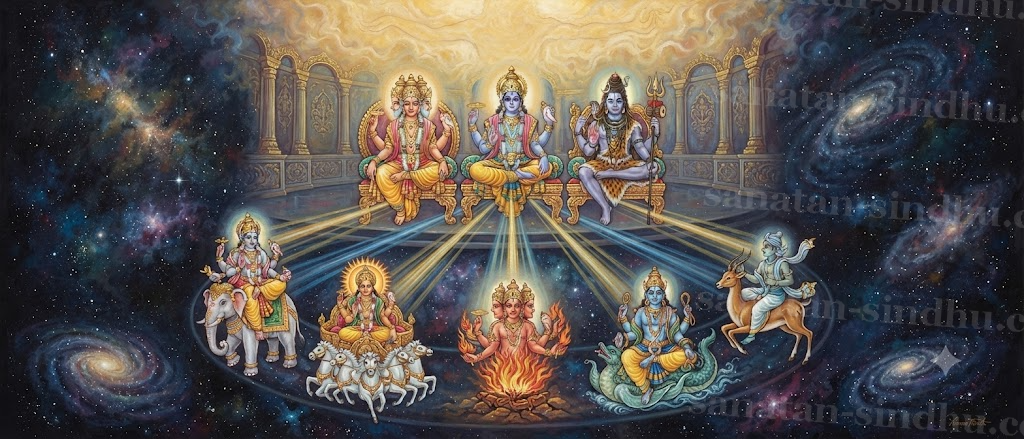
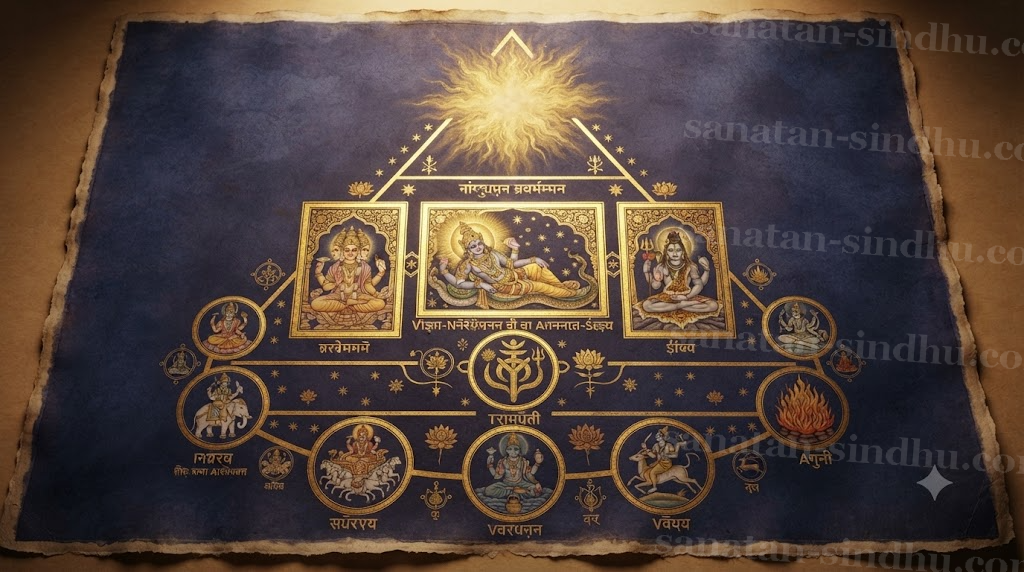
Hindu theology is not a flat pantheon. It is a stratified architecture worked out across the three pillars of Indian wisdom — the Vedas, the Upaniṣads, and the Bhagavad Gītā (collectively the Prasthānatrayī). Understood in that architecture, three levels stack cleanly:
- Nirguṇa Brahman — the formless, changeless, quality-less absolute
- Saguṇa Brahman / Iśvara — the personal cosmic creator, expressed as the Trimūrti (Brahmā, Viṣṇu, Śiva)
- Devas / Devatās — the administrative offices governing localised departments of the cosmos (Indra, Sūrya, Varuṇa, Vāyu, Agni, and so on)
The move from the Vedic period (when Indra thunders as celestial sovereign) to the Purāṇic period (when Indra bows before Viṣṇu) is not a swap of gods. It is the same worshippers coming to see the whole ladder rather than one rung.
Nirguṇa Brahman — the ground of being
At the top of the hierarchy is Nirguṇa Brahman: absolute, formless, without qualities. It is kūṭastha-nitya — eternally changeless, entirely outside time, space and causality.
Ontologically, Brahman is the vivarta upādāna kāraṇa — the apparent material cause of the universe. The classical Vedāntic image is the rope-snake illusion: a rope in dim light is mistaken for a snake by an anxious mind. The rope itself does not change; only the perception does. Brahman remains completely unaffected by the projection of the universe.
Iśvara — the personal cosmic creator
When that non-dual awareness is conditioned by its own creative potency (māyā), it is perceived as Iśvara — the personal deity with attributes: omniscient, omnipotent, universally compassionate.
In contrast to Brahman's changelessness, Iśvara is pravāha-nitya — eternally in flux, cycling manifestation. Iśvara is the pariṇāmi upādāna kāraṇa — the transforming material cause. The classical image is milk becoming curd: the substance genuinely reshapes itself without losing its essential nature.
The Trimūrti — Brahmā, Viṣṇu, Śiva — are the three functional faces of Iśvara: creation (sṛṣṭi), maintenance (sthiti), dissolution (laya). Not three competing gods. Three offices of the same personal Absolute.
The Bhāgavatam summarises the same truth in three registers:
1. Brahman — the impersonal, all-pervading effulgence 2. Paramātmā — the Super-Soul residing within every being 3. Bhagavān — the supreme personal deity with all opulences
The Devas — administrative offices and immanent laws
Below the Trimūrti sit the Devas. The tradition holds two distinct definitions in tension:
A. Jīva-Deva — a Deva is a sentient being (jīva) who has earned residence in a celestial realm (Svarga) through extraordinary meritorious karma (puṇya). Superior mind, superior body — but still bound to saṁsāra. The office of 'Indra' or 'Sūrya' is temporary; when the current holder's puṇya is exhausted, they transmigrate back into lower species.
B. Adhidaiva-Deva — a Deva is a functional knowledge-power that governs a physical law. On this deeper reading, Lakṣmī is not just an anthropomorphic figure on a lotus; she is the immanent cosmic law that governs the generation and distribution of resources. Sarasvatī is the law that distributes intelligence and creative capacity. On this reading, the Devas are the software of the universe running on Iśvara's operating system.
Both readings are correct at their own level. The office holder is a jīva; the office itself is a law of nature.
The Kena humbling — when the Devas met their source
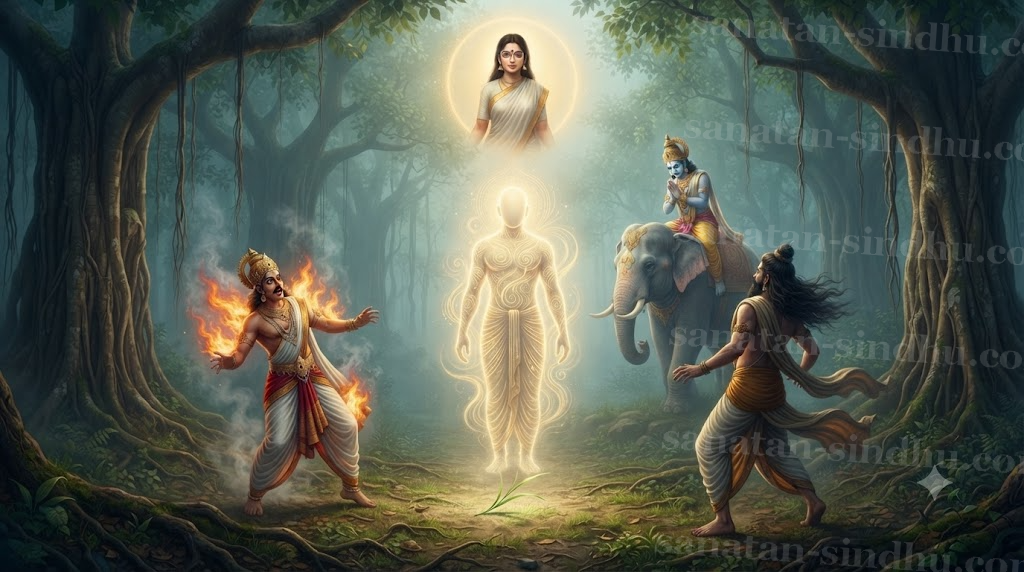
After a great cosmic victory, the Devas grew proud. To humble them, Brahman appeared before them as a mysterious luminous being — a Yakṣa. Unable to comprehend it, the Devas dispatched Agni to investigate. The Yakṣa placed a blade of grass before Agni and asked him to burn it. Fire, lord of burning, failed. Vāyu was sent next — asked to blow the same blade away. Wind, lord of motion, failed.
Finally Indra approached. The Yakṣa vanished. In its place stood Umā Haimavatī (Vidyā, Knowledge), who revealed the truth: all power belongs to Brahman. The Devas do not shine on their own — they shine because the Absolute lends them light. (See our story: The Yakṣa and the Blade of Grass.)
The major Vedic devas at a glance
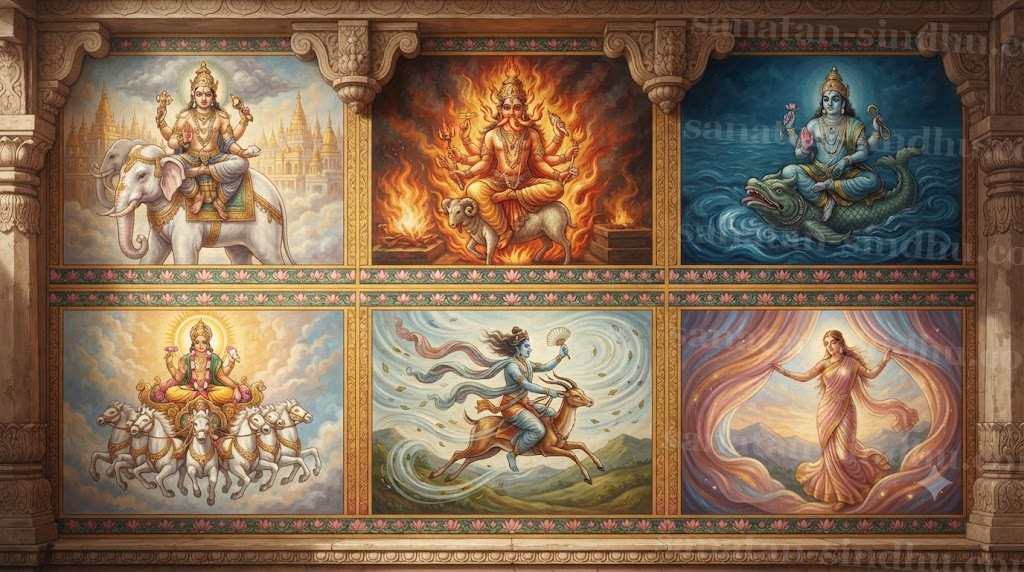
- Indra — king of the devas, wielder of the Vajra, the striker who releases the rains held by Vṛtra. In the Kena story, the first among devas to be humbled.
- Agni — fire, the divine messenger who carries every offering (havana) between worlds. First word of the Ṛgveda: agnim īḷe puróhitam.
- Varuṇa — cosmic moral judge in the Vedic layer, keeper of Ṛta (cosmic order); later reassigned as lord of oceans. His noose (pāśa) binds the untruthful.
- Sūrya — the sun, riding a golden chariot drawn by seven horses (the seven rays / seven Vedic meters). In later Purāṇic literature integrated as Sūrya-Nārāyaṇa — the visible material form of Viṣṇu's preserving energy. The Gāyatrī Mantra addresses him as Savitṛ, the divine stimulator, praying for the illumination of the intellect (dhī).
- Vāyu — the cosmic breath, macrocosmic counterpart of prāṇa in the body. Father of Hanumān and Bhīma.
- Uṣas — the goddess of dawn, one of the most beloved of Vedic devīs, sung in over 20 hymns of the Ṛgveda as the young bride of the sun who bares her breast of light each morning.
Macro-micro isomorphism — the cosmic body inside the human body
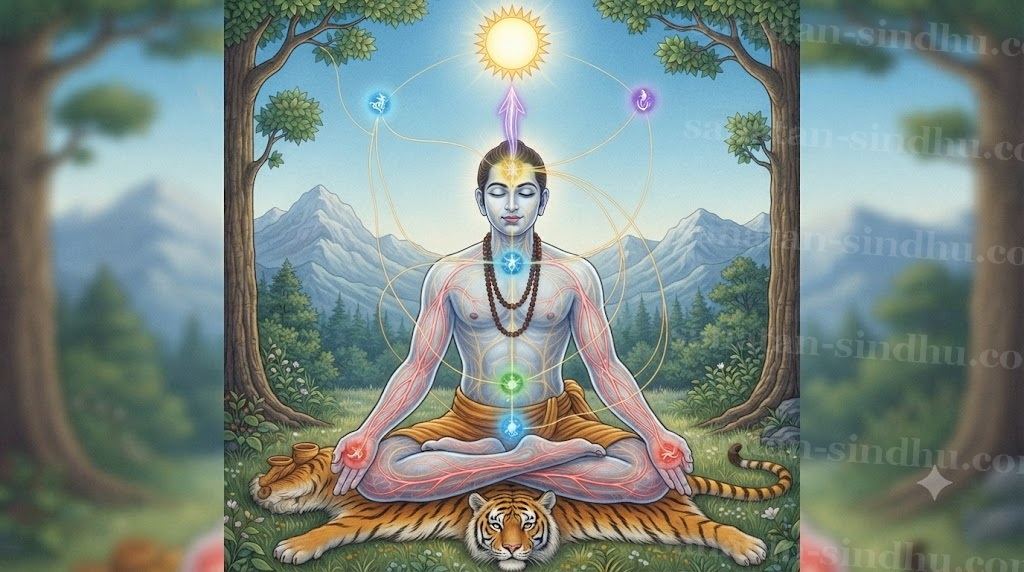
The Devas are not only 'out there'. The tradition insists on a macro-micro isomorphism — the same laws that govern the universe govern the body. Prāṇa operates in the body through a fivefold physiological division, each corresponding to a macrocosmic force:
- Prāṇa — located in eyes, ears, mouth, nose; macrocosmically energised by Sūrya, the external prāṇa of the universe.
- Apāna — the downward-moving breath governing excretion and procreation.
- Samāna — resides in the digestive centre, distributing food; macrocosmic counterpart is the atmospheric air.
- Vyāna — pervades circulation and nerves; macrocosmic counterpart is the external air.
- Udāna — the ascending breath that leads the soul out of the body at death, guided by its accumulated virtues and lapses.
The devas, in this framing, are the pattern by which the outside and the inside of a human being are the same weave.
The three levels, side by side
| Parameter | Nirguṇa Brahman | Iśvara (Trimūrti) | Devas | |---|---|---|---| | Reality status | Satyam — absolute, non-dual | Mithyā as cosmic form; satyam in essence | Mithyā — bound by localised office | | Temporal state | Kūṭastha-nitya (changeless) | Pravāha-nitya (cyclically flowing) | Anitya (temporal; bound by an epoch) | | Material cause | Vivarta upādāna (apparent) | Pariṇāmi upādāna (transforming) | Secondary instrument channelling universal laws | | Karma | Beyond action and result | Karma-phala-dātā — dispenser of results | Subject to prior karma; transmigrates when merit ends | | Realised through | Jñāna Yoga | Bhakti Yoga | Karma Kāṇḍa — Vedic ritual, for temporal gains |