A framework of cyclic cosmogenesis
The study of Hindu cosmogony traces a movement from the abstract monism of the Vedic period to the personalised, sectarian theism of the Purāṇas. In the earliest layer of Sanskrit literature the universe is not the artifact of an external creator but a spontaneous, self-unfolding manifestation of a single Absolute (Brahman). The transition from unmanifest (Avyakta) to manifest (Vyakta) is mediated by the Trimūrti — Brahmā (creator), Viṣṇu (preserver), Śiva (dissolver).
Time is structured as an eternal succession of creation, maintenance, and dissolution. The base unit is the Mahāyuga — Kṛta + Tretā + Dvāpara + Kali — equal to 4,320,000 solar years. One Kalpa is a day of Brahmā (1,000 Mahāyugas, ~4.32 × 10⁹ years); an equal night of dissolution (Pralaya) follows. Brahmā's total lifespan spans one hundred 'Brahmā-years' — approximately 3.11 × 10¹⁴ solar years — at whose end the entire cosmos undergoes Mahāpralaya and returns to the primordial unmanifest, before the cycle begins anew.
Brahmā — from Hiraṇyagarbha to Padmanābha
The cosmogonic origin of Brahmā is rooted in the Vedic concept of Hiraṇyagarbha — the 'Golden Womb' — invoked in Ṛgveda 10.121 as the primordial locus of manifestation. In the Upanishadic prose, this is refracted through a threefold division of consciousness: Virāṭ (waking, gross), Hiraṇyagarbha (dream, subtle cosmic mind), and Avyākṛta (deep sleep, causal). Brahmā is the personification of Mahat — the cosmic intellect — animated by Rajas Guṇa.
हिरण्यगर्भः समवर्तताग्रे भूतस्य जातः पतिरेक आसीत् । स दाधार पृथिवीं द्यामुतेमां कस्मै देवाय हविषा विधेम ॥
hiraṇyagarbhaḥ samavartatāgre bhūtasya jātaḥ patireka āsīt | sa dādhāra pṛthivīṃ dyāmutemāṃ kasmai devāya haviṣā vidhema ||
'Hiraṇyagarbha was present at the beginning; when born, he was the sole lord of created beings; he upheld this earth and heaven — to which god shall we offer our oblation?'
The Purāṇic synthesis — Matsya Purāṇa 2.25–30 — recounts that after the great dissolution, the self-manifested Being (Svayambhū) generated the primordial waters and cast a seed into them; the seed became the golden egg from which Brahmā emerged, dividing the shell into heaven and earth. The Viṣṇu Purāṇa and Bhāgavata Purāṇa preserve the dominant iconography: at the dawn of each Kalpa Viṣṇu reclines on Śeṣanāga in the Ocean of Milk, and from his navel rises a lotus within which Brahmā is born — hence Padmanābha.
Viṣṇu — the three strides and the pervading consciousness
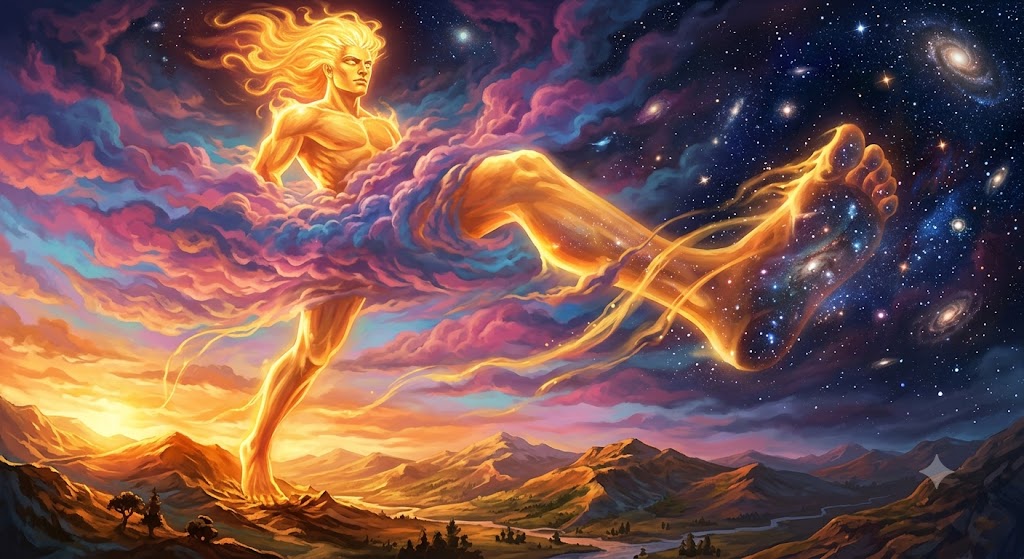
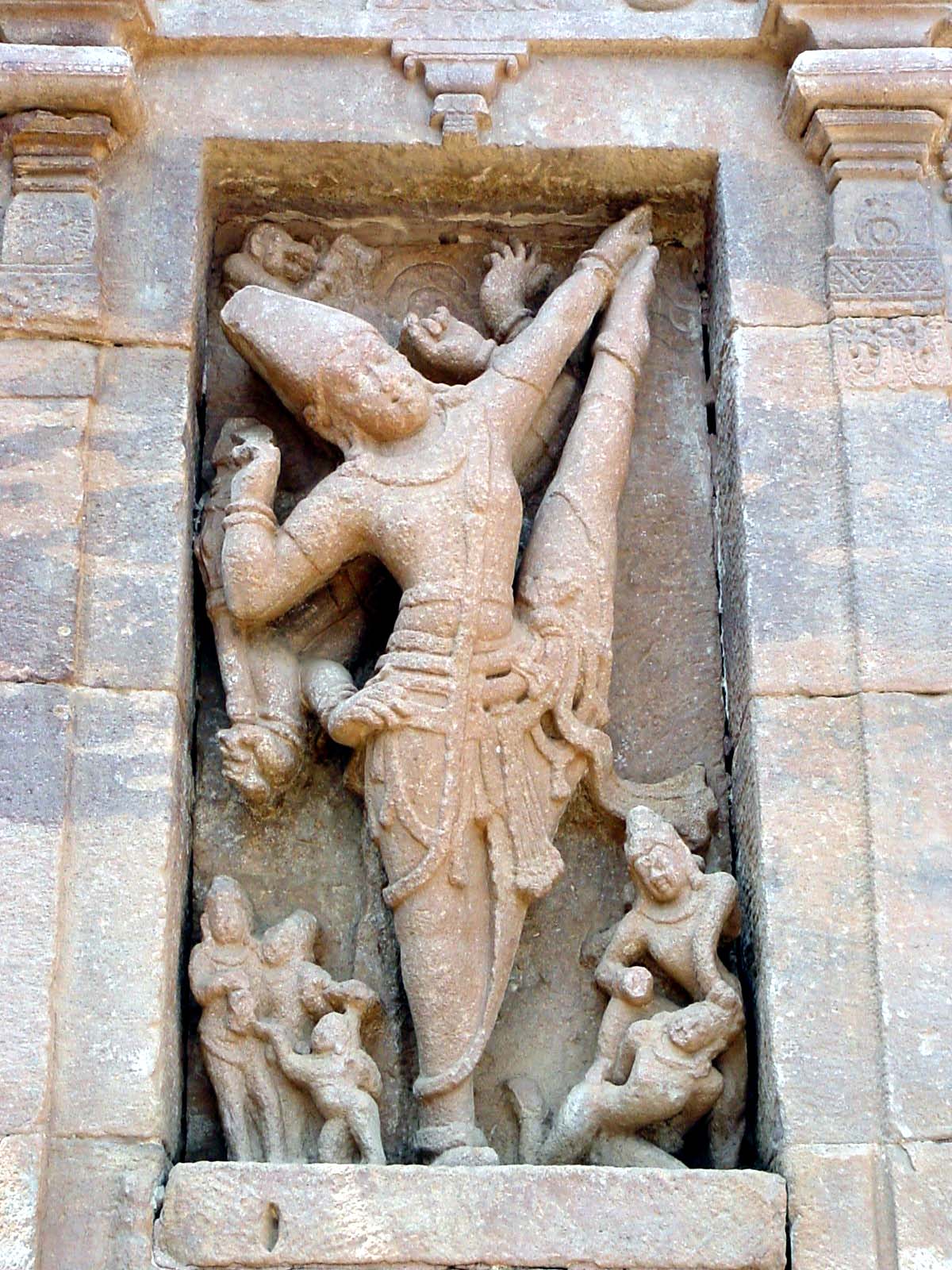
In the Ṛgveda, Viṣṇu is a solar deity of light, space, and cosmic order. His central motif is Trivikrama, the three strides that measure out the cosmos:
विष्णोर्नु कं वीर्याणि प्र वोचं यः पार्थिवानि विममे रजांसि । यो अस्कभायदुत्तरं सधस्थं विचक्रमाणस्त्रेधोरुगायः ॥
viṣṇor nu kaṃ vīryāṇi pra vocaṃ yaḥ pārthivāni vimame rajāṃsi | yo askabhāyad uttaraṃ sadhasthaṃ vicakramāṇas tredhorugāyaḥ ||
'I will now declare the heroic deeds of Viṣṇu, who measured out the earthly regions, who established the upper dwelling place, striding threefold — the wide-paced explorer.'
Yāska's Nirukta reads the three steps as the sun's traversal of earth, atmosphere, and high heavens. The name Viṣṇu is derived from the root viṣ — 'to pervade' — a gloss confirmed by Ādi Śaṅkarāchārya in his commentary on the Viṣṇu Sahasranāma.
The Upanishadic layer identifies Viṣṇu-Nārāyaṇa as the Supreme Absolute (Para Brahman). The Nārāyaṇa Sūktam declares him the indwelling soul of every being, and the Purāṇas develop his cosmogonic state as Anantaśayana — reclining upon infinite time on the primordial ocean — from which the ten Daśāvatāra descend to restore Dharma whenever cosmic order tilts toward chaos.
Śiva — from Rudra to the Jyotirliṅga
Śiva's cosmogonic lineage begins in the Ṛgvedic Rudra (RV 2.33), fierce storm-god and 'Father of the Maruts'. The Yajurvedic Śatarudrīya (Taittirīya Saṃhitā 4.5) makes his pervasiveness explicit:
यो रुद्रो अग्नौ यो अप्सु य ओषधीषु यो रुद्रो विश्वा भुवनाऽऽविवेश तस्मै रुद्राय नमो अस्तु ॥
yo rudro agnau yo apsu ya oṣadhīṣu yo rudro viśvā bhuvanā''viveśa tasmai rudrāya namo astu ||
'The Rudra who is in the fire, who is in the waters, who is in the plants — the Rudra who has entered and pervaded all beings: to that Rudra be homage.'
The Śvetāśvatara Upaniṣad elevates Rudra-Śiva to the non-dual Absolute — eko hi rudro na dvitīyāya tasthuḥ — 'Rudra is truly one; knowers of Brahman admit no second.'
The Purāṇic synthesis crystallises in the Liṅgodbhavamūrti. When Brahmā and Viṣṇu quarrelled over supremacy, Śiva appeared between them as a limitless pillar of fire; Brahmā flew upward as a swan, Viṣṇu dove downward as a boar, and neither could find its end. From the pillar's centre Śiva revealed himself, declaring that both had been born of his transcendent energy — Brahmā the active Rajas, Viṣṇu the preserving Sattva, Śiva the transcendent ground of both.
The non-dual paradigm — Kashmiri Trika Shaivism
Systematised by Vasugupta (c. 850 CE) and Abhinavagupta (c. 975–1025 CE), the Trika system holds that the universe is entirely real — a voluntary manifestation of the dynamic consciousness of Paramāśiva. The descent of consciousness is charted through 36 Tattvas, beginning with Śiva (pure Prakāśa) and Śakti (reflective Vimarśa), and contracting through the five Kañchukas — Kalā, Vidyā, Rāga, Kāla, Niyati — until it experiences itself as the bounded individual. Liberation is the spontaneous recognition (Pratyabhijñā) that one has always been Śiva. The canonical texts include the Śiva Sūtras, the Mālinīvijayottara Tantra, and Abhinavagupta's Tantrāloka.
Ritual topography — the festivals of the triad
- Kārtika Pūrṇimā (Brahmā) — full-moon of Kārtika (Oct–Nov). Commemorates Brahmā's cosmic Yajña; observed at the Brahmā Temple at Pushkar with lake-bathing and Dīpadāna. Scriptural anchors: Ṛgveda 10.121; Matsya Purāṇa; Brahma Purāṇa.
- Vaikuṇṭha Ekādaśī (Viṣṇu) — waxing moon of Mārgaśīrṣa (Dec–Jan). Gates of Vaikuṇṭha are opened; devotees pass through the Vaikuṇṭha Dvāra at Sri Ranganathaswamy, Srirangam. Anchored in the Viṣṇu Purāṇa.
- Anant Caturdaśī (Viṣṇu) — Bhādrapada (Sept). A fourteen-knot thread honours Ananta / Śeṣanāga and the fourteen Lokas.
- Mahā Śivarātri (Śiva) — 14th night of the dark half of Māgha (Feb–Mar). Celebrates the Jyotirliṅga manifestation and the cosmic marriage of Śiva and Pārvatī. Anchored in the Śiva Purāṇa; the Śrī Rudram is chanted through the night.
Comparative matrix
A synthesis of the scriptural, ontological, and ritual dimensions of the three:
| Dimension | Brahmā | Viṣṇu | Śiva |
|---|---|---|---|
| Vedic antecedent | Hiraṇyagarbha / Prajāpati (RV 10.121) | Solar deity of the three strides (RV 1.154) | Rudra, the storm-god (RV 2.33) |
| Upanishadic identification | Sūtrātman, subtle cosmic mind | Nārāyaṇa as Para Brahman (Nārāyaṇa Sūktam) | The one without a second (Śvetāśvatara 3.2) |
| Puranic narrative | Born from the golden egg / Padmanābha lotus | Anantaśayana; Daśāvatāra | Liṅgodbhava; birth of Rudra |
| Guṇa | Rajas — active creative principle | Sattva — preserving balance | Tamas as dissolution; transcendent Sattva |
| Primary festival | Kārtika Pūrṇimā (Pushkar) | Vaikuṇṭha Ekādaśī (Srirangam) | Mahā Śivarātri |
| Non-dual paradigm | — | Śrī Vaiṣṇava, Advaita readings of Nārāyaṇa | Kashmiri Trika (Pratyabhijñā) |