The metaphysics of creation
In Hindu philosophy, before the physical universe exists there is only Brahman — the formless, infinite, absolute reality. When Brahman decides to manifest into a tangible universe, it assumes the active quality (Rajas Guṇa) as Lord Brahma. Brahma is the mind that conceptualises the cosmos, engineering the templates for all physical matter, laws of nature, and living beings.
Decoding the symbolism
Unlike other deities who wield weapons of war, Brahma's iconography is entirely centred around intellect, creation, and time. Every element of his appearance is a metaphor for the mind and the cosmos.
- The Four Heads represent the four directions of space — his omnipresent gaze over creation — and the four Vedas (Ṛg, Yajur, Sāma, Atharva), which flowed from his mouths at the dawn of time.
- The White Beard symbolises eternal wisdom and the fact that creation is an ancient, ongoing process.
- The Haṁsa (swan), his vāhana, is renowned for Nīra-Kṣīra Viveka — the ability to separate milk from a mixture of milk and water. This is viveka, the intellect's power to separate truth from illusion.
- The Kamaṇḍalu (water pot) contains the cosmic water from which all creation is physically birthed.
- The Akṣamālā (rosary) tracks the endless, cyclical passage of cosmic time.
The great mystery: why is Brahma not worshipped?
Travel across India and you will find thousands of temples dedicated to Vishnu and Shiva, but only a tiny handful dedicated to Brahma — most famously the Pushkar Temple in Rajasthan. Why did the creator of the universe get sidelined? The answer lies in two layers: one mythological, one philosophical.
The mythological explanation — the race of the infinite pillar
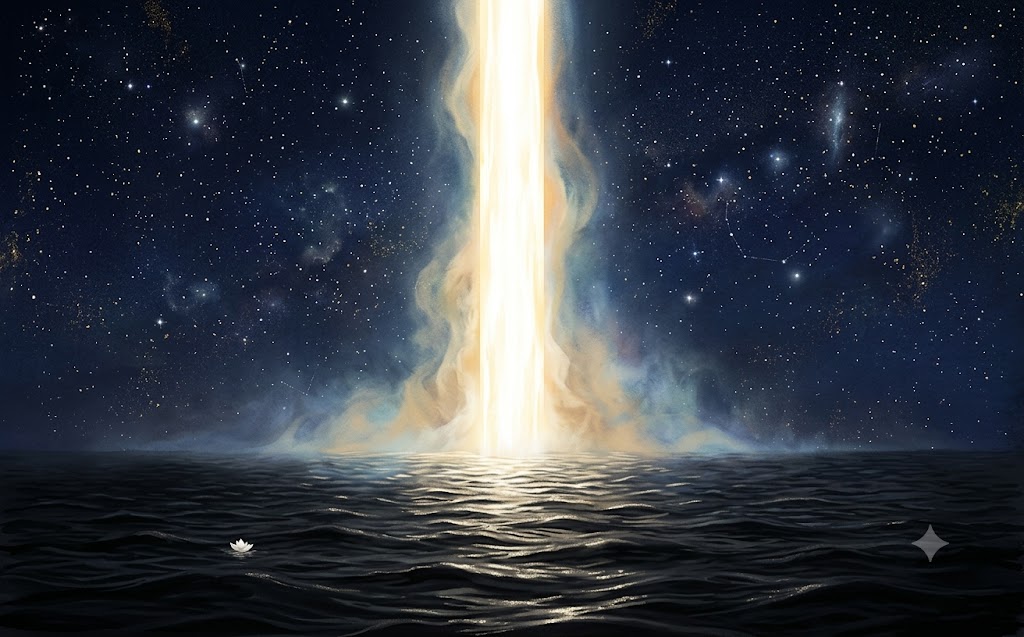
Vishnu and Brahma once argued over who was superior. A massive, endless pillar of fire appeared between them (an unmanifested form of Shiva). Whoever found its end first would be declared supreme. Vishnu became a boar and dug into the earth; Brahma became a swan and flew upward.
Neither could find the end. Brahma spotted a Ketakī flower falling and persuaded it to lie for him, claiming he had reached the top. When Shiva revealed himself, he was furious at the deceit. He cursed Brahma that he would never be worshipped by humanity, and banned the Ketakī flower from religious rituals.
The philosophical reality
Beyond the myth, Hindu metaphysics explains Brahma's lack of temples through a beautiful architectural metaphor:
- Brahma is the builder; Vishnu is the house; Shiva is the eventual recycling of the materials.
- Once a house is built, you do not worship the contractor daily — you live in and care for the house (Preservation / Vishnu), and you respect the forces that will one day renovate it (Transformation / Shiva).
- Brahma represents the past (creation is already done); Vishnu the present (survival); Shiva the future (liberation). Human beings naturally pray to the forces regulating their current life and ultimate spiritual freedom.
Vedic antecedent — the Hiraṇyagarbha
The cosmogonic origin of Brahmā is rooted in the Vedic concept of Hiraṇyagarbha — the 'Golden Womb' or 'Cosmic Embryo'. The Hiraṇyagarbha Sūkta (Ṛgveda 10.121) opens with the primordial locus of manifestation:
हिरण्यगर्भः समवर्तताग्रे भूतस्य जातः पतिरेक आसीत् । स दाधार पृथिवीं द्यामुतेमां कस्मै देवाय हविषा विधेम ॥
hiraṇyagarbhaḥ samavartatāgre bhūtasya jātaḥ patireka āsīt | sa dādhāra pṛthivīṃ dyāmutemāṃ kasmai devāya haviṣā vidhema ||
'Hiraṇyagarbha was present at the beginning; when born, he was the sole lord of created beings; he upheld this earth and heaven — to which god shall we offer our oblation?'
The adjacent Nāsadīya Sūkta (RV 10.129) frames a pre-cosmic state devoid of both existence and non-existence, in which 'the One' breathed, breathless, by its own intrinsic power. Out of that void, cosmic desire (Kāma) arose as the first seed of mind, and from it the golden embryo took shape.
Upanishadic identification — Sūtrātman
In the later Upanishadic prose, particularly the Taittirīya tradition, the Absolute Brahman is refracted through a threefold division of cosmic consciousness:
- Virāṭ — the gross, physical manifestation of the universe (waking).
- Hiraṇyagarbha — the subtle cosmic mind, repository of all intellect and psychic energy (dream).
- Avyākṛta — the causal, unmanifest state of consciousness (deep sleep).
Here Brahmā is the personification of Mahat — the cosmic intellect — wielding the active, creative energy of Rajas Guṇa. The Upanishads name him Sūtrātman, the 'thread-soul' that runs through and binds together every individual mind.
Puranic narrative — from cosmic waters to the lotus
The Matsya Purāṇa (2.25–30) records that after the great dissolution (Mahāpralaya) the universe lay in darkness. The self-manifested Being (Svayambhū) generated the primordial waters, cast a seed into them, and that seed became a brilliant golden egg — the Hiraṇyagarbha. Remaining within the egg for one cosmic year, the creator emerged as Brahmā and divided the golden shell into heaven and earth.
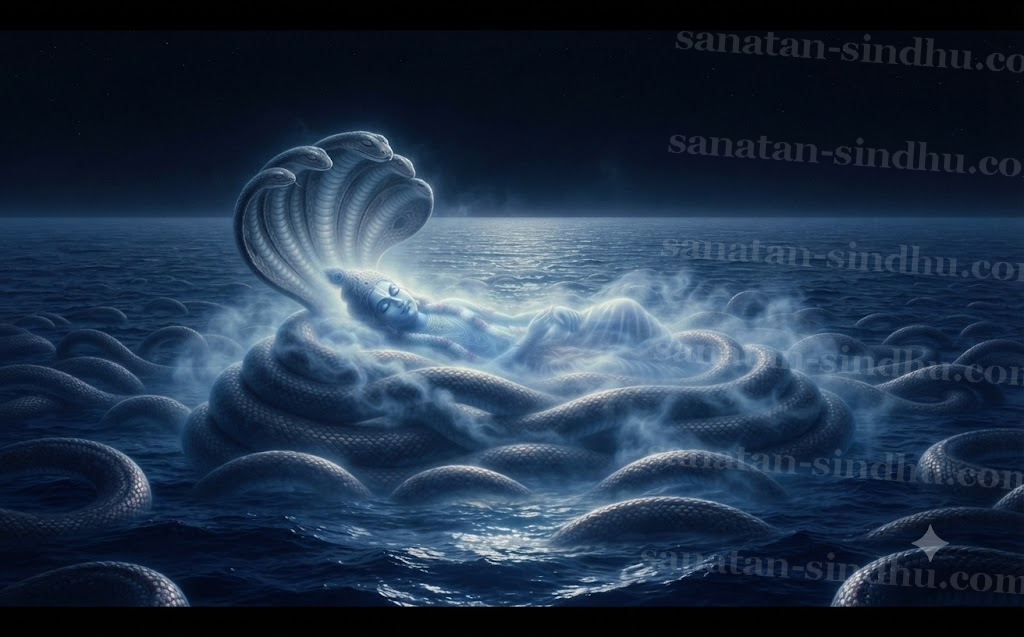
The Viṣṇu Purāṇa and the Bhāgavata Purāṇa (Canto 3) preserve an alternative that has become the dominant iconography: at the dawn of a new Kalpa, Viṣṇu reclines on the serpent Śeṣanāga within the Ocean of Milk. From his navel rises a single radiant lotus, and within its petals Brahmā is born — hence the epithet Padmanābha ('the lotus-navelled one').
Brahmā, finding himself amid darkness, descends the lotus stalk for centuries seeking its source. Failing, he returns and hears the two syllables ta-pa ('penance') echoing across the waters. Twelve thousand divine years of meditation grant him the vision and creative power to construct the worlds.
Associated festival — Kārtika Pūrṇimā
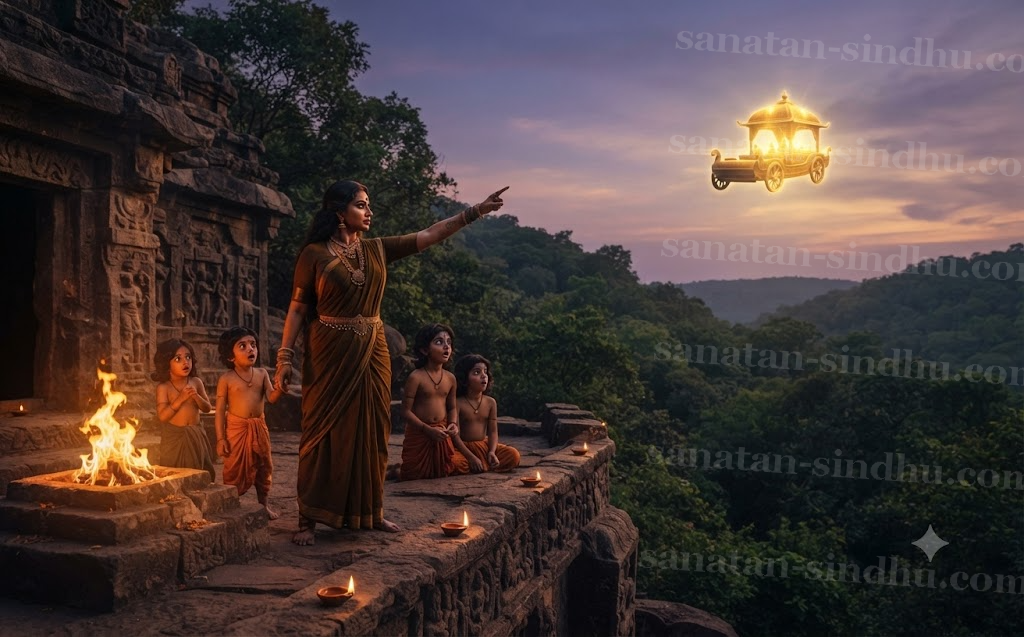
The primary festival attached to Brahmā's cosmogonic role is Kārtika Pūrṇimā, the full-moon day of Kārtika (October–November). It commemorates the great Yajña by which Brahmā initiated structured creation. Though he is rarely a daily temple deity, this day is observed at the Brahmā Temple in Pushkar, Rajasthan — the lake there is held to have formed from a lotus petal Brahmā himself let fall — with ritual bathing and lamp-offerings (Dīpadāna).
Further reading
For the full comparative treatment of Brahmā, Viṣṇu and Śiva as a cosmogonic triad — Vedic antecedents through Purāṇic synthesis, festival topography, and the non-dual paradigms of Kashmiri Trika Shaivism — see the essay Trimūrti — Scriptural Origins.