An encyclopedia of Sanātana Dharma
Sanatan Sindhu emblemSanatan Sindhu

Deities · Trimurti

Lord Vishnu

विष्णु

Visnu

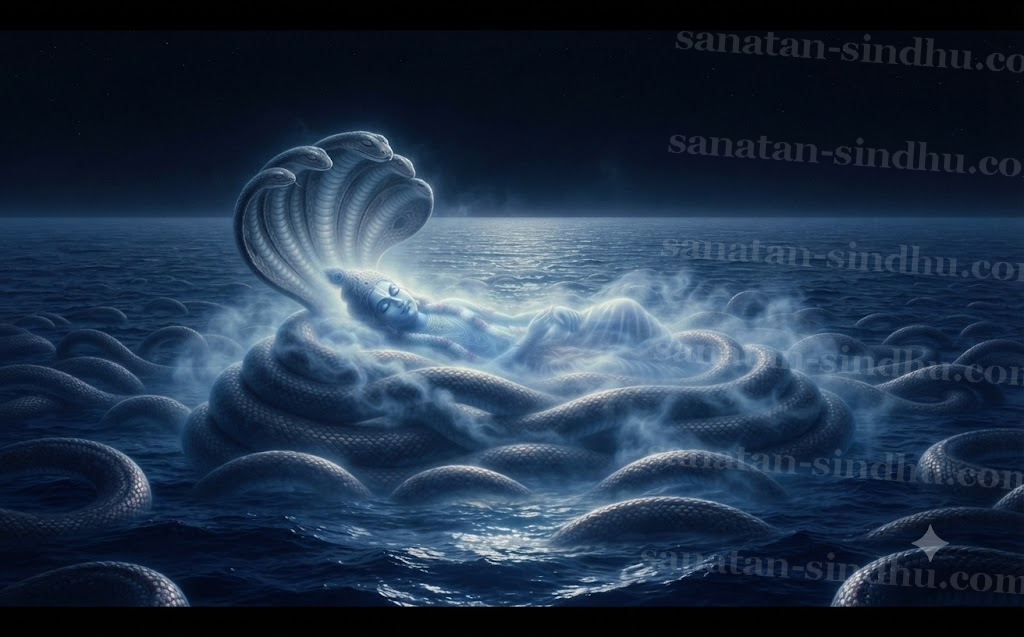
The supreme preserver and protector within the Hindu Trinity (Trimurti). Within Vaishnavism, he is the Supreme Absolute Reality (Para Brahman), who descends to Earth in various incarnations (Dashavatara) whenever cosmic order (Dharma) is threatened by chaotic forces. He rests upon the multi-headed serpent Sheshanaga in the cosmic ocean.

Quick facts

Era
Eternal / Sanatana
vahana
Garuda (Divine Eagle-Man)
consort
Goddess Lakshmi
Abode
Vaikuntha / Ksheera Sagara (Ocean of Milk)

Attributes & symbols

Emblems most often depicted with Lord Vishnu. Hover for gloss · click to search.

Epithets

Names and titles by which Lord Vishnu is invoked across the śāstras.

The preserver and sustainer

If Brahma is the architect who builds the cosmic machinery, Vishnu is the operator who keeps it running. He embodies Sattva Guṇa — the quality of balance, harmony, truth, and structural integrity.
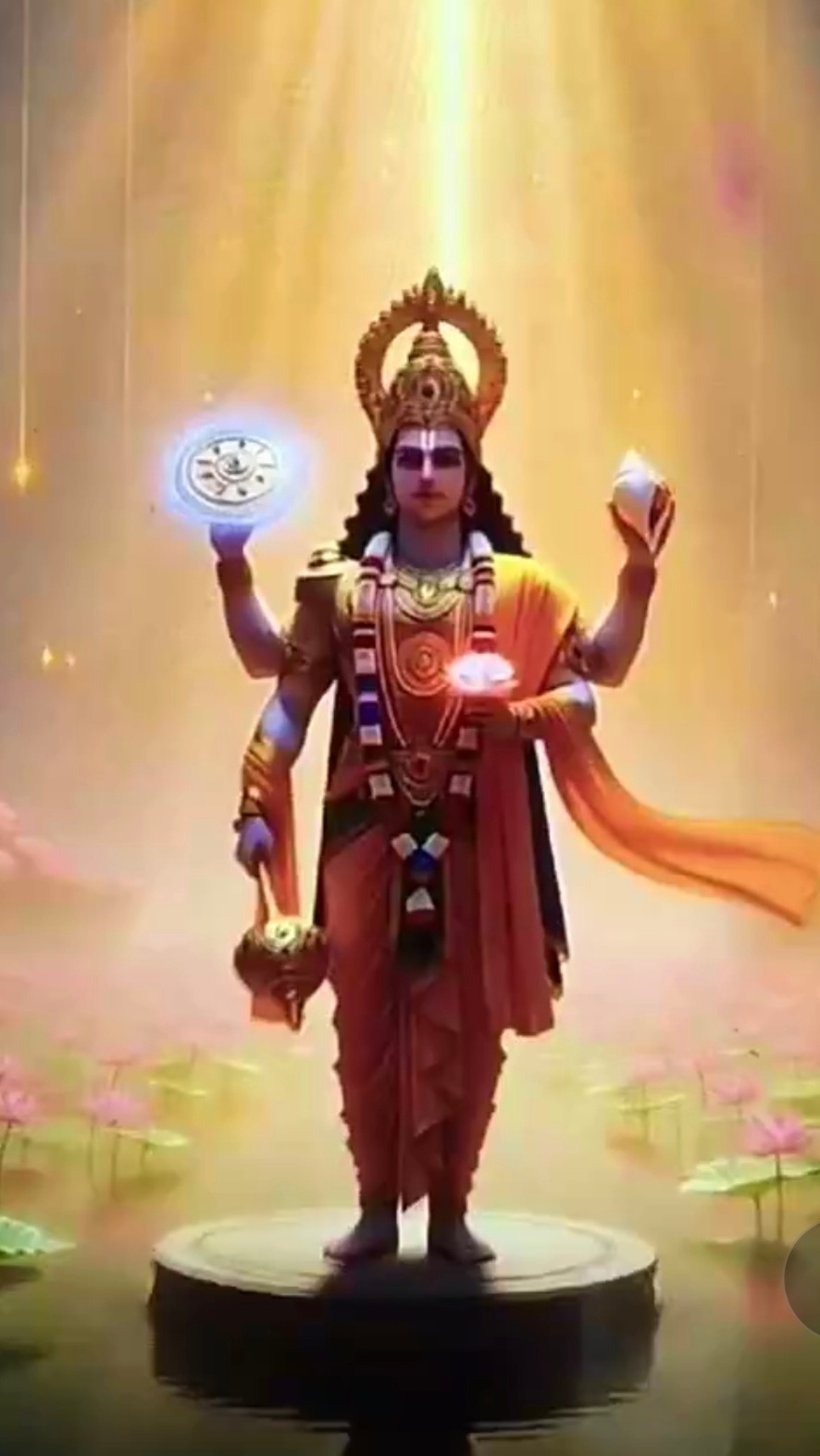
Viṣṇu standing serenely on a lotus, four arms holding the Sudarśana Cakra, conch, mace, and lotus, bathed in golden light

While Brahma exists mostly in the background and Shiva waits in stillness at the edge of destruction, Vishnu is actively engaged with the universe. He rests upon the multi-headed serpent Ananta-Śeṣa — infinite time and space — floating on the Kṣīra Sāgara, the cosmic Ocean of Milk. Whenever the universe tips dangerously toward chaos, Vishnu wakes from his cosmic slumber to restore balance.

The principle of Dharma

At the heart of Vishnu's role is Dharma — not merely 'religion', but the fundamental moral, ethical, and physical laws that keep the universe from collapsing into randomness. When greed, ego or evil destabilise this order, Vishnu manifests a fraction of his divine consciousness into the physical world through an Avatāra (literally 'to descend').

Yadā yadā hi dharmasya glānir bhavati bhārata… abhyutthānam adharmasya tadātmānaṁ sṛjāmy aham.

Whenever righteousness wanes and unrighteousness dominates, I manifest myself to protect the good, destroy evil, and firmly re-establish Dharma.

— Bhagavad Gītā

The Daśāvatāra — a metaphor for evolution

Vishnu's ten primary incarnations form one of the most stunning conceptual frameworks in ancient philosophy, mirroring the biological and psychological evolution of consciousness.

AvatāraFormBiological / conceptual stage
1. MatsyaThe FishAquatic life: origins in the primordial waters.
2. KūrmaThe TortoiseAmphibian: life takes its first steps on land.
3. VarāhaThe BoarTerrestrial: purely land-based mammals emerge.
4. NarasiṁhaHalf-man, half-lionThe transition between animal instinct and intellect.
5. VāmanaThe DwarfEarly Homo sapiens: fully human, physically small, mind developing.
6. ParaśurāmaWarrior with axeEarly tribal society: fierce, volatile, primitive tools.
7. RāmaThe Ideal KingCivilisation and morality: organised laws, ethics, governance.
8. KṛṣṇaDivine StatesmanAdvanced society: complex politics and philosophy.
9. BuddhaThe EnlightenedSpiritual awakening: turn toward inner peace and higher consciousness.
10. KalkiFuture warriorThe end cycle: the universe resets.

The cosmic tools of preservation

  • The Pāñcajanya (conch) — its sound is the primordial vibration of creation (Oṁ), calling humanity to awaken to their higher truth.
  • The Sudarśana Cakra (discus) — a spinning wheel of razor-sharp light representing cosmic mind and time. It cuts through ego instantly.
  • The Kaumodakī (mace) — physical power, mental strength, and the laws of cause and effect (Karma).
  • The Padma (lotus) — spiritual liberation, beauty and purity blooming unpolluted out of the mud of material life.

Vedic antecedent — the three strides

In the Ṛgveda, Viṣṇu is a solar deity of light, space, and cosmic order. The central Vedic motif is Trivikrama, the three strides by which he measures out the cosmos:

विष्णोर्नु कं वीर्याणि प्र वोचं यः पार्थिवानि विममे रजांसि । यो अस्कभायदुत्तरं सधस्थं विचक्रमाणस्त्रेधोरुगायः ॥

viṣṇor nu kaṃ vīryāṇi pra vocaṃ yaḥ pārthivāni vimame rajāṃsi | yo askabhāyad uttaraṃ sadhasthaṃ vicakramāṇas tredhorugāyaḥ ||

'I will now declare the heroic deeds of Viṣṇu, who measured out the earthly regions, who established the upper dwelling place, striding threefold — the wide-paced explorer.'

Ṛgveda 1.154.1

Yāska's Nirukta (c. 4th century BCE) reads the three steps as the sun's traversal of earth, atmosphere, and high heavens — establishing a stable Loka for life. The name Viṣṇu is derived from the root viṣ ('to enter into', 'to pervade'); Ādi Śaṅkarāchārya's commentary on the Viṣṇu Sahasranāma glosses it as veveṣṭi — 'he pervades everything'.

Upanishadic identification — Nārāyaṇa as Para Brahman

The Nārāyaṇa Upaniṣad and Subāla Upaniṣad elevate Viṣṇu-Nārāyaṇa to the Supreme Absolute Reality (Para Brahman). The Nārāyaṇa Sūktam of the Yajurvedic Taittirīya Āraṇyaka declares:

नारायणं परं ब्रह्म तत्त्वं नारायणः परः । नारायणः परो ज्योतिरात्मा नारायणः परः ॥

nārāyaṇaṃ paraṃ brahma tattvaṃ nārāyaṇaḥ paraḥ | nārāyaṇaḥ paro jyotir ātmā nārāyaṇaḥ paraḥ ||

'Nārāyaṇa is the Supreme Brahman; Nārāyaṇa is the Supreme Reality; Nārāyaṇa is the Supreme Light; Nārāyaṇa is the Supreme Soul.'

Nārāyaṇa Sūktam

Here Nārāyaṇa is the indwelling soul of all beings, seated within the heart as a brilliant flame of consciousness — the one from whom Brahmā, Śiva, and the elements themselves emerge.

Puranic narrative — Anantaśayana and the ten descents

The Viṣṇu Purāṇa and Bhāgavata Purāṇa extend the Vedic foundation into a complete cosmological drama. Viṣṇu's primary state is Anantaśayana — reclining upon the serpent Śeṣa (infinite time) within the primordial milk-ocean (Kṣīra Sāgara) — representing the unmanifest potential of the universe. When cosmic order tilts toward chaos, he descends through the ten Daśāvatāra:

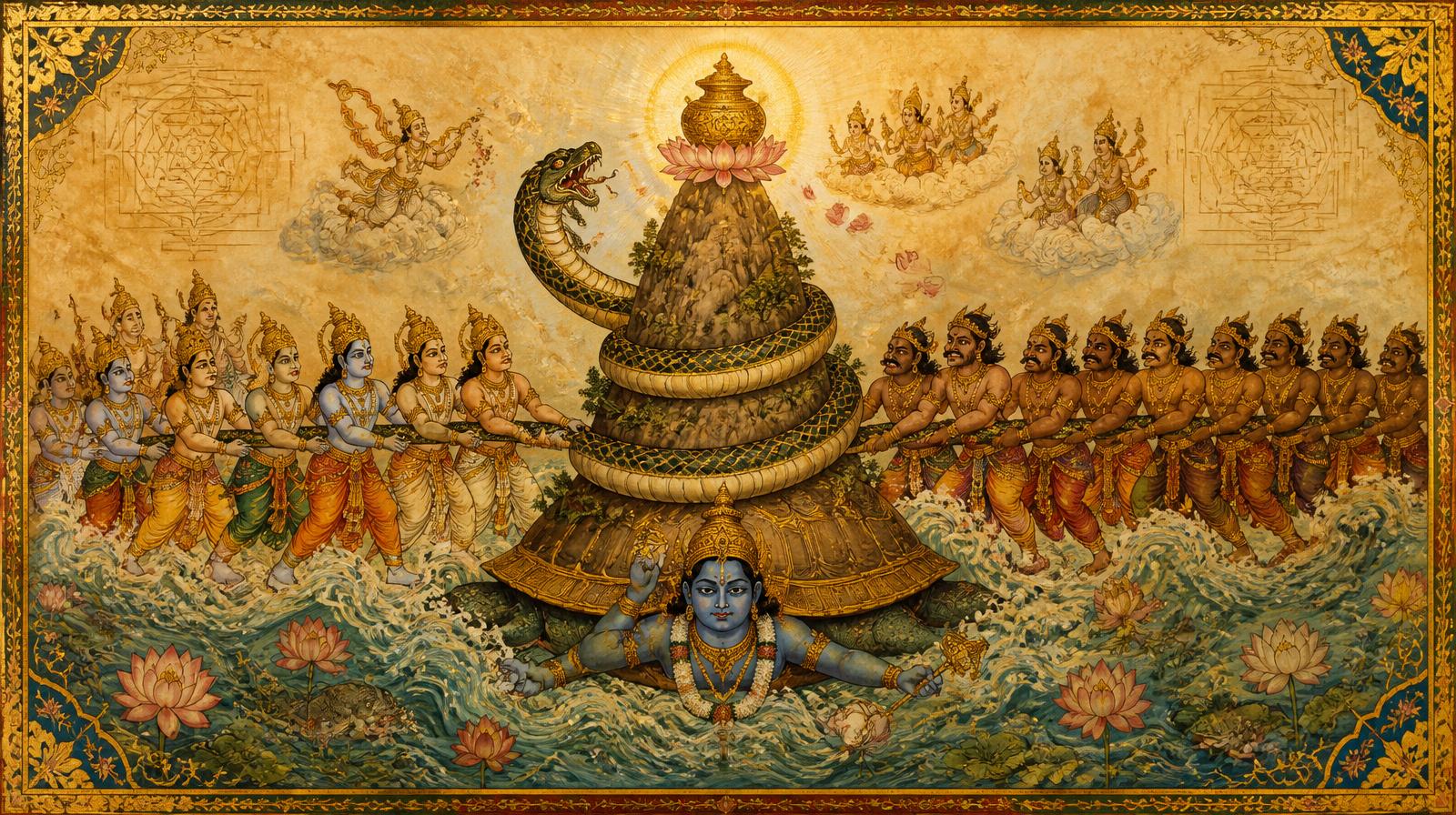
1. Matsya rescues Manu and the Vedas from the cosmic flood. 2. Kūrma becomes the pivot on his back for the churning of the ocean (Samudra Manthan). 3. Varāha raises the earth-goddess Bhūmīdevī from the depths. 4. Narasiṃha slays the demon Hiraṇyakaśipu to restore balance. 5. Vāmana subdues king Bali in three strides — mirroring the Rigvedic Trivikrama. 6. Paraśurāma purges the earth of corrupt militaristic rulers. 7. Rāma exemplifies ethical conduct (Maryādā Puruṣottama). 8. Kṛṣṇa delivers the Bhagavad Gītā on the field at Kurukṣetra. 9. Buddha introduces teachings of non-violence (Ahiṃsā). 10. Kalki, foretold at the end of Kali Yuga, dissolves the degenerate world and reopens Satya Yuga.

Associated festivals — Vaikuṇṭha Ekādaśī & Anant Caturdaśī

  • Vaikuṇṭha Ekādaśī — observed in the waxing moon of Mārgaśīrṣa (December–January). On this day the gates of Viṣṇu's celestial abode, Vaikuṇṭha, are believed opened. At Sri Ranganathaswamy Temple, Srirangam, devotees fast and pass through the Vaikuṇṭha Dvāra — a symbolic enactment of liberation (Mokṣa).
  • Anant Caturdaśī — celebrated in Bhādrapada (September), honouring Viṣṇu in his Ananta (infinite) form reclining on Śeṣanāga. A sacred thread with fourteen knots is bound at the wrist, representing the fourteen Lokas sustained within Viṣṇu's cosmic form.

Further reading

For the full comparative treatment of Brahmā, Viṣṇu and Śiva as a cosmogonic triad — Vedic antecedents through Purāṇic synthesis, festival topography, and the non-dual paradigms of Kashmiri Trika Shaivism — see the essay Trimūrti — Scriptural Origins.
Essays

Related essays

All essays
Essay · Foundations

The Beginningless Dawn — the true origins of Sanātana Dharma

Why the tradition calls itself eternal — cyclic cosmic time (Yugas, Kalpas, Mahāpralaya), the Vedas as Apauruṣeya (unauthored) sound cognised by Rishis, and the archeo-astronomical dating that anchors the earliest scriptural layers.

Essay · Cosmogony · Ṛgveda 10.129

Nāsadīya Sūkta — the hymn of creation

A verse-by-verse reading of the Nāsadīya Sūkta — the Rishi's meditation on what preceded existence itself. From Tad Ekam (‘That One’) breathing breathlessly, through the primal desire (Kāma) that becomes the seed of mind, to the outward stretching of the cosmic ray — and the final, honest ‘perhaps even He knows not.’

Essay · Vocabulary

What is Dharma — and what is a Hindu?

The words Dharma, Sanātana and Hindu — where they come from, what they actually mean, and how the four great sampradāyas (Vaiṣṇavism, Śaivism, Śāktism, Smārtism) scale the same spiritual mountain from different sides.

Essay · Cosmogony

Trimūrti — Scriptural Origins

A comparative study of Brahmā, Viṣṇu and Śiva — Vedic antecedents, Upanishadic identifications, Purāṇic narratives, and the non-dual paradigm of Kashmiri Trika Shaivism.

Essay · Śaiva Cosmology

The Infinite Forms of the Formless — Śiva's descents and cosmic purpose

Unlike Viṣṇu's ten physical Dashāvatāras, Śiva's descents are Anśāvatāras and Rudras — instantaneous manifestations that dissolve ego, transmit Yoga, and restore Dharma. A tour of the 19 Primary Avatars, the 11 Rudras, the 28 Yogeśvaras, the Pañchabrahma, and the Śaiva-Vaiṣṇava synthesis of Hanumān as the 11th Rudra — anchored to the Mathurā Pillar Inscription of 380 CE.

Essay · Hanumān · Śaiva-Vaiṣṇava Synthesis

Sacred Wind, Eternal Devotee — Hanumān's lore and cultural significance

A textual stratigraphy of Hanumān across the Vālmīki Rāmāyaṇa, the Śiva Purāṇa, the Adhyātma and Ānanda Rāmāyaṇas, and Tulsīdās's Rāmcharitmānas — plus the Upaniṣadic anchors that place Him as a premier Vedic scholar, the Pañchamukhī rescue in Pātāla Loka, the pact with Śani, the origin of the sindūr offering, the Hanumad Rāmāyaṇa, and the metaphysics of cyclical time.

Essay · Vaiṣṇava Cosmology

The Ten Descents — Daśāvatāra and the awakening of consciousness

Viṣṇu's ten avatāras read as a parallel to biological and social evolution — from Matsya the fish to Kalki the future rider — with the Vedāntic twist that the Lord *descends* (avatāra) so the soul (jīva) can *ascend* (pariṇāma).

Essay · Vaiṣṇava Theology

Two traditions on the Eighth — Kṛṣṇa, Balarāma and the question of who the avatāra is

Two authoritative streams disagree about the eighth Daśāvatāra: one names Kṛṣṇa the avatāra with Balarāma as Ādi-Śeṣa, the other (Gauḍīya) names Kṛṣṇa Svayam Bhagavān with Balarāma as the eighth. Both are read side by side.

Essay · Vedic & Vedāntic Cosmology

The Devas and the Trimūrti — a stratified cosmology

Indra, Agni, Varuṇa, Sūrya, Vāyu and the other Vedic devas were once celestial sovereigns; in the Purāṇic era they appear subordinate to Brahmā, Viṣṇu, and Śiva. Not a replacement — a philosophical stratification through Nirguṇa Brahman, Iśvara, and the administrative devas.

Essay · Guru-Śiṣya Paramparā

Guru Pūrṇimā — the scriptural significance of the teacher

The full-moon day of Āṣāḍha honours the lineage of teachers who dispel darkness. From Veda Vyāsa the Ādi Guru of recorded knowledge, through the Mundaka and Kaṭha Upaniṣads, to Śiva as Ādiyogi transmitting yoga to the Saptarishis — a reading of the Guru as the bridge to the Absolute.

Essay · Temple architecture

Echoes, shadows and sacred geometry — 11 architectural marvels of the Hindu dynasties

Ancient and medieval Hindu builders treated stone as an instrument of optics, acoustics, geology and celestial alignment. Eleven wonders — from a solar sundial of zodiac pillars at Sringeri to a mountain chiselled from the top down at Ellora, musical monoliths at Hampi, a shadowless Chola apex, a hanging pillar at Lepakshi and an inverted stepwell in Patan.

Related lore

All stories →

Vishnu Purana, Bhagavata Purana, Mahabharata

The Churning of the Cosmic Ocean

An epic cosmic event where the celestial Devas and the demonic Asuras form a temporary alliance to churn the primeval Ocean of Milk, extracting the nectar of immortality (Amrita) alongside multiple legendary treasures.

5 chapters · read →

Valmiki Ramayana, Shiva Purana

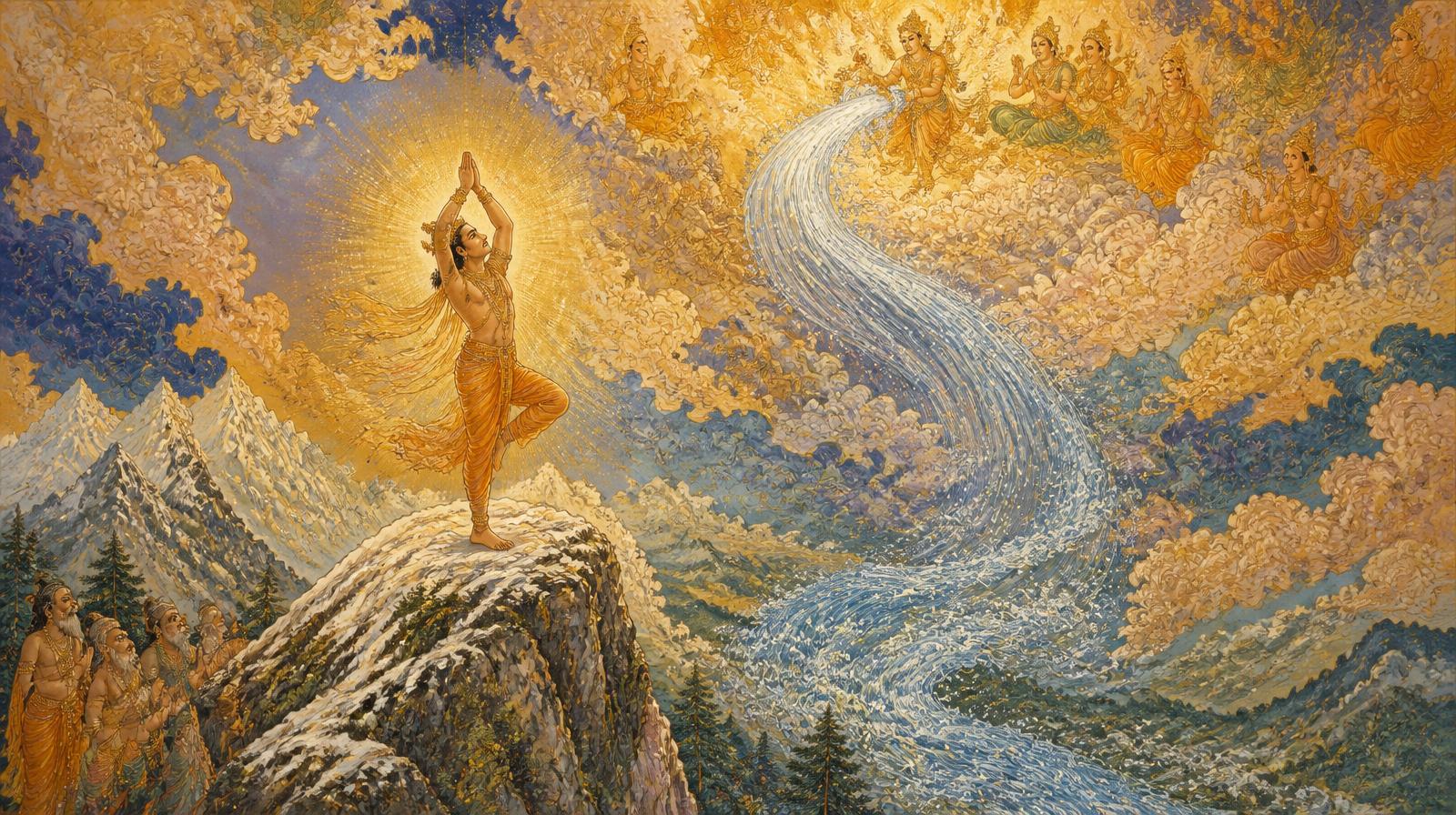
The Descent of Ganga: Earth's Sacred Flow

The epic saga of King Bhagiratha's monumental penance to bring the celestial river Ganga from the heavens down to Earth to liberate the restless souls of his incinerated ancestors.

3 chapters · read →

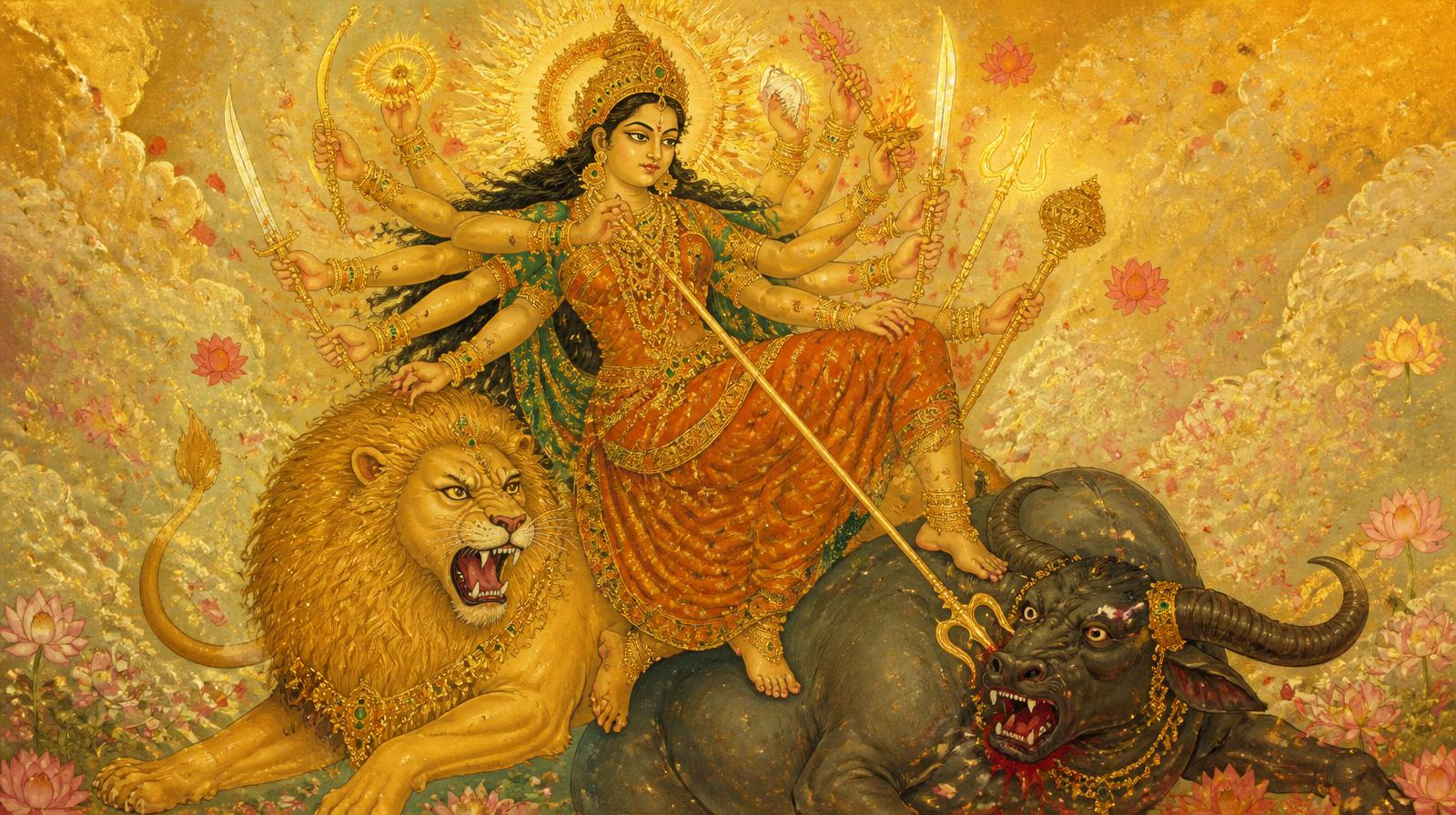
Markandeya Purana, Devi Bhagavata Purana

The Triumph of the Invincible Mother Durga

The spectacular manifestation of Goddess Durga from the combined fiery anger of the gods to defeat the shape-shifting buffalo demon Mahishasura, who held a boon of near-invincibility.

3 chapters · read →

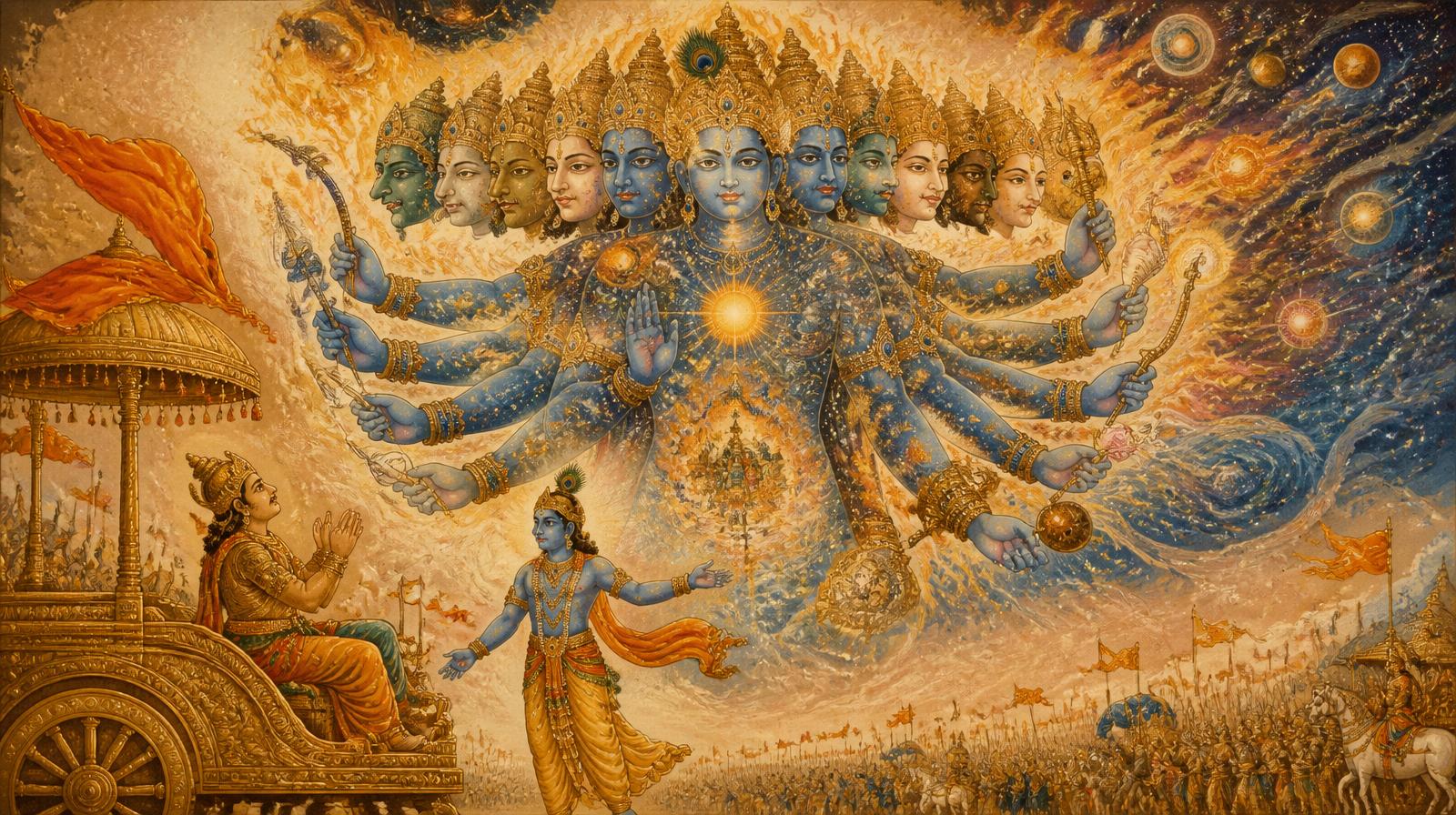
Bhagavad Gita, Mahabharata

The Revelation of the Vishwarupa: Universal Form of Krishna

On the battlefield of Kurukshetra, Lord Krishna resolves the moral crisis of the warrior prince Arjuna by revealing his awe-inspiring, infinite cosmic form that encapsulates all of time, space, and creation.

3 chapters · read →

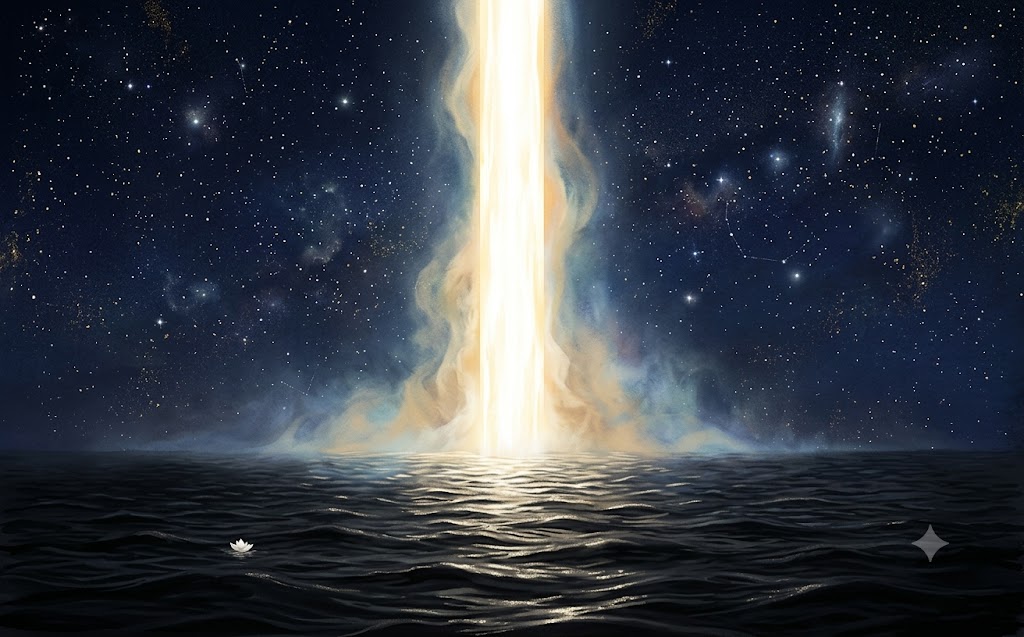
Shiva Purana, Linga Purana, Kurma Purana

The Pillar of Fire: Lingodbhava

When Brahmā and Viṣṇu quarrelled over which of them was supreme, Śiva appeared between them as a limitless pillar of fire — neither could find its beginning or its end, and both came to know the transcendent ground from which they had been born.

3 chapters · read →

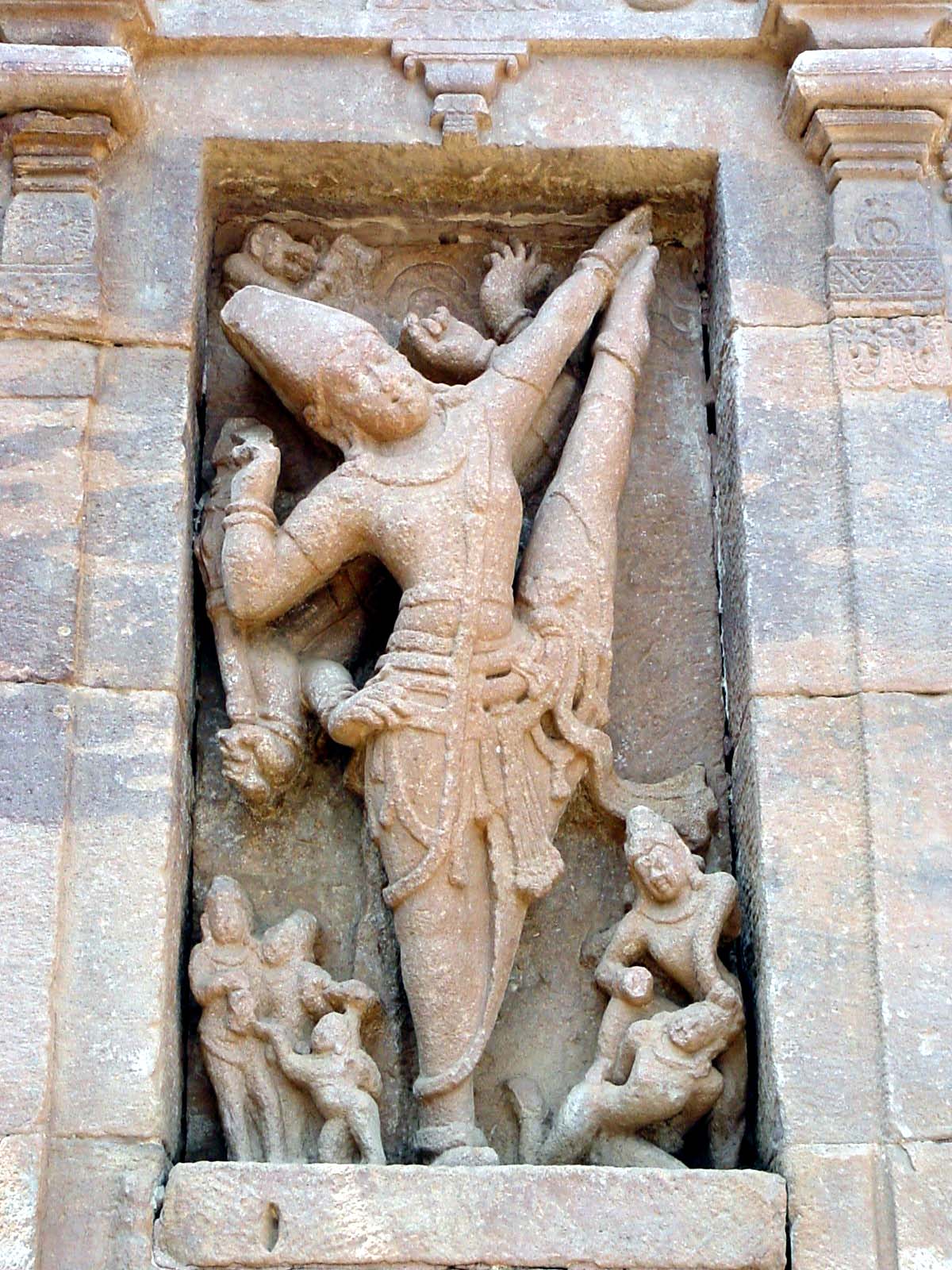
Rigveda 1.154, Bhagavata Purana, Vishnu Purana

The Three Strides: Vāmana and Trivikrama

The Ṛgvedic hymn celebrates Viṣṇu as the god who measured out the three worlds in three strides. The Purāṇas retell it as the story of Vāmana, the dwarf-brāhmaṇa, who humbles the noble Asura king Bali with three quiet steps.

3 chapters · read →

Shiva Purana (Shatarudra Samhita, Chapters 11-12), Sharabha Upanishad

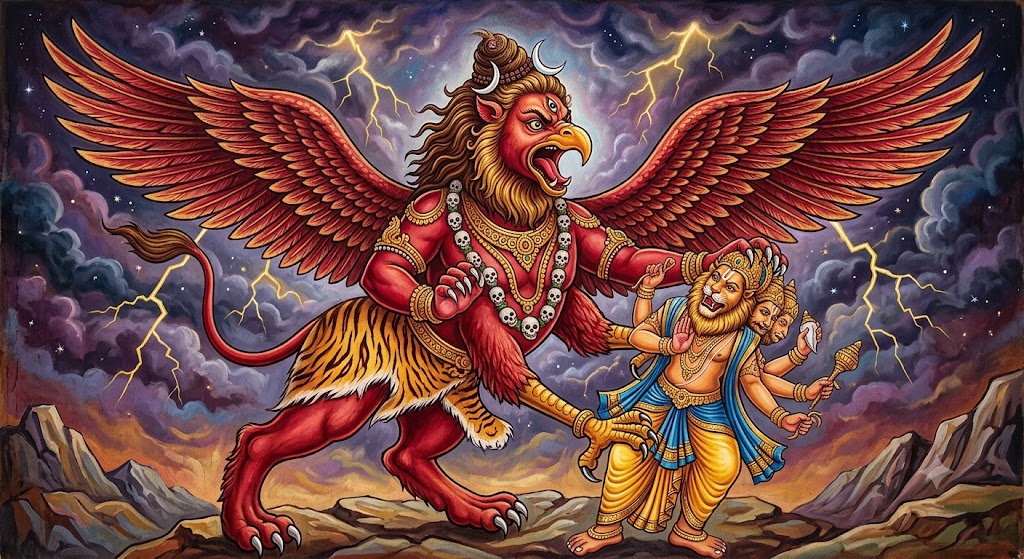
The Great Pacifier: Sharabha Avatar

To pacify and balance the unstoppable, fiery fury of Lord Vishnu's Narasimha incarnation after the slaying of Hiranyakashipu, Lord Shiva manifests as the magnificent winged being Sharabha, illustrating the eternal unity of Hari and Hara.

3 chapters · read →

Shatapatha Brahmana 1.8.1, Matsya Purana, Bhagavata Purana Canto 8

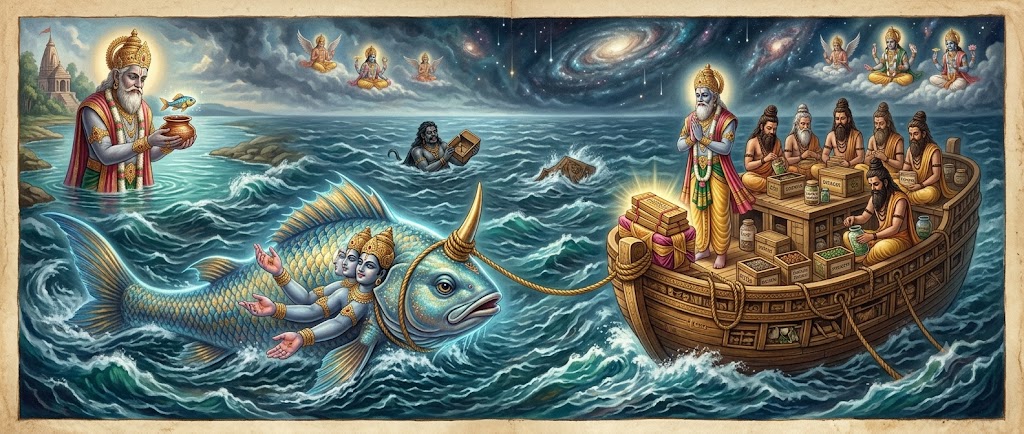
The Fish, the Flood, and the Saved Vedas

The first descent of Viṣṇu — as a tiny fish who grows without limit, warns King Satyavrata of a coming cosmic flood, and then tows an ark holding the seven sages and the seeds of every species across the trackless ocean while recovering the stolen Vedas.

3 chapters · read →

Vishnu Purana, Bhagavata Purana Canto 3, Varaha Purana

The Boar Who Lifted the Earth

When the demon Hiraṇyākṣa dragged the goddess Earth (Bhūmi Devī) into the cosmic ocean, Viṣṇu descended as a colossal boar to plunge into the depths, defeat the demon, and lift the earth back into her orbit on his tusks.

3 chapters · read →

Bhagavata Purana Canto 7, Vishnu Purana

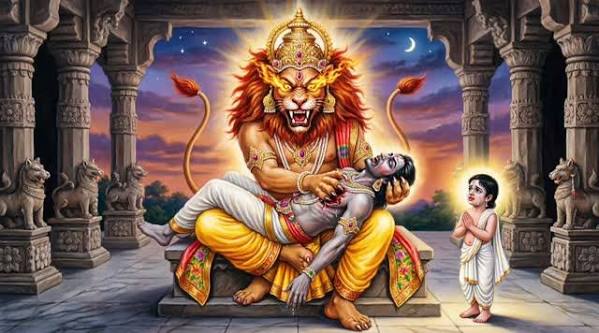
The Lion-Man from the Shattered Pillar

How Viṣṇu honoured every clause of the tyrant Hiraṇyakaśipu's impossible boon by emerging as Narasiṃha — half man, half lion — at twilight, on the threshold, across his lap, tearing with claws instead of weapons; and how the child devotee Prahlāda stood unshaken through it all.

3 chapters · read →

Heritage Store

Bespoke artifacts inspired by Lord Vishnu

All artifacts →

The Churning of the Ocean: Unabridged Digital Audiobook

Inspired by the legend of Lord Vishnu

Experience the ultimate cosmic struggle in high-definition spatial audio. Narrated by a renowned Vedic scholar, this immersive audiobook dramatizes the Samudra Manthan epic with traditional Sanskrit chants, ambient orchestration, and cinematic sound design that transports you straight to the shores of the Ocean of Milk.

$19.99

Vishnu's Dashavatara: Collectors Leather-Bound Epic

Inspired by the legend of Lord Vishnu

Unearth the ten divine descents of Lord Vishnu in this leather-bound luxury volume. Elaborating on the transition from the fish avatar Matsya to the turtle Kurma who held up Mount Mandara, this text presents unabridged Puranic narratives paired with gorgeous woodcut prints and vintage illustrations.

$149.99