
A story chained to Gajendra
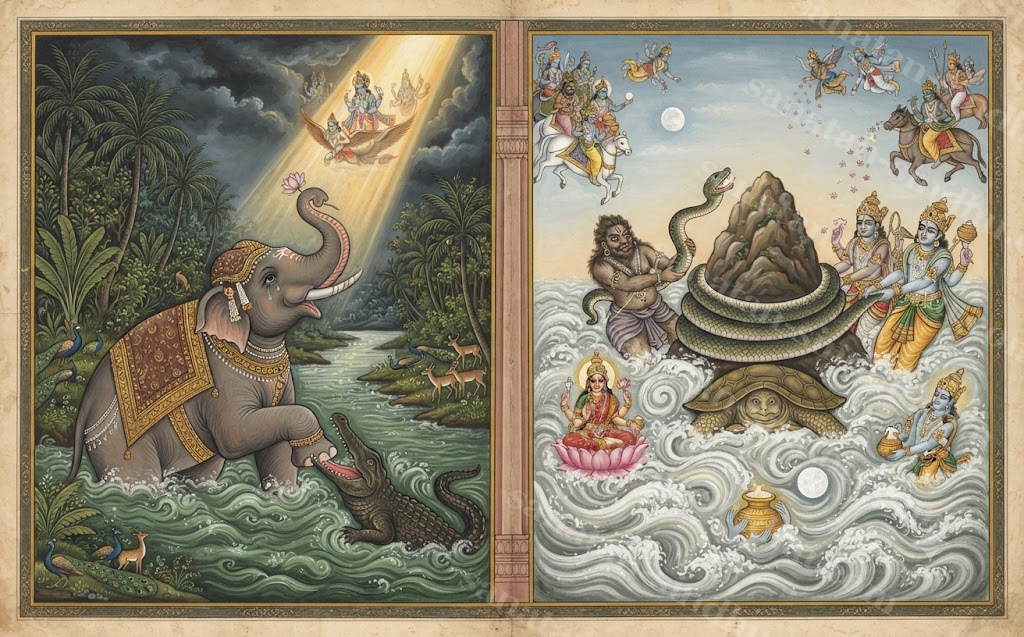
The Bhāgavata Purāṇa never tells Samudra Manthan in isolation. Canto Eight opens with Gajendra Mokṣa — the elephant-king, seized by a crocodile, exhausting every ounce of his own strength before finally surrendering completely to Viṣṇu, who comes at once. Only after that story does Śuka, narrating to the dying King Parīkṣit, move to the churning of the ocean (Canto 8, chapters 6–11).
That ordering is deliberate, not chronological convenience. The Bhāgavata is using Gajendra's personal surrender as the template for a cosmic-scale replay: the Devas, like Gajendra, exhaust their own power first — Indra's arrogance draws Durvāsā's curse, the Devas lose their splendour, the Asuras nearly overrun heaven — and only turn to Viṣṇu once self-effort has failed. The Viṣṇu Purāṇa and the Mahābhārata's Ādi Parva tell the same churning, but as cosmology and genealogy; the Bhāgavata tells it as a second sermon on śaraṇāgati — complete surrender — delivered at civilisational scale. That is a difference of purpose, not just of detail.
The second Mohinī
The site's own story of the churning ends where most retellings end: Viṣṇu takes the form of Mohinī, distributes the amṛta to the Devas alone, and the Asuras are cheated of the nectar they helped churn for. In the Bhāgavata, that is not the last appearance of Mohinī.
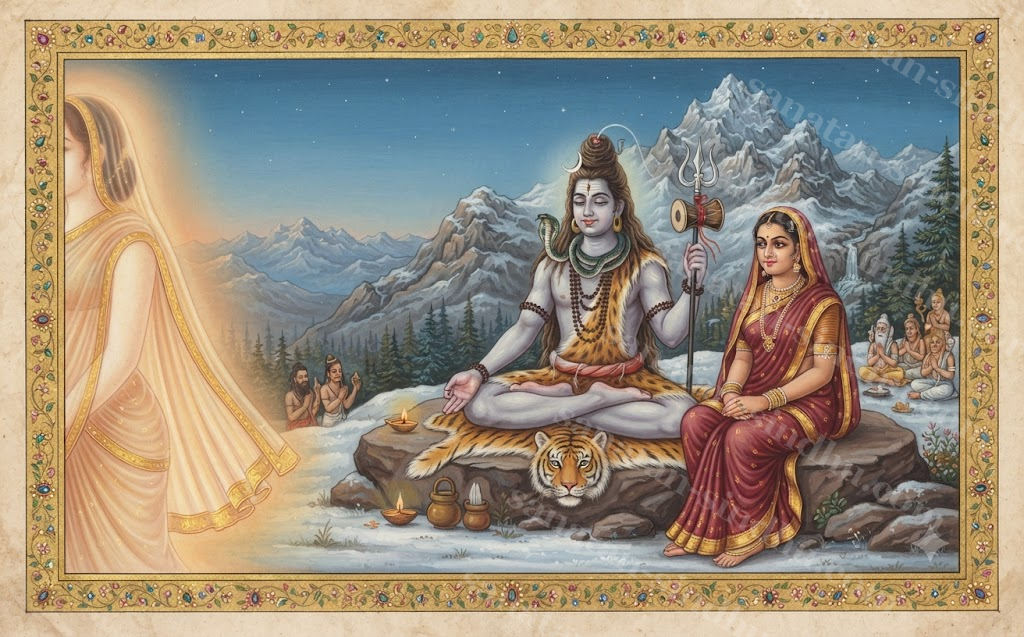
Canto 8, chapter 12 tells a separate, later episode. Śiva — having heard of Mohinī's beauty from Pārvatī — asks to see the form for himself, out of what the text frames as philosophical curiosity rather than desire. Viṣṇu obliges. Śiva, the tradition's own exemplar of yogic detachment, is for a moment visibly moved — and then, unprompted, recovers his composure. Viṣṇu's own words to him afterward are recorded across the standard translation lineage in close variants of: 'I am glad that even though you were deluded by my māyā in the form of a woman, you have of your own accord recovered your natural state of freedom from ego, born of devotion.'
The Gauḍīya Vaiṣṇava commentarial tradition built on this passage draws a specific distinction: being moved by yoga-māyā (Viṣṇu's own play) is not the same as being lost in mahā-māyā (ordinary delusion) — the difference is whether one remembers Kṛṣṇa through the experience or forgets him. Śiva remembers; that is the point of the episode. It is not a story about Śiva's weakness. It is a story about what devotion looks like even at the moment attention slips — and it exists nowhere in the Viṣṇu Purāṇa or Mahābhārata tellings blended into the site's existing narrative.
Where the tellings genuinely differ
This is worth naming plainly rather than smoothing over.
Frame narrator. The Bhāgavata's account comes from Śuka to Parīkṣit; the Viṣṇu Purāṇa's comes from Parāśara to Maitreya; the Mahābhārata's own telling in the Ādi Parva comes through the Sauti–Śaunaka frame. Three different transmission lineages are vouching for the same event — that convergence, across independent lines, is part of why the story is treated as historically load-bearing rather than a single author's invention.
What the episode is for. The Viṣṇu Purāṇa's telling sits inside a broader cosmogonic and dynastic account. The Bhāgavata's telling sits inside an extended argument for bhakti as the reliable path when self-power runs out — Gajendra before it, the second Mohinī episode after it, both making the same point from different angles.
Scope. Only the Bhāgavata carries the Śiva–Mohinī sequel. A reader who knows only the blended, composite version — as told in the site's own story — is missing a chapter that exists in one source tradition and not the others. This essay exists specifically to surface that gap, not to re-narrate what is already told well elsewhere on the site.
Read the full narrative
For the churning itself — Mount Mandara, the Kūrma avatar, Vāsuki, Halāhala, the fourteen treasures, Lakṣmī's emergence, and the first Mohinī — see the site's own The Churning of the Cosmic Ocean, which already draws on all three source traditions for that narrative.
Sources
- Primary scripture: Bhāgavata Purāṇa, Canto 8, chapters 6–12 (the churning through the Śiva–Mohinī episode), read via the standard Bhaktivedanta / Gauḍīya Vaiṣṇava translation lineage — cross-referenced across independent presentations of that translation rather than a single primary fetch, since this piece was researched while the usual primary hosting sites were unreachable.
- Classical commentary: the Gauḍīya Vaiṣṇava commentarial tradition's yoga-māyā/mahā-māyā distinction on Bhāgavata Purāṇa 8.12.
- Comparative context: Viṣṇu Purāṇa and Mahābhārata (Ādi Parva) tellings, already synthesised in this site's own Churning of the Cosmic Ocean story.
- Excluded: an exact Sanskrit verse citation for the Śiva–Mohinī dialogue. The English rendering above is well corroborated across independent sources, but a specific verse number has not been independently verified against a primary edition, so no Devanāgarī/IAST verse block is given here. Worth adding once that verification is possible.