
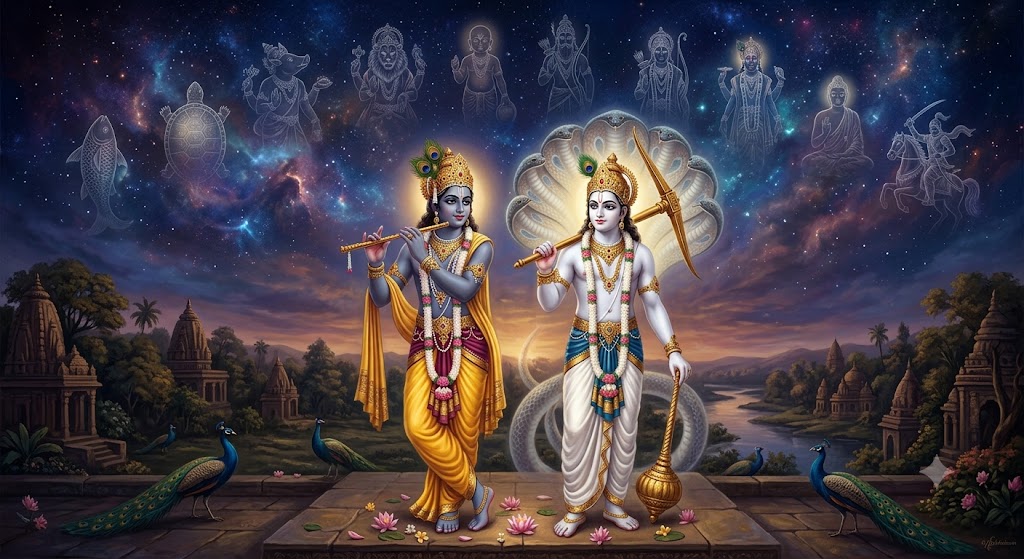
Why two answers to one question
Ask any devotee to list the ten avatāras and you will get one of two answers at slot eight. The Mahābhārata and Viṣṇu Purāṇa stream says Kṛṣṇa is Viṣṇu's direct eighth avatāra, and Balarāma is Ādi-Śeṣa — the thousand-headed cosmic serpent on whom Viṣṇu rests. The Gauḍīya Vaiṣṇava stream (following the Śrīmad Bhāgavatam read through Caitanya Mahāprabhu) reverses the emphasis: *Kṛṣṇa is Svayam Bhagavān* — the source of all avatāras rather than one of them — and Balarāma is the eighth avatāra**, his first plenary expansion.
This is not a contradiction to solve. It is two focal lengths on the same mystery, each with strong scriptural footing.
Stream A — Balarāma as Ādi-Śeṣa
In the tenth canto of the Bhāgavata Purāṇa, when Earth pleads with Brahmā about the burden of corrupt kings, Viṣṇu instructs his creative potency Yogamāyā:
'The plenary expansion of my self is Ananta Śeṣa, who supports the cosmic manifestation. He will appear first as the embryo in Devakī's womb, and you must transplant him to Rohiṇī.' (paraphrased, BP 10.2.8)
Because the embryo was pulled from Devakī's womb to Rohiṇī's, Balarāma is called Saṅkarṣaṇa — 'he who was drawn away'.
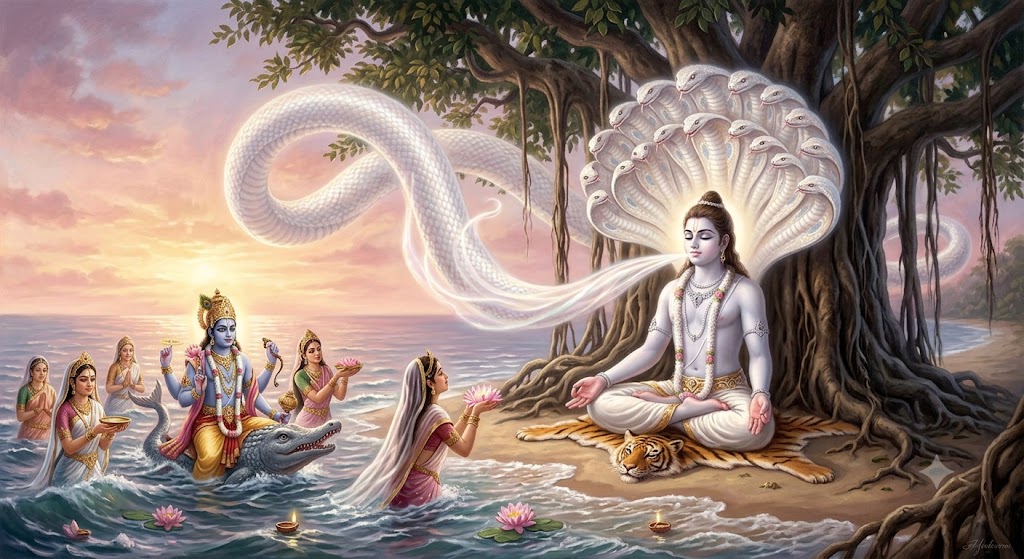
The Mahābhārata's Mausala Parva and the eleventh canto of the Bhāgavata both describe Balarāma's departure (tirobhāva): sitting under a banyan tree by the ocean, a colossal white serpent with a thousand hoods emerges from his mouth and is welcomed home by Varuṇa, the sacred rivers and the devas. This is Ādi-Śeṣa returning to the cosmic depths.
The two hairs — a warning about literal reading
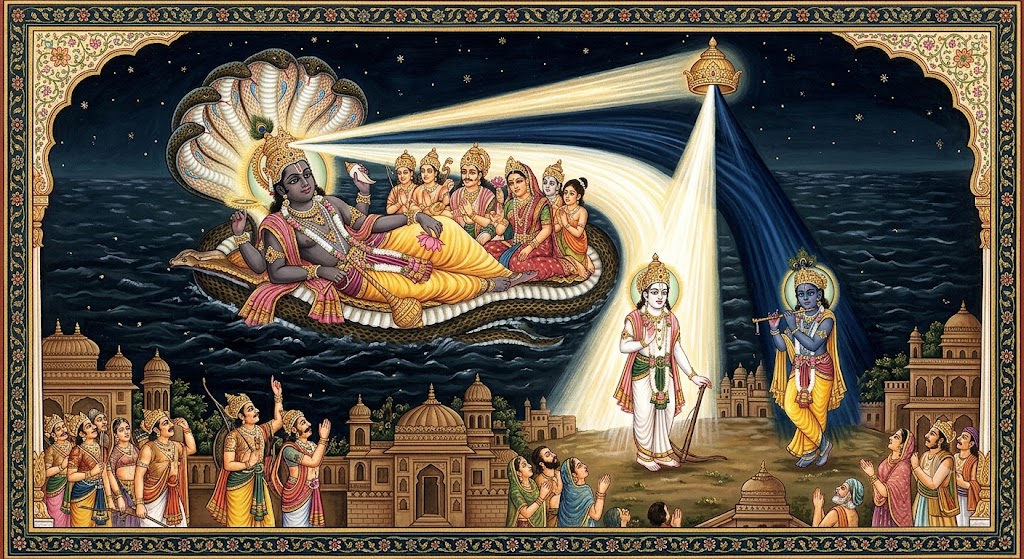
The Viṣṇu Purāṇa (Book 5) contains a striking passage: Viṣṇu plucks two hairs from his head — one white, one black — and announces that they will descend into the Yadu dynasty. The white hair becomes fair Balarāma; the black hair becomes dark Kṛṣṇa.
The commentator Śrīdhara Svāmī cautions strongly against a literal reading. The Supreme has a fully spiritual, changeless body (sac-cid-ānanda) — no aging, no grey hairs. In classical Sanskrit, keśa is not only 'hair'; it also means divine ray or splendour. So sita-kṛṣṇa-keśau refers to two rays of divine light — a luminous white ray manifesting the power of Ananta Śeṣa (as Balarāma), and a dark, all-attractive ray manifesting Viṣṇu himself (as Kṛṣṇa).
Elder and younger — a beautiful role reversal
Across yugas, Viṣṇu and Śeṣa play master and servant. But the dynamic shifts:
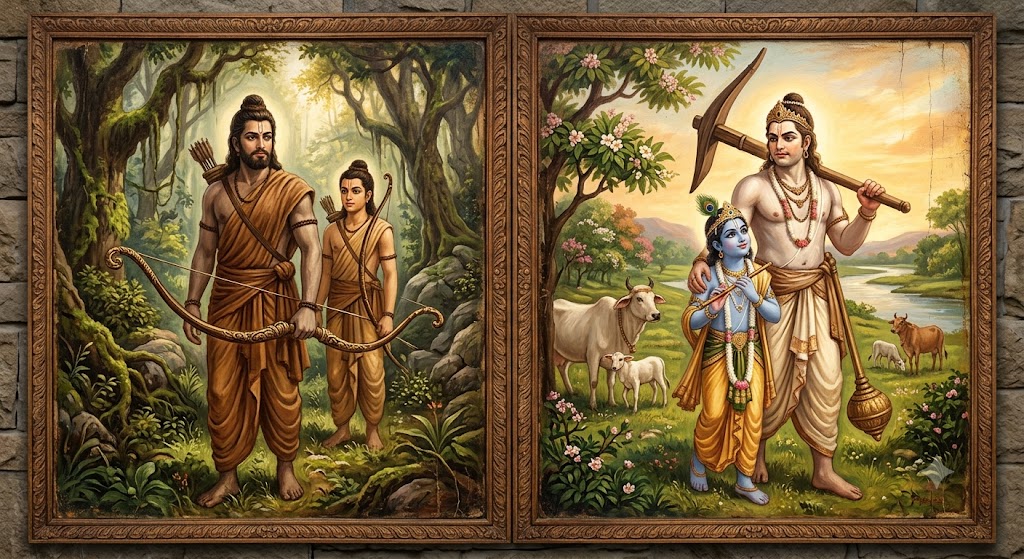
- Tretā Yuga (Rāma-līlā) — Viṣṇu descends as the elder brother Rāma; Śeṣa as the younger brother Lakṣmaṇa. Stern obedience, constant service. Lakṣmaṇa suffers because his junior position restricts how much he can protect his Lord.
- Dvāpara Yuga (Kṛṣṇa-līlā) — the roles reverse to satisfy Śeṣa's own desire to lead and protect. Śeṣa descends as the elder brother Balarāma (Dauji); Viṣṇu as the younger Kṛṣṇa. Loving authority, protective guidance during childhood, a supportive shield through every complex pastime.
The theological point is exquisite: the same eternal companionship, played across two different melodies of love.
Read against the evolution parallel
If we align with Stream A (Balarāma = Śeṣa, Kṛṣṇa = eighth avatāra), the biological-social parallel of the Daśāvatāra gains a striking third dimension:
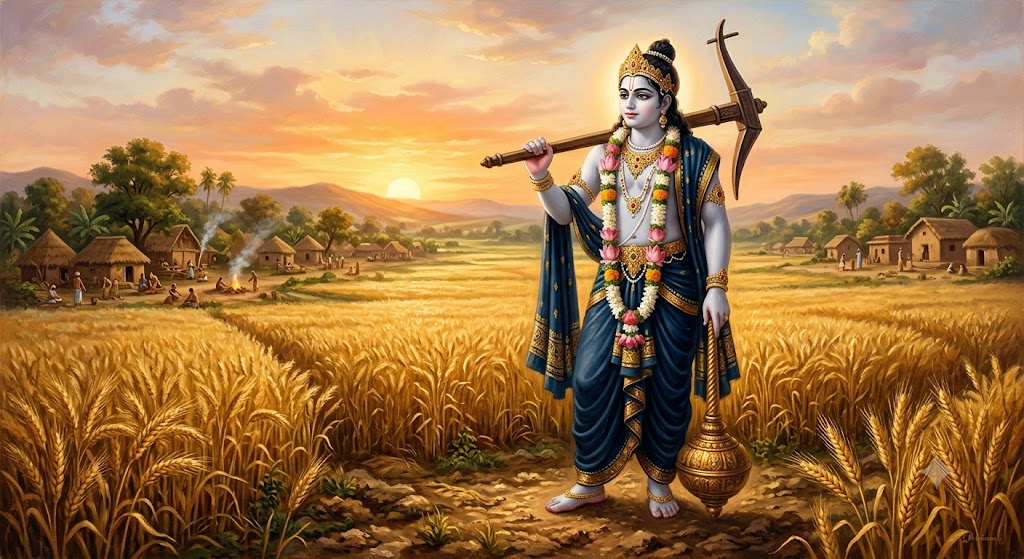
*Balarāma as the support of life. Metaphysically, Ananta Śeṣa is the cosmic force holding the planetary globes in place — the gravitational and geological stabilisation of the earth. Balarāma's chosen weapon is the plough (hala); he is the lord of agriculture and fertility. Anthropologically, before humanity could sustain the politically nuanced society of Kṛṣṇa's era, it had to transition from nomadic hunting to structured agriculture*. Balarāma is that stabilising foundation — literal ground, literal food.
*Kṛṣṇa as the ultimate integration. With the ecological and social foundation stabilised, human consciousness is ready for its absolute peak: the philosopher of the Gītā, the strategist of Kurukṣetra, the teacher of bhakti. The Gauḍīya insistence that Kṛṣṇa is Svayam Bhagavān* is another way of saying the same thing — that at Kṛṣṇa, the ladder does not continue upward; it opens into infinity.
How this website holds both
In our Daśāvatāra lists we show both orderings side by side with a short note on the tradition each belongs to. In individual entity pages, Balarāma is presented as Ādi-Śeṣa and as Saṅkarṣaṇa, with both his agricultural iconography (plough, mace, dark-blue garments, forest-flower garland, fair complexion) and his cosmic role as the support of the worlds. Readers who follow Gauḍīya sources are pointed to the alternate ordering; readers who follow Mahābhārata / Viṣṇu Purāṇa sources are pointed to this essay's Stream A.
The tradition is large enough to hold both without either being wrong.