Descent and ascent — two arrows in one bow
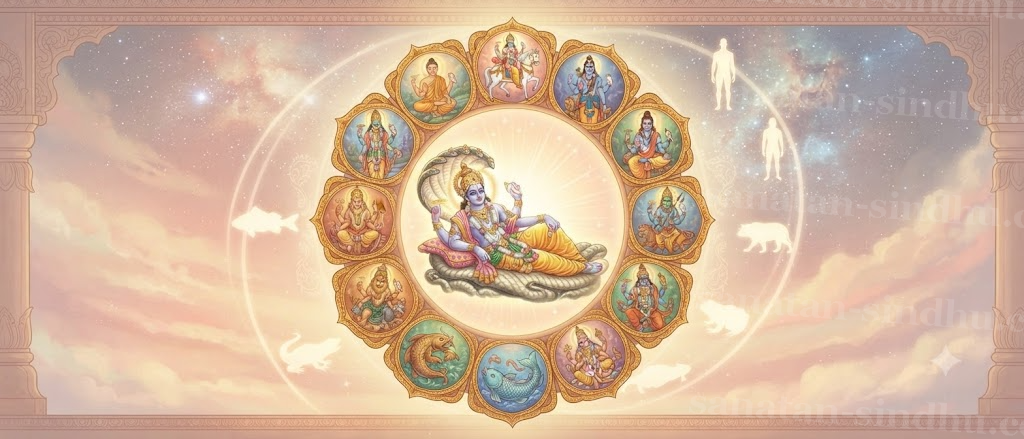
The word avatāra comes from ava-tṝ, 'to cross downward'. Viṣṇu takes on a form and steps into the material world — not because he needs to evolve, but because we do. Traditional Vedānta calls the soul's long climb through 84 lakh (8.4 million) species of life pariṇāma — a gradual expansion of awareness from inert matter to a fully awakened human.
The Bhagavad Gītā (4.7–8) states the mission plainly: every time righteousness (dharma) collapses, the Lord manifests to protect the good, dissolve chaos, and re-set cosmic order.
Involution first, evolution after. The Sāṁkhya cosmology teaches that divine energy must first plunge into the densest layers of matter to set the spiritual coordinates. Only then can life climb back up. The ten avatāras are the plunge; the 8.4 million species are the climb.
The uncanny biological parallel
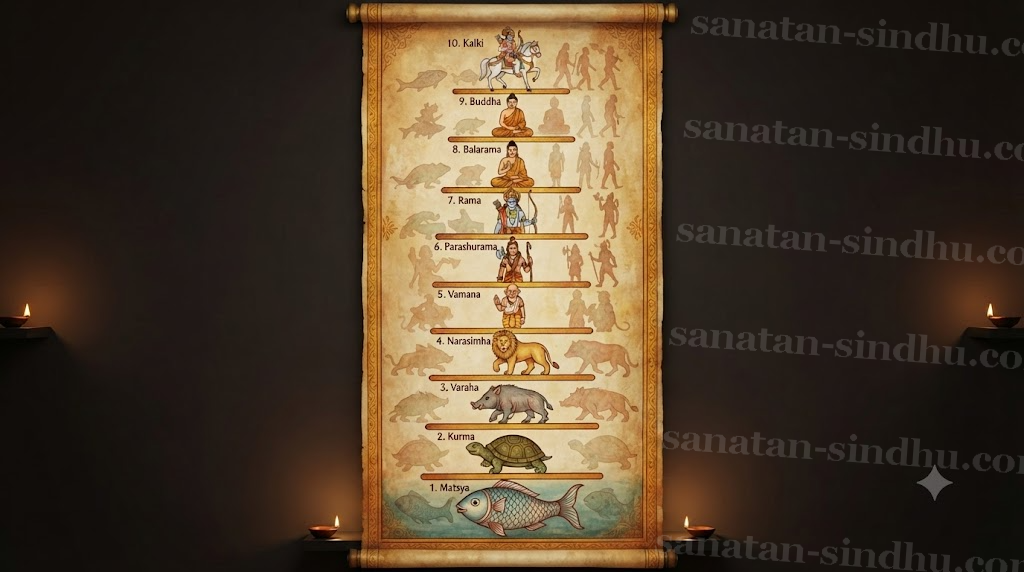
Read in sequence, the ten avatāras trace a curve that modern eyes recognise instantly:
- Matsya — fish (aquatic, no true spine — adaṇḍa)
- Kūrma — tortoise (amphibian, segmented shell — vajra-daṇḍa)
- Varāha — boar (terrestrial mammal, fully formed spine — meru-daṇḍa)
- Narasiṃha — man-lion (the transitional hybrid — madhya-bhāva)
- Vāmana — short-statured early human (kṣudra-mānave)
- Paraśurāma — tool-wielding tribal human (asabhya-varga)
- Rāma — the fully civilised ethical human (sabhya)
- Kṛṣṇa / Balarāma — the philosopher-statesman-agriculturist pair
- Buddha — the analytic, meditative human
- Kalki — the future rider (post-human / restorative)
A 19th-century Gauḍīya Vaiṣṇava commentator locked this parallel into Sanskrit verse in a Sanskrit work published in 1880. In that reading, Matsya accompanies fish-souls, Kūrma the shelled ones, Varāha the spined mammals; Narasiṃha bridges animal fury and human intellect; Vāmana marks the arrival of upright infinite consciousness inside a small frame.
But this is a parallel, not a claim of Darwinism-in-the-Purāṇas. Modern biology describes a linear, gradual replacement of species. The Purāṇic model is cyclical and purposeful — the Lord descends into existing worlds at particular cosmic moments to meet each stage of the jīva's climb.
Matsya — the fish, the flood, and the saved Vedas
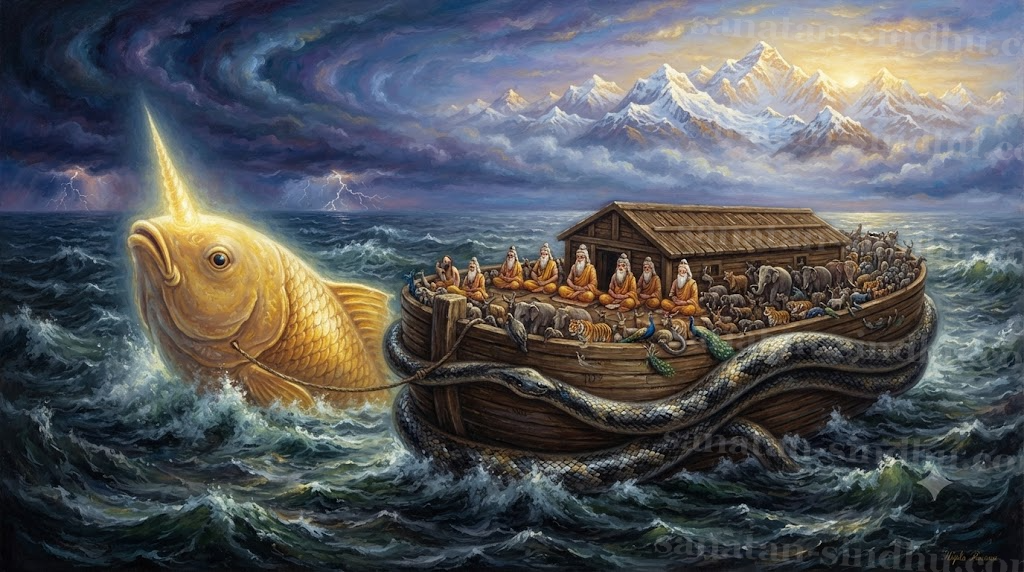
The first descent, recorded in the Śatapatha Brāhmaṇa (1.8.1) and expanded in the eighth canto of the Bhāgavata Purāṇa, marks the shift from the sixth Manu's reign (Cākṣuṣa Manvantara) to the seventh (Vaivasvata Manvantara).
A tiny fish is brought in cupped hands to King Satyavrata. It grows overnight until no vessel can hold it. Revealed as Viṣṇu, Matsya warns of a coming cosmic flood, instructs the king to build a boat, load in the seven sages and the seeds of every species, and tie the vessel to his horn using the serpent Vāsuki as the rope. Matsya tows the ark across the trackless ocean, destroys the demon Hayagrīva, recovers the stolen Vedas and delivers them safely to Brahmā — imparting the Matsya Purāṇa to Satyavrata along the way.
What it encodes: the earliest phase of biological life, the primordial oceanic memory, and the theology that the sound of the Vedas is what survives every dissolution.
Narasiṃha — reason born from fury
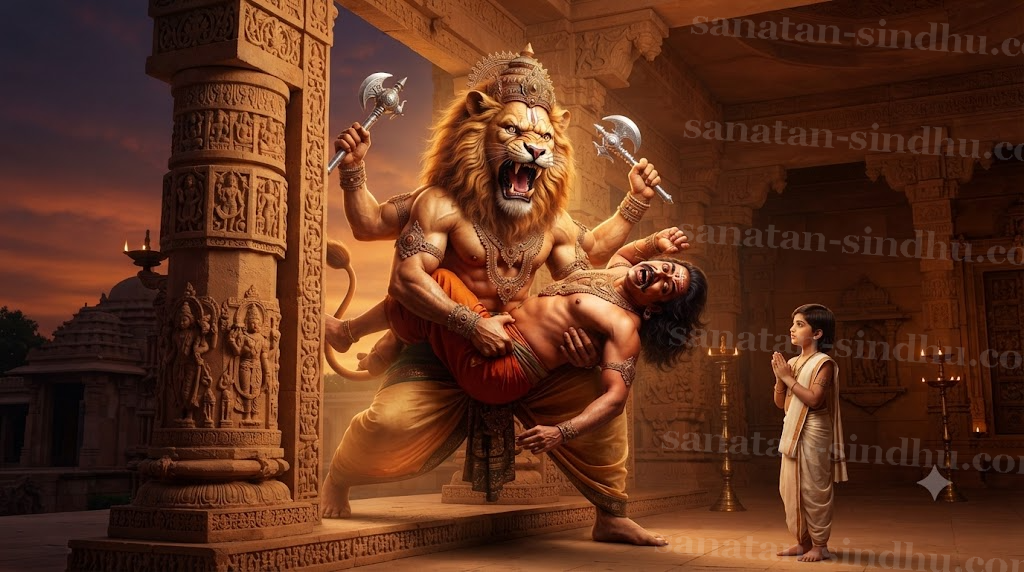
The fourth avatāra (Bhāgavata, Canto 7) resolves an impossible boon. King Hiraṇyakaśipu had secured immunity from death by day or night, indoors or outdoors, on ground or in sky, by man, beast, or weapon. When his own son Prahlāda's devotion to Viṣṇu became unshakeable, the king struck a palace pillar in rage.
With a thunderclap the pillar shattered, and Viṣṇu emerged as Narasiṃha — man's body, lion's head, terrible claws. He seized the king, dragged him to the threshold (neither indoor nor outdoor), laid him across his lap (neither ground nor sky), at twilight (neither day nor night), and tore his chest with claws (not weapons). Every clause of the boon was honoured; every cell of adharma was undone.
What it encodes: the moment intelligence and moral discrimination begin to emerge from within the animal frame — the transitional dawn of the human mind.
Vāmana — three strides to infinity
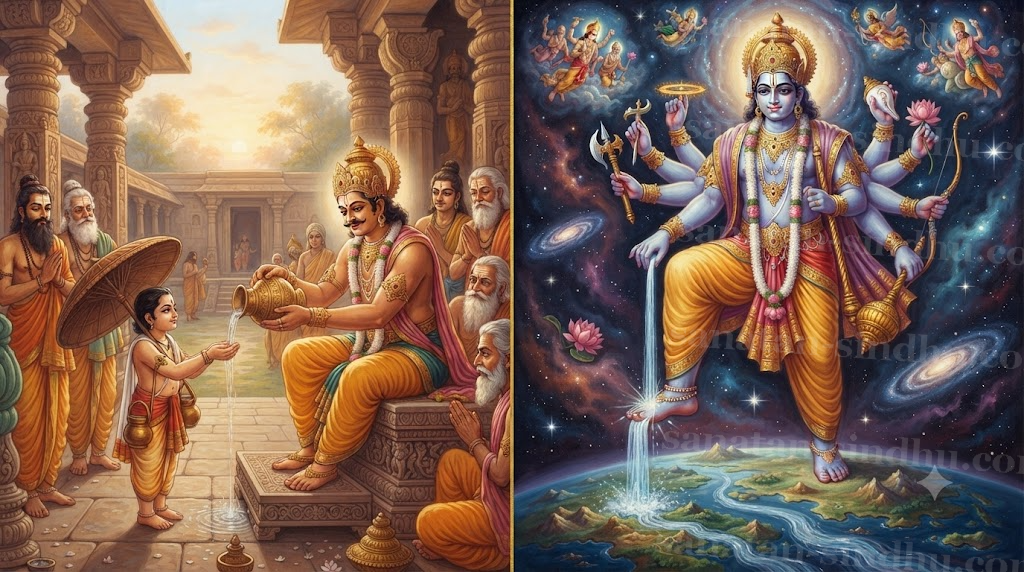
The fifth descent is the small brāhmaṇa-dwarf who arrives at King Bali's sacrifice and asks for three paces of land. Bali agrees. Vāmana then expands into his cosmic Trivikrama form — one stride covers the earth and the lower regions, another the sky and the heavens; his foot pierces the outer shell of the universe, and the water from Brahmā's kamaṇḍalu trickles down his toe to become the sacred Ganges.
What it encodes: the upright human frame. Small in stature, infinite in potential. Vāmana is where the physical form is finally correct for the full expression of consciousness — the rest of the arc is now cognitive and moral.
Buddha and Kalki — the two ends of Kali
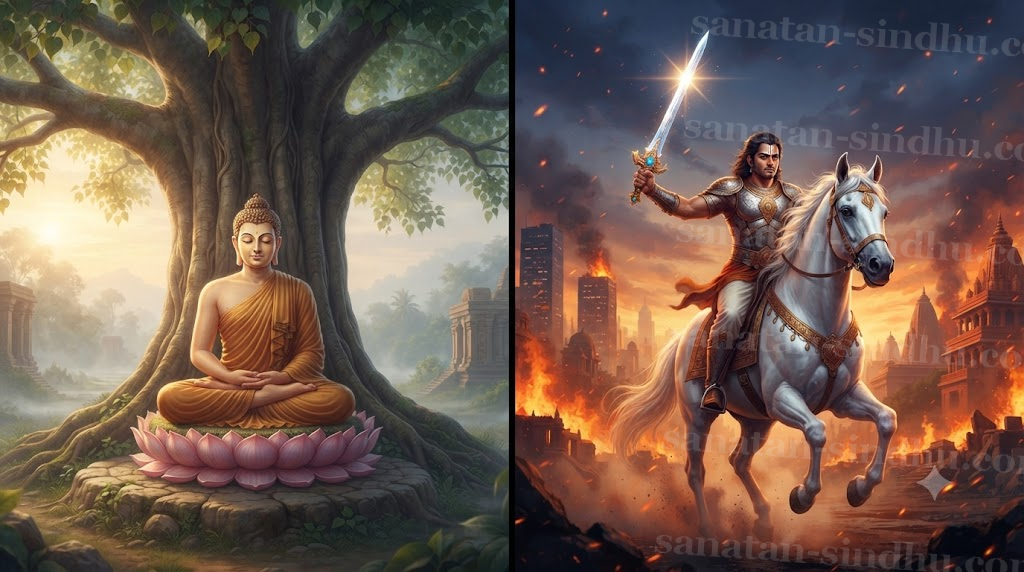
As Kali Yuga begins, the human mind turns to rigorous logic and philosophical deconstruction (tarka-niṣṭha-nare). The Lord descends as the Buddha — a teacher of dispassion, mindfulness, and the cessation of suffering. In the commentator's schema above, Buddha meets the analytic human where they stand.
As the age closes and materialism becomes total (nāstike), the Lord will appear as Kalki — mounted on the white horse Devadatta, wielding the jewel-hilted sword Ratnamaru (Nandaka), riding out to defeat the dark generals Koka and Vikoka and reset the cosmic wheel. In modern readings, Kalki is often figured as the post-human or restorative intelligence on the horizon — the wheel about to turn once again.
Two different domains of knowing
The Vedāntic principle of apauruṣeya-śabda — that revealed sound operates outside the reach of the physical senses — means the Vedas and the empirical sciences occupy distinct domains. Science studies the material curve of species. The Purāṇas map the consciousness curve of the soul as it moves through those species. The two can rhyme without one being reduced to the other.
The avatāras are not fossils. They are the calibration marks on a ladder whose top rung is the direct, loving recognition of the Absolute.