The verse the tradition calls final
सर्वधर्मान्परित्यज्य मामेकं शरणं व्रज । अहं त्वा सर्वपापेभ्यो मोक्षयिष्यामि मा शुचः ॥ १८.६६ ॥
sarva-dharmān parityajya mām ekaṃ śaraṇaṃ vraja | ahaṃ tvā sarva-pāpebhyo mokṣayiṣyāmi mā śucaḥ || 18.66 ||
'Abandoning all dharmas, take refuge in Me alone. I shall free you from every sin; do not grieve.'
Eighteen chapters of karma, jñāna and dhyāna have been laid out in careful order. Then, in a single verse, Kṛṣṇa sweeps the table. The tradition names it the Carama Śloka — the ultimate instruction — and much of Vaiṣṇava theology is a commentary on these two lines.
What exactly is abandoned
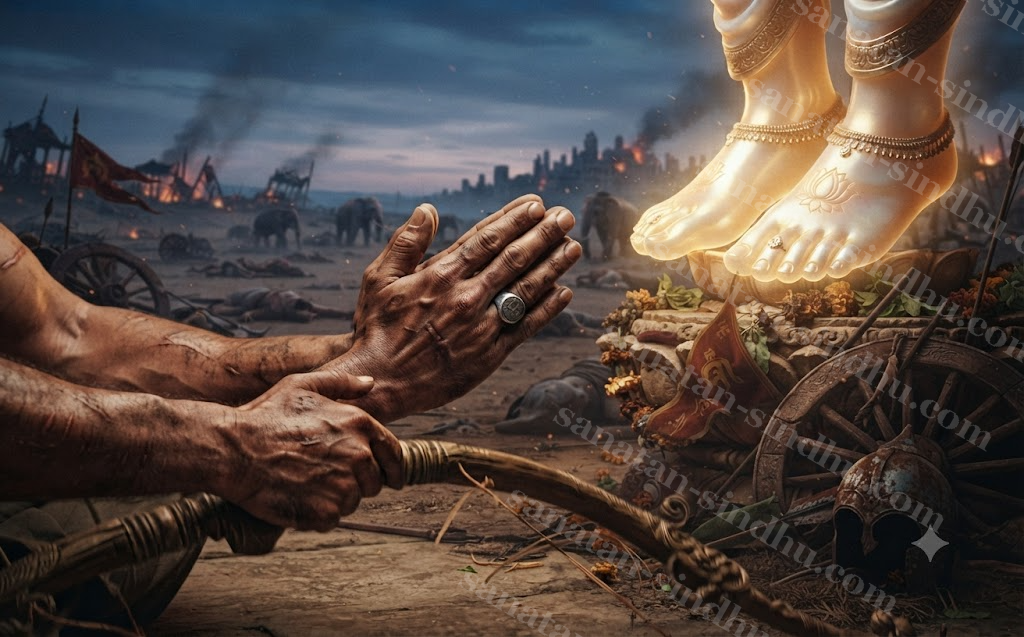
The obvious misreading is that Kṛṣṇa cancels duty. That cannot be right: four verses earlier the same speaker insists that acts of sacrifice, charity and austerity must never be given up (18.5), and the whole conversation ends with Arjuna taking up his bow.
What is abandoned is the reliance — the quiet accounting by which a person expects merit to add up to liberation. Parityajya here strips away the ledger, not the labour.
Prapatti — Rāmānuja's doctrine of surrender
In the Śaraṇāgati Gadya, Śrī Rāmānujācārya reads the verse as the founding text of prapatti. The jīva is aṇu, atomically small; the weight of accumulated karma is immeasurably large. No quantity of personal asceticism can bridge that ratio, because the one doing the bridging is the finite party.
So the burden moves. Mokṣayiṣyāmi — 'I shall liberate you' — puts salvation on the side of the omnipotent. The devotee's contribution is consent: the six limbs of śaraṇāgati as the Śrīvaiṣṇava ācāryas list them — resolving to do what pleases the Lord, refusing what does not, trusting He will protect, choosing Him as protector, offering oneself, and the plain acknowledgement of helplessness (kārpaṇya).
The Āḻvārs had already sung it. Nammāḻvār's Tiruvāymoḻi stands on the same helplessness, and the Tamil devotional line and the Sanskrit commentary meet exactly here.
The Gauḍīya reading — beyond even liberation
Śrī Caitanya Mahāprabhu's followers push further. Where Rāmānuja reads surrender as the means to mokṣa, the Gauḍīya tradition holds that prema-bhakti has no interest in mokṣa at all; liberation is a by-product a lover does not stop to collect.
On this reading Kṛṣṇa sets down the majestic voice of the universal teacher in this verse and speaks as the beloved: leave the machinery of rule-bound worship (vaidhī bhakti) and step into spontaneous love (rāgānugā bhakti). The closing mā śucaḥ — 'do not grieve' — is heard not as reassurance after a command but as the embrace that makes the command unnecessary.
The same note elsewhere
Surrender is not a sectarian invention. The Śvetāśvatara Upaniṣad ends with the disciple's whole hope resting on grace: yasya deve parā bhaktir yathā deve tathā gurau (6.23) — where devotion to the divine and to the teacher are equal, the truths stand revealed.
The Sikh Gurus put the same movement in Punjabi: the Japji Sāhib closes its argument with hukam rajāī chalṇā — to walk in accordance with the divine order — which is 18.66 in another language. Across the Indian religious landscape the last step is always the one the seeker cannot take alone.