The chapter that gathers everything
At seventy-eight verses, chapter eighteen is the longest in the Gītā and the deliberate synthesiser. It revisits renunciation, sorts action, agent, intellect, resolve and even food into the three guṇas, restates svadharma, and only then discloses the destination of the soul.
It opens with a question of definition, because the argument it must settle is a technical one.

Sannyāsa and tyāga — resolving the Mīmāṃsā quarrel
Behind the opening verses stands an old rivalry. The Pūrva Mīmāṃsā school held that Vedic ritual action must be performed perpetually to secure svarga. Radical ascetics held the opposite: all action binds, therefore all action must be physically abandoned. Kṛṣṇa refuses both with a distinction:
काम्यानां कर्मणां न्यासं संन्यासं कवयो विदुः । सर्वकर्मफलत्यागं प्राहुस्त्यागं विचक्षणाः ॥ १८.२ ॥
kāmyānāṃ karmaṇāṃ nyāsaṃ sannyāsaṃ kavayo viduḥ | sarva-karma-phala-tyāgaṃ prāhus tyāgaṃ vicakṣaṇāḥ || 18.2 ||
'The sages know sannyāsa to be the laying down of actions driven by desire; the discerning call tyāga the relinquishing of the fruits of all actions.'
Sacrifice, charity and austerity — yajña-dāna-tapaḥ-karma — must never be abandoned, He adds, for they purify even the wise (18.5). Renunciation is therefore not a departure for the Himālaya. It is vigorous work in the world without an egoic claim on the outcome.
The Īśa Upaniṣad had compressed the same instruction into its first line: tena tyaktena bhuñjīthā — 'enjoy by renouncing' (Īśa 1).
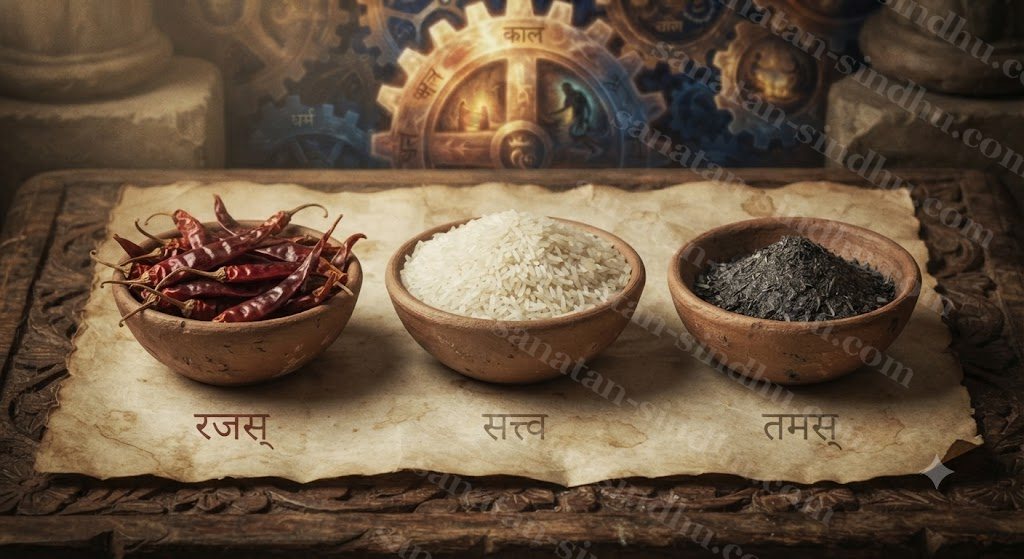
The taxonomy of the three guṇas
The middle of the chapter is a remarkable piece of psychological classification. Knowledge, action, agent, understanding, resolve and happiness are each sorted three ways.
- Sāttvika knowledge sees one imperishable reality in all beings, undivided in the divided (18.20).
- Rājasika knowledge sees only separate entities of distinct kinds (18.21).
- Tāmasika knowledge clings to one fragment as if it were the whole, without reason (18.22).
The same triple grid is applied to charity, austerity and even to the resolve that holds a mind together — a diagnostic tool a reader can turn on their own motives without any teacher present.
Madhva — the machine and the one who turns it
Śrī Madhvācārya's Dvaita, developed in the Kannada country, rests heavily on a verse near the chapter's end:
ईश्वरः सर्वभूतानां हृद्देशेऽर्जुन तिष्ठति । भ्रामयन्सर्वभूतानि यन्त्रारूढानि मायया ॥ १८.६१ ॥
īśvaraḥ sarva-bhūtānāṃ hṛd-deśe 'rjuna tiṣṭhati | bhrāmayan sarva-bhūtāni yantrārūḍhāni māyayā || 18.61 ||
'The Lord dwells in the heart-region of all beings, O Arjuna, turning them all as though mounted on a machine, by His māyā.'
For Madhva this is the end of human arrogance. Liberation follows from the vibrating realisation of total dependence on Hari; the jīva is pratibimba, a reflection, incapable of independent action. Renunciation, on this reading, is simply the alignment of one's will with the will of the Indweller.
Rāmānuja reads the same verse as intimacy rather than mechanism, and Śaṅkara reads the machine as the body-mind apparatus of māyā. One verse, three schools, no forced agreement.
Yathecchasi tathā kuru — the freedom at the end
Then comes what may be the most distinctive sentence in world scripture. Having delivered knowledge He Himself calls more secret than the secret, Kṛṣṇa does not demand submission:
इति ते ज्ञानमाख्यातं गुह्याद्गुह्यतरं मया । विमृश्यैतदशेषेण यथेच्छसि तथा कुरु ॥ १८.६३ ॥
iti te jñānam ākhyātaṃ guhyād guhyataraṃ mayā | vimṛśyaitad aśeṣeṇa yathecchasi tathā kuru || 18.63 ||
'Thus has knowledge more secret than all secrets been declared to you by Me. Reflect on it fully, and then do as you wish.'
Vimṛśya — having deliberated. The teaching is offered to the intellect, not imposed on the will. Only after Arjuna chooses freely — kariṣye vacanaṃ tava, 'I shall do as You say' (18.73) — does the dialogue end.
The same respect for enquiry runs through the tradition. The Buddha's counsel to the Kālāmas — test what you hear against your own experience before accepting it — belongs to the same intellectual climate as yathecchasi tathā kuru.