
The verse itself
चातुर्वर्ण्यं मया सृष्टं गुणकर्मविभागशः । तस्य कर्तारमपि मां विद्ध्यकर्तारमव्ययम् ॥ ४.१३ ॥
cāturvarṇyaṃ mayā sṛṣṭaṃ guṇa-karma-vibhāgaśaḥ | tasya kartāram api māṃ viddhy akartāram avyayam || 4.13 ||
'The fourfold varṇa was brought forth by Me according to the division of guṇas (inherent qualities) and karma (work). Though I am its maker, know Me to be the non-doer, the unchanging.'
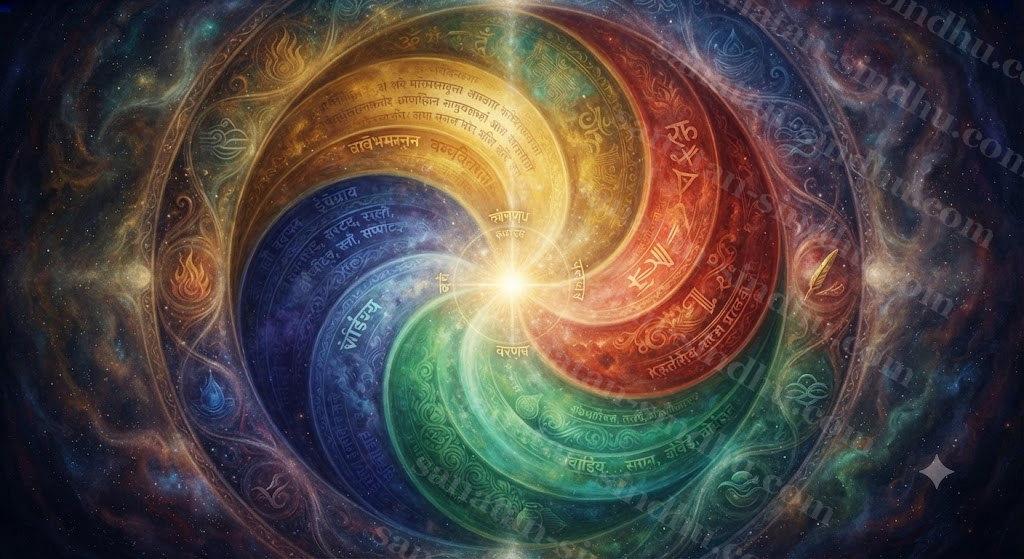
Everything in the modern argument turns on four syllables: guṇa-karma-vibhāgaśaḥ — 'by the division of quality and work'. The verse names no father, no lineage, no birth. It names a temperament and the labour that flows from it.
The second half is easy to skip and impossible to skip honestly. Kṛṣṇa calls Himself akartāram — the non-doer. The order He describes is a feature of prakṛti, not a decree binding the Self.
The orthodox reading — birth as the residue of karma
Traditional commentators, reading 4.13 alongside the Dharmaśāstra literature, took birth and quality to be knotted together: a soul is born into a family precisely because its accumulated karma and guṇa fit that station. On this reading heredity is not the cause of varṇa but its visible symptom.
Ācārya Śaṅkara accepts the structure as an arrangement within māyā for the orderly working of nature — and then throws the weight of his commentary on the second line. The Lord, being akartā, is untouched by the arrangement; and the seeker's business is not to polish a social label but to see through the whole field of names and forms to Brahman.
The Upaniṣadic precedent is older than the argument. When the boy Satyakāma admits he does not know his father's lineage and tells the plain truth, Gautama Hāridrumata accepts him at once: naitad abrāhmaṇo vivaktum arhati — 'no one but a brāhmaṇa could speak so' (Chāndogya Upaniṣad 4.4.5). Truthfulness, not parentage, settled the question.
The reformist and mystical readings
Modern ācāryas and the older Bhakti saints argue the birth-based reading straight out of the Sanskrit.
- A late-19th-century Vedāntic reformer-monk held that varṇa was meant to be mobile. If a person born in a śūdra household shows sattva — purity, restraint, hunger for knowledge — that person's varṇa is brāhmaṇa, whatever the register says.
- A 20th-century philosopher-yogi read the four not as social classes at all but as four cosmic energies a complete human being must eventually hold together: wisdom, courage, harmonious production, and service.
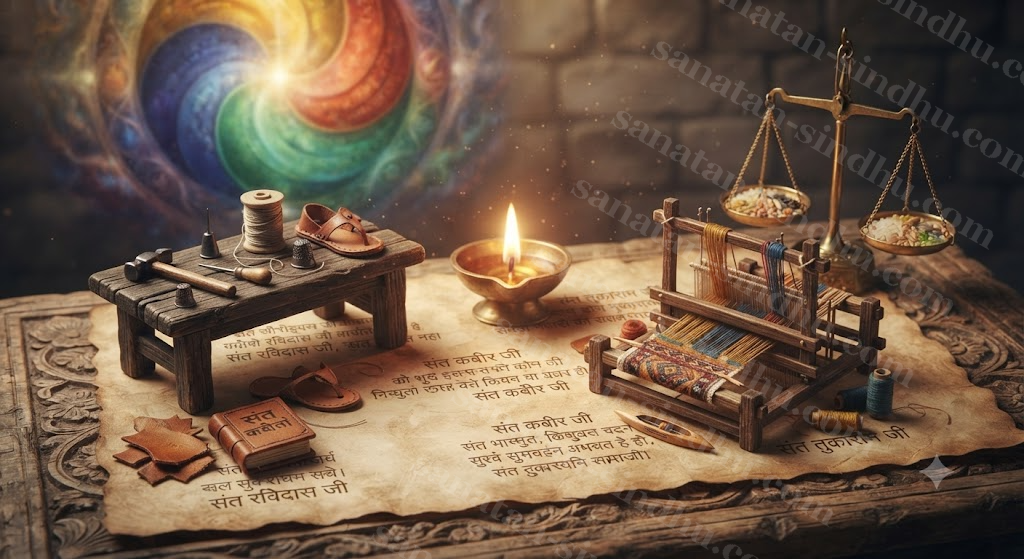
The Bhakti poets settled it by living it. Ravidās the cobbler, Kabīr the weaver, Nāmdev the calico-printer, Tukārām the grain-seller — all counted as teachers by the very tradition whose hierarchy would have ranked them low. Basavaṇṇa's Vīraśaiva movement made the point structurally, dissolving the ranking inside the anubhava maṇṭapa.
The Śramaṇa traditions pressed the same distinction. The Dhammapada devotes a whole chapter to it: na jaṭāhi na gottena na jaccā hoti brāhmaṇo — 'not by matted hair, nor by clan, nor by birth does one become a brāhmaṇa' (Dhammapada 393). The Uttarādhyayana Sūtra of the Jains says it in one line: kammuṇā bambhaṇo hoi — 'by one's deeds one becomes a brāhmaṇa' (25.33).
The counter-verse in chapter nine
If 4.13 were meant to lock the door, chapter nine leaves it wide open:
मां हि पार्थ व्यपाश्रित्य येऽपि स्युः पापयोनयः । स्त्रियो वैश्यास्तथा शूद्रास्तेऽपि यान्ति परां गतिम् ॥ ९.३२ ॥
māṃ hi pārtha vyapāśritya ye 'pi syuḥ pāpa-yonayaḥ | striyo vaiśyās tathā śūdrās te 'pi yānti parāṃ gatim || 9.32 ||
'For those who take refuge in Me, O Pārtha — whatever their birth — reach the supreme goal.'
Whatever sociology the earlier verse describes, the soteriology of the text refuses to be gated by it. The highest destination is declared open irrespective of birth, and it is declared by the same speaker, in the same conversation.
How to hold the verse today
Read 4.13 as a description of function, not a sanction of rank. Four capacities exist in every society — the capacity to know, to protect, to produce, to serve — and any of the four can be corrupted into a claim of superiority, which is exactly what the verse's own second line forbids by naming the Lord as the non-doer.
The text supplies its own corrective. Where the verse could be read as hierarchy, 9.32 answers with access; where it could be read as heredity, the Sanskrit answers with guṇa-karma; and where it could be read as identity, Śaṅkara answers that the goal is to transcend the label entirely.