
Arjuna's question
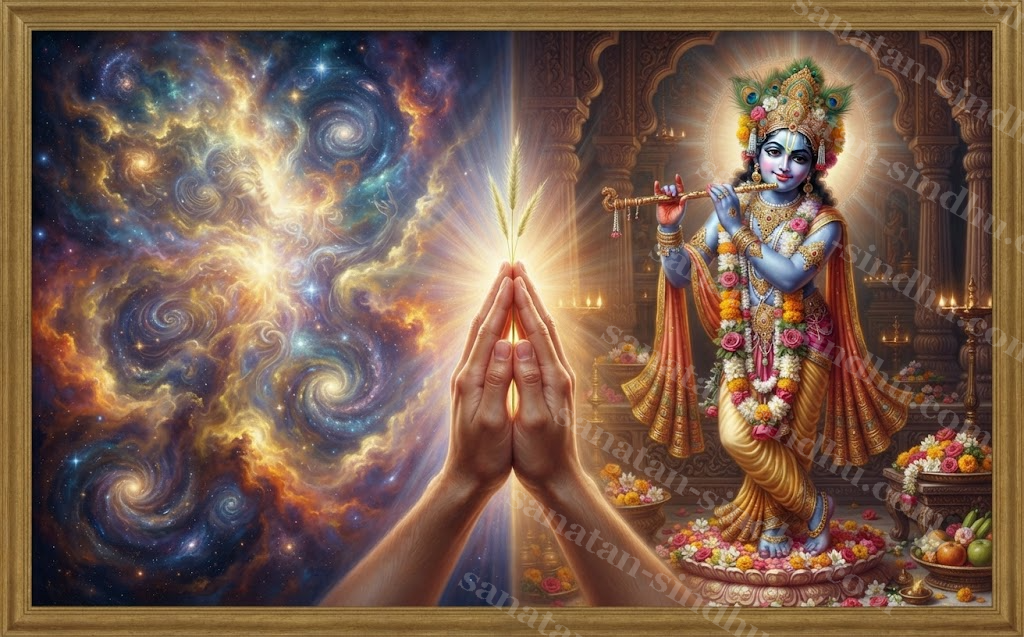
Twenty verses long, chapter twelve is the shortest in the Gītā and the emotional nucleus of the whole text. Arjuna asks it directly: of those who worship You with steady devotion, and those who worship the imperishable unmanifest, which are the better versed in yoga (12.1)?
The question is not a beginner's confusion. It is the fault line between nirguṇa and saguṇa — the attributeless Absolute and the Lord with infinite auspicious qualities — that Indian theology has argued about ever since.
The warning about the formless path
Kṛṣṇa answers that those who fix their minds on Him with supreme faith are held to be the most perfect — and then adds a psychological caution rather than a doctrinal condemnation:
क्लेशोऽधिकतरस्तेषामव्यक्तासक्तचेतसाम् । अव्यक्ता हि गतिर्दुःखं देहवद्भिरवाप्यते ॥ १२.५ ॥
kleśo 'dhikataras teṣām avyaktāsakta-cetasām | avyaktā hi gatir duḥkhaṃ dehavadbhir avāpyate || 12.5 ||
'Greater is the difficulty of those whose minds are set on the unmanifest; the unmanifest goal is reached with pain by the embodied.'
The operative word is dehavadbhiḥ — 'by those who possess bodies'. The objection is not that the formless is false. It is that embodied minds are built for form, and asking them to fasten on a void is arduous work.
Kṛṣṇa then offers a descending ladder anyone can enter at their own rung: fix the mind on Me; if not, practise; if not, work for My sake; if not, renounce the fruit of what you do (12.8–12.11).
Rāmānuja — the Tamil-Sanskrit synthesis
Śrī Rāmānujācārya, who brought the ecstatic Tamil poetry of the Āḻvārs (the Nālāyira Divya Prabandham) into conversation with the Sanskrit Upaniṣads, uses this chapter to crown bhakti as the supreme and most natural path.
His argument is anthropological as much as theological. A mind housed in a body cannot organically conceptualise an attributeless entity; the attempt produces kleśa, real strain. Worship of the saguṇa Lord — possessed of compassion, beauty, accessibility — lets a human being use the emotional equipment they already have, redirecting affection from perishable objects to the imperishable.
The Upaniṣads themselves refuse to choose. Dve vāva brahmaṇo rūpe mūrtaṃ caivāmūrtaṃ ca — 'two indeed are the forms of Brahman, the formed and the formless' (Bṛhadāraṇyaka Upaniṣad 2.3.1).
The Sikh synthesis — formless yet intensely personal
The later Bhakti movements dissolved the opposition rather than settling it. The Sikh tradition founded by Gurū Nānak Dev Ji worships Akāl Purakh, the Timeless One, explicitly nirankār — without form. The Mūl Mantar opens the Guru Granth Sāhib with it: ik oaṅkār sat nām kartā purakh nirbhau nirvair akāl mūrat ajūnī saibhaṅ gur prasād.
Yet the method of approach is the intense personal devotion of chapter twelve: nām simran, the remembrance of the Name, and śabad kīrtan, sung congregationally. The Gurūs demonstrated in practice that burning love for the Formless need not carry the kleśa Kṛṣṇa warns of — provided the heart is soaked in surrender and humility rather than in metaphysical effort.
Kabīr, whose verses sit inside the Guru Granth Sāhib itself, had made the same discovery from another direction: a Beloved with no shape, addressed with every endearment.

How a devotee is recognised
The chapter ends not with metaphysics but with a character reference. From verse 13 onward Kṛṣṇa lists the traits of the one dear to Him:
अद्वेष्टा सर्वभूतानां मैत्रः करुण एव च । निर्ममो निरहङ्कारः समदुःखसुखः क्षमी ॥ १२.१३ ॥
adveṣṭā sarva-bhūtānāṃ maitraḥ karuṇa eva ca | nirmamo nirahaṅkāraḥ sama-duḥkha-sukhaḥ kṣamī || 12.13 ||
'One who bears ill-will to no being, who is friendly and compassionate, free of possessiveness and ego, the same in pain and pleasure, and forgiving...'
Not one of these marks is ritual. Every one is relational.
Centuries later the Gujarati saint-poet Narsinh Mehta translated the list into living speech in Vaiṣṇava jana to — a true Vaiṣṇava is the one who pīḍa parāyī jāṇe re, who feels the pain of another as their own. The Gītā's bhakti is not a private trance; it is verified in how its holder treats other beings.