The request for the divine eye
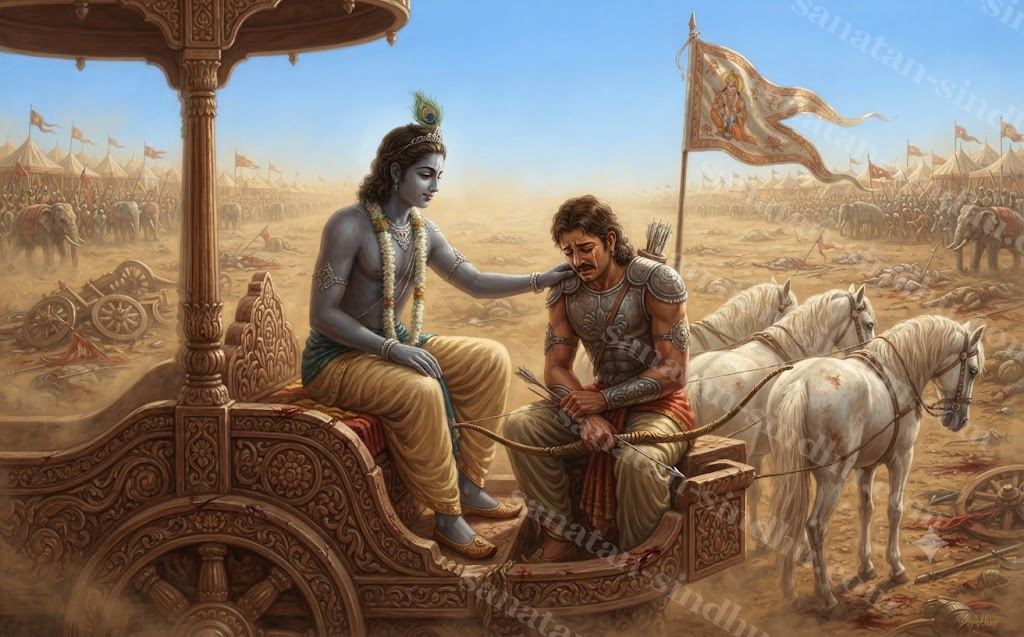
Through ten chapters the Gītā argues. In the eleventh it stops arguing and shows. Arjuna, having heard Kṛṣṇa enumerate His glories, asks to see the imperishable form itself — and is told at once that mortal sight cannot manage it:
न तु मां शक्यसे द्रष्टुमनेनैव स्वचक्षुषा । दिव्यं ददामि ते चक्षुः पश्य मे योगमैश्वरम् ॥ ११.८ ॥
na tu māṃ śakyase draṣṭum anenaiva sva-cakṣuṣā | divyaṃ dadāmi te cakṣuḥ paśya me yogam aiśvaram || 11.8 ||
'But you cannot see Me with your own eye. I give you a divine eye — behold My sovereign yoga.'
The vision is granted, not achieved. The organ of perception itself has to be replaced before the object can appear.
What the divine eye shows
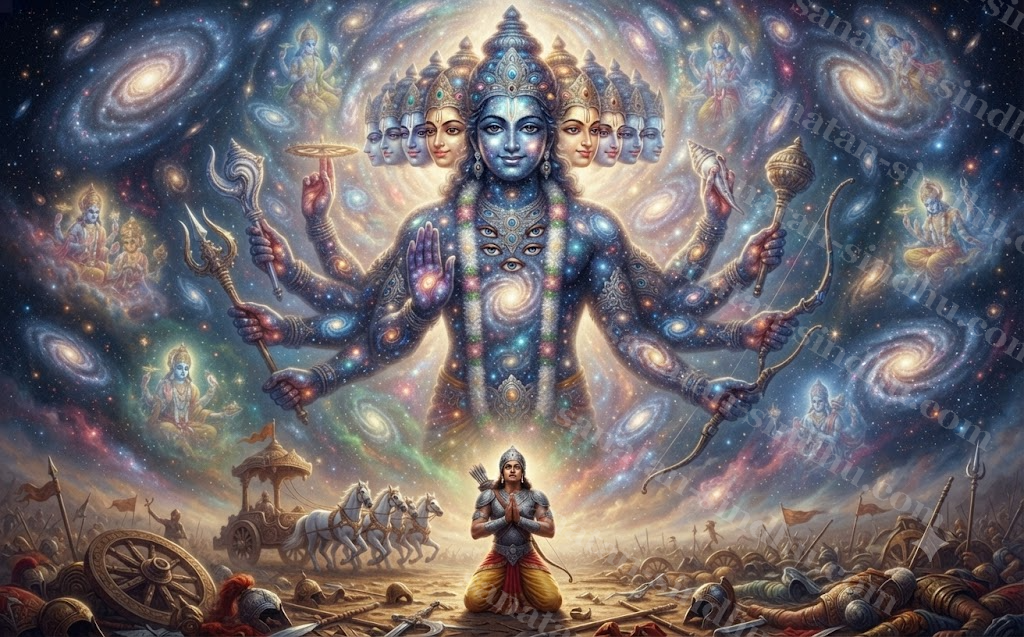
Most scriptures make the sight of God restful. This one does not. Arjuna sees no gentle deity but boundless space, blazing light, mouths and eyes without number, all the worlds running at once inside a single body.
दिवि सूर्यसहस्रस्य भवेद्युगपदुत्थिता । यदि भाः सदृशी सा स्याद्भासस्तस्य महात्मनः ॥ ११.१२ ॥
divi sūrya-sahasrasya bhaved yugapad utthitā | yadi bhāḥ sadṛśī sā syād bhāsas tasya mahātmanaḥ || 11.12 ||
'If a thousand suns were to rise together in the sky, that radiance might resemble the splendour of that Great Being.'
His hair stands on end; he stammers; he apologises for every casual word he ever used with his friend. The vision is not information. It is a recalibration of the one who receives it.
Kāla — the devourer of worlds
The theological centre of the chapter is one self-identification:
कालोऽस्मि लोकक्षयकृत्प्रवृद्धो लोकान्समाहर्तुमिह प्रवृत्तः । ऋतेऽपि त्वां न भविष्यन्ति सर्वे येऽवस्थिताः प्रत्यनीकेषु योधाः ॥ ११.३२ ॥
kālo 'smi loka-kṣaya-kṛt pravṛddho lokān samāhartum iha pravṛttaḥ | ṛte 'pi tvāṃ na bhaviṣyanti sarve ye 'vasthitāḥ pratyanīkeṣu yodhāḥ || 11.32 ||
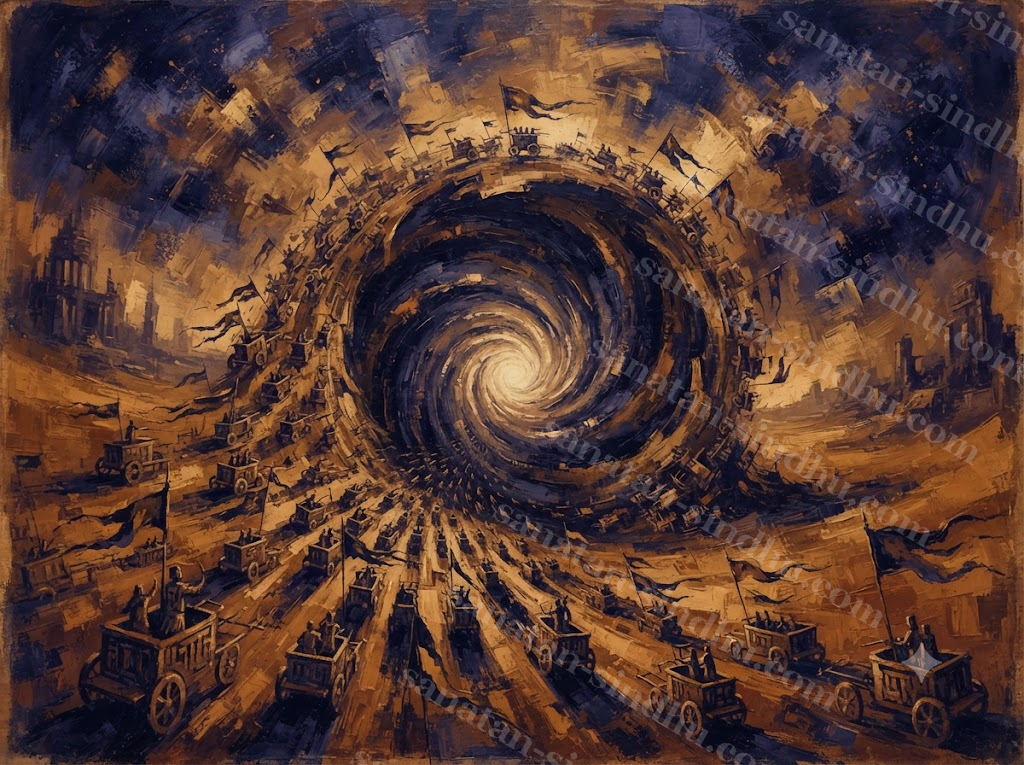
'I am Time, grown mighty, the destroyer of worlds, come forth to gather them in. Even without you, none of these warriors arrayed in the opposing ranks shall survive.'
This is the Gītā's answer to the question of why destruction exists in a world held to be divine. The Sanātana position is not that God is the good half of a pair fighting the bad half. God is the totality — including the dissolution that no one escapes. The jaws that crush the armies of both sides make the point without argument.
The image is not new to the eleventh chapter. The Kaṭha Upaniṣad had already said that death itself is merely the seasoning of the meal at which Brahman dines (1.2.25), and the Ṛgveda's Puruṣa Sūkta (10.90) had already described the cosmos as one body. Chapter eleven makes the metaphor visible.
Madhva's reading — the instrument and the Independent
Ācārya Madhva, founder of the Dvaita school, leans on this chapter to establish the absolute asymmetry between the svatantra (independent reality — Viṣṇu) and the asvatantra (the dependent reality of every jīva). The terror Arjuna feels is the accurate emotional register of that gap.
And the practical instruction that follows the vision is precisely dependence: nimitta-mātraṃ bhava savyasācin — 'be merely the instrument, O ambidextrous archer' (11.33). The vision does not remove Arjuna's work. It removes his ownership of it.
Why the form is withdrawn
Arjuna cannot hold the sight. He begs for the four-armed form, then for the familiar human one, and Kṛṣṇa returns to it and comforts him — vyapeta-bhīḥ prīta-manāḥ punas tvaṃ tad eva me rūpam idaṃ prapaśya (11.49).
The chapter's final teaching is contained in that withdrawal. The totality is real, but the relationship is what a human being can live inside. Chapter twelve, which begins immediately after, asks the obvious next question: with what may we actually worship?