The ocean as a highway
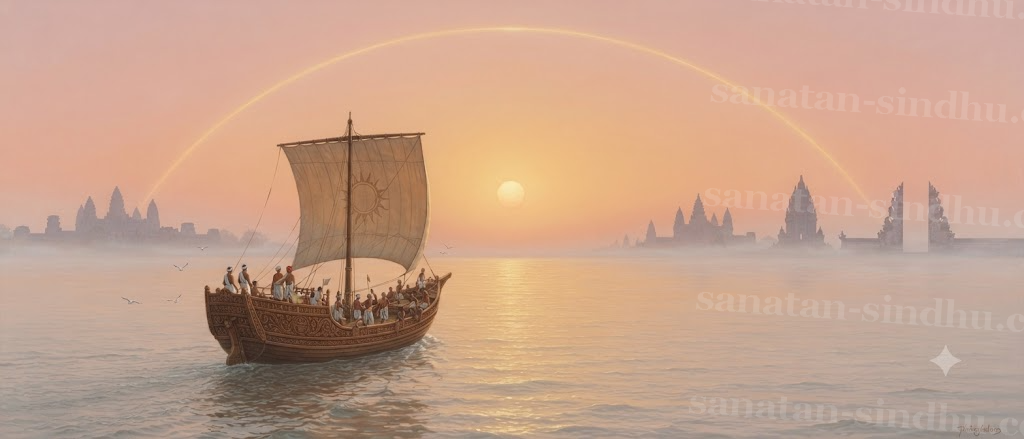
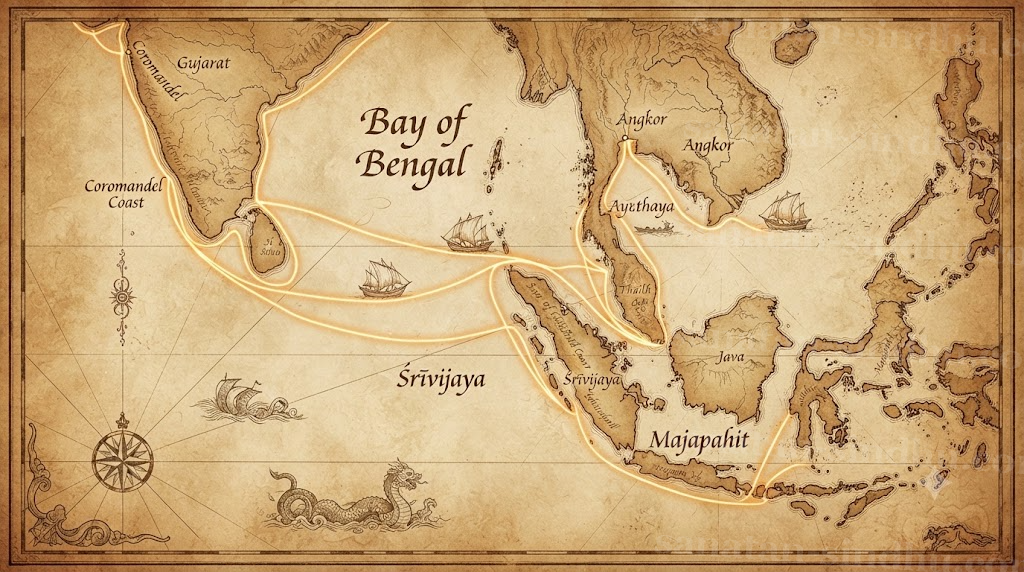
Long before modern borders were drawn, traders, scholars and priests from the Indian subcontinent sailed eastward, carrying the epics, philosophy and vocabulary of Sanātana Dharma with them. When these ideas landed on the shores of Southeast Asia — in kingdoms such as Śrīvijaya (Sumatra), Majapahit (Java), the Khmer empire (Cambodia) and Ayutthaya (Siam) — they did not erase local cultures. They fused with them.
This was not a transmission by conquest. There is no record of an Indian army imposing a creed on Java or the Mekong. What travelled was a vocabulary of honour, duty and kingship, and a set of stories large enough that local courts could act them out as their own. Historians call the result localisation: the Rāmāyaṇa read in Javanese, Mount Meru rebuilt in Khmer sandstone, Viṣṇu's eagle raised as a national emblem.
What remains today
The region is now predominantly Muslim (Indonesia, Malaysia) or Buddhist (Thailand, Cambodia). Yet the cultural and linguistic DNA of Sanātana Dharma is completely intact, and often hides in plain sight:
- Every monarch of Thailand's ruling Chakri dynasty takes the ceremonial title Rāma; the present king reigns as Rama X.
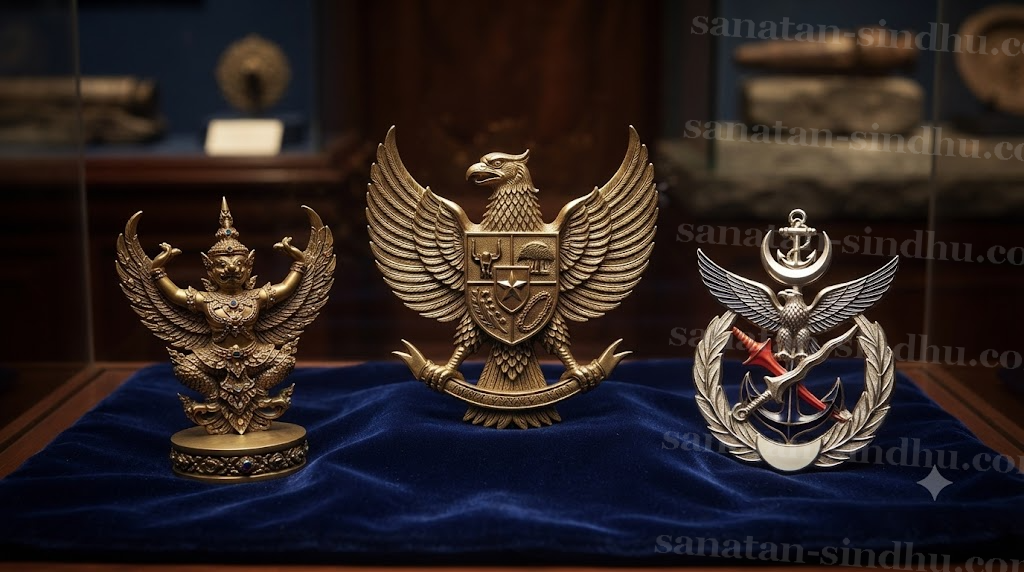
- Indonesia's national emblem and its national airline are both Garuḍa, the eagle-mount of Viṣṇu.
- A Malaysian or Indonesian naval admiral holds the rank Laksamana — from Lakṣmaṇa, Rāma's guardian brother.
- The Malay and Indonesian word for a country is Negara, from nagarī; for language, Bahasa, from bhāṣā; for a cabinet minister, Menteri, from mantrī.
- The largest religious monument on earth, Angkor Wat, was built as a temple to Viṣṇu, ringed by a moat standing for the Kṣīra Sāgara, the ocean of milk.
None of this is museum material. It is the working furniture of modern states.
Three studies to follow
This essay is the doorway. Three companion studies take the material further, each following one strand:
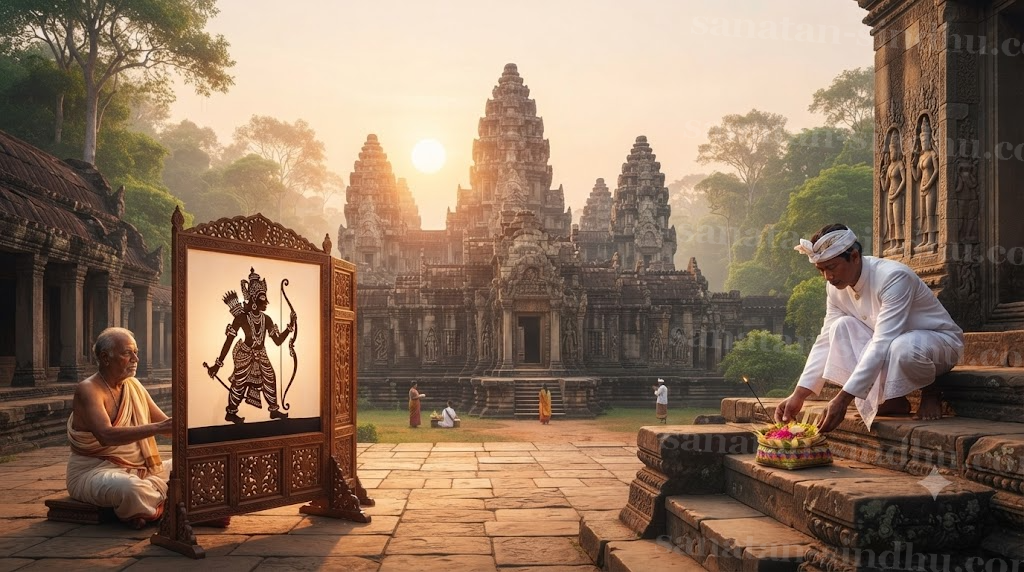
- Stone and shadow — the Rāmāyaṇa in Javanese shadow-puppet theatre (Wayang Kulit), the Trimūrti spires of Prambanan, and the 49-metre Samudra Manthana relief at Angkor Wat. Read Shadows of the Rāmāyaṇa and stones of the gods.
- The living flame — why Bali remains over eighty per cent Hindu, how Agama Hindu Dharma differs from Indian practice, and how the Rāmāyaṇa is danced in Kecak, Khon and Robam Preah Ream. Read The living flame — Bali and the sacred dance.
- Language and legends — how Lakṣmaṇa became an admiral, Hanumān a reconnaissance codeword, and Sanskrit the register of ASEAN statecraft. Read Sanskrit tides — the language and legends of Southeast Asia.
Why it survived: fluidity, not fortification
The tradition endured across the ocean for the same reason it endured at home. It did not insist on a single centre, a single language of worship, or a single authorised telling of a story. It offered a canvas.
So Rāvaṇa becomes, in some Javanese and Malay tellings, a tragic figure maddened by love rather than a flat villain. The monkeys building the bridge to Laṅkā are carved at Prambanan as the birds and macaques of the Javanese rainforest. A Balinese temple leaves the god's throne deliberately empty. The coordinates changed and the languages shifted; the pursuit — cosmic balance, honouring the divine, standing up for what is right — did not.