Bali — the island of a thousand temples
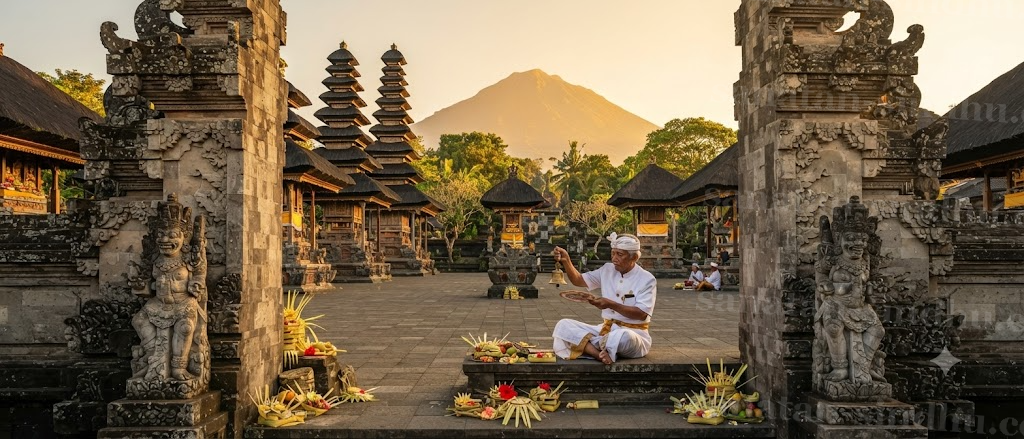
Grand stone monuments like Angkor Wat and Prambanan eventually became archaeological wonders of vanished empires. But the spiritual fire of Sanātana Dharma never went out in Southeast Asia. It migrated and evolved, and today it burns brightest on one island: Bali.
Indonesia is the world's most populous Muslim-majority nation, yet Bali remains over eighty per cent Hindu. This is not an accident of geography but the outcome of a deliberate cultural rescue. When the Hindu-Buddhist Majapahit empire of Java collapsed in the sixteenth century as Islamic sultanates rose, the empire's royals, priests, artists and philosophers moved eastward to Bali, carrying their palm-leaf manuscripts (lontar), their arts and their rites. The island became a living fortress of the tradition.
Agama Hindu Dharma — what makes it distinct
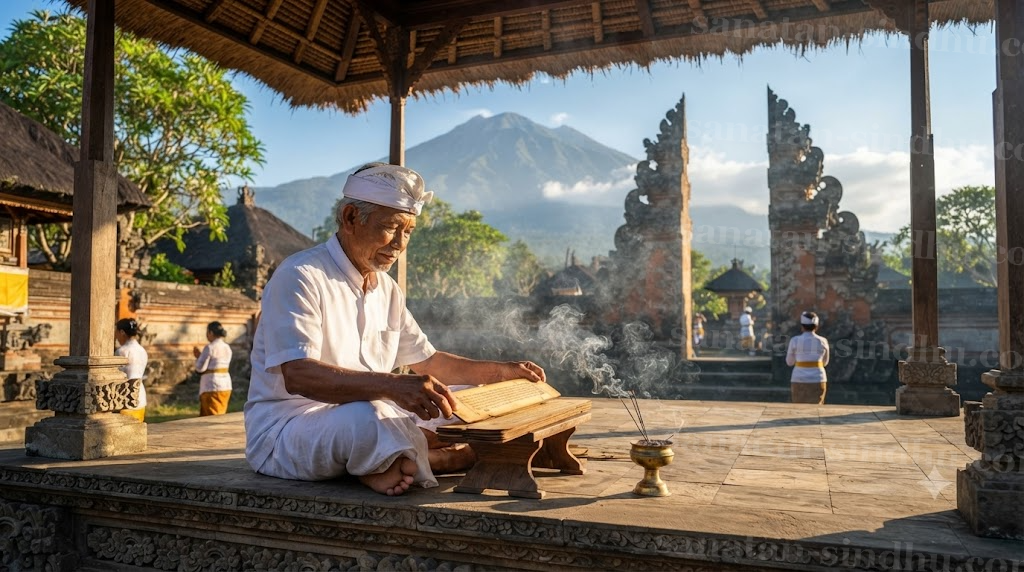
Balinese Hinduism blends Purāṇic tradition with local animism and ancestor veneration. Three features set it apart from Indian practice.
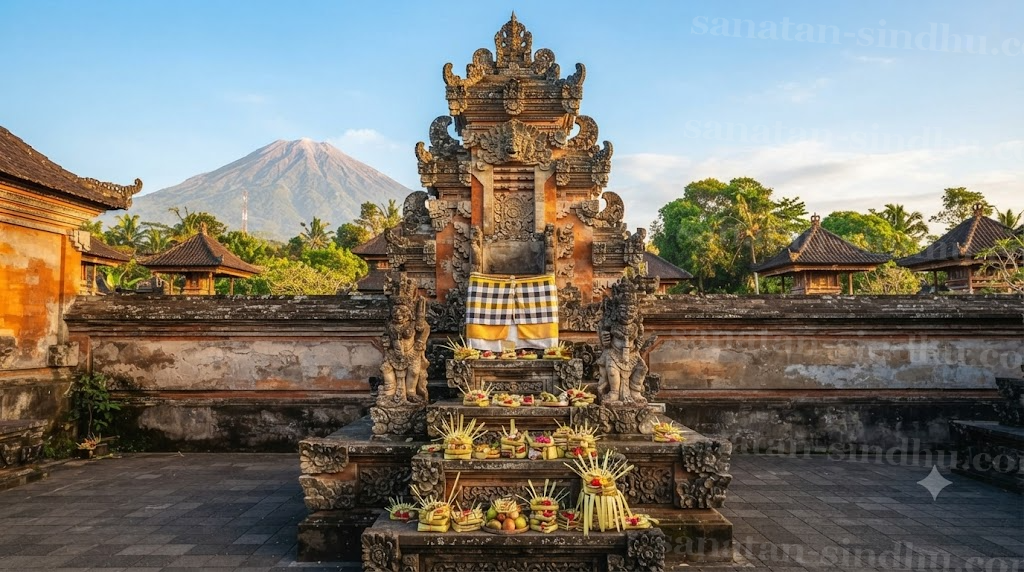
- The supreme void (Acintya). At the head of the Balinese pantheon is Sang Hyang Widhi Wasa, also called Acintya, 'the unthinkable' — the formless ultimate, close to the Upaniṣadic Brahman. Every temple holds an empty stone throne, the Padmāsana, left deliberately vacant, because the supreme cannot be caught in a likeness.
- Shrines without permanent images. Where Indian temples house fixed mūrtis, Balinese temples are open-air courtyards with empty shrines. The gods are held to dwell on the holy mountains — Gunung Agung above all — and to descend into the shrines only for the temple's festival, its Odalan.
- Daily offerings (canang sari). On every street lie small square trays woven from coconut leaf, filled with flowers, betel and burning incense. They are set out several times a day to thank the creator and settle the spirits of the earth, maintaining the balance the Balinese call Tri Hita Karana — right relation with the divine, with other people, and with the land.
Kecak — the Rāmāyaṇa rendered in human sound
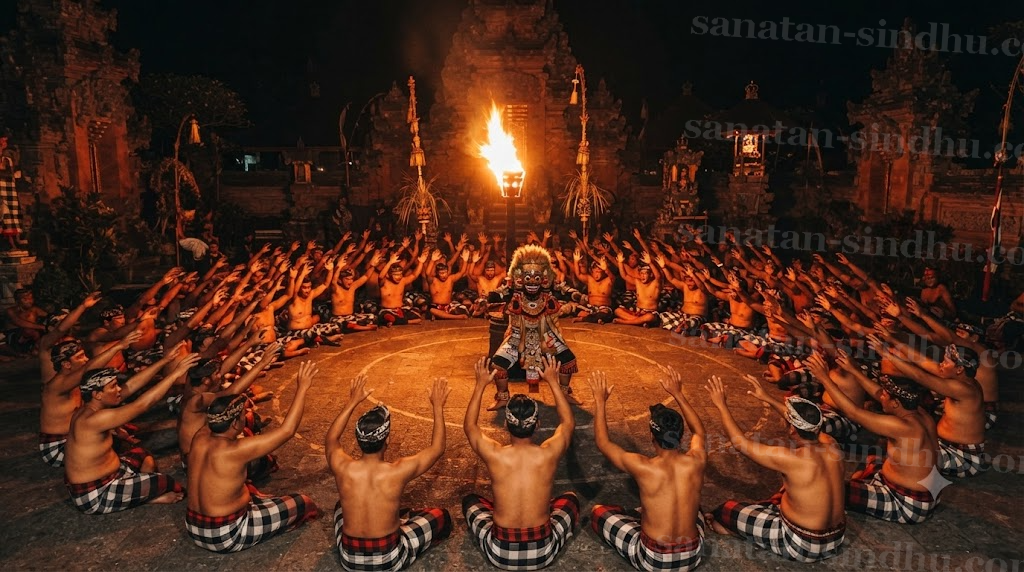
Bali's most famous performance is the Kecak, a Rāmāyaṇa drama that uses no musical instruments at all.
Fifty to a hundred and fifty bare-chested men sit in concentric rings around a central torch and become the orchestra themselves, chanting an unbroken interlocking chak-a-chak-a-chak.
The vocal style descends from Sanghyang, an old pre-Hindu trance rite used to drive off malevolent spirits; in the 1930s Balinese artists set that trance-chant under the battle scenes of the Rāmāyaṇa. The ring of bodies is the Vānara Senā, the monkey army of Hanumān and Sugrīva. As the story moves from Sītā's abduction to the final war, the human wall sways, collapses, surges and lifts its hands — an effect that is less spectacle than induced trance.
Royal postures — Khon and Robam Preah Ream
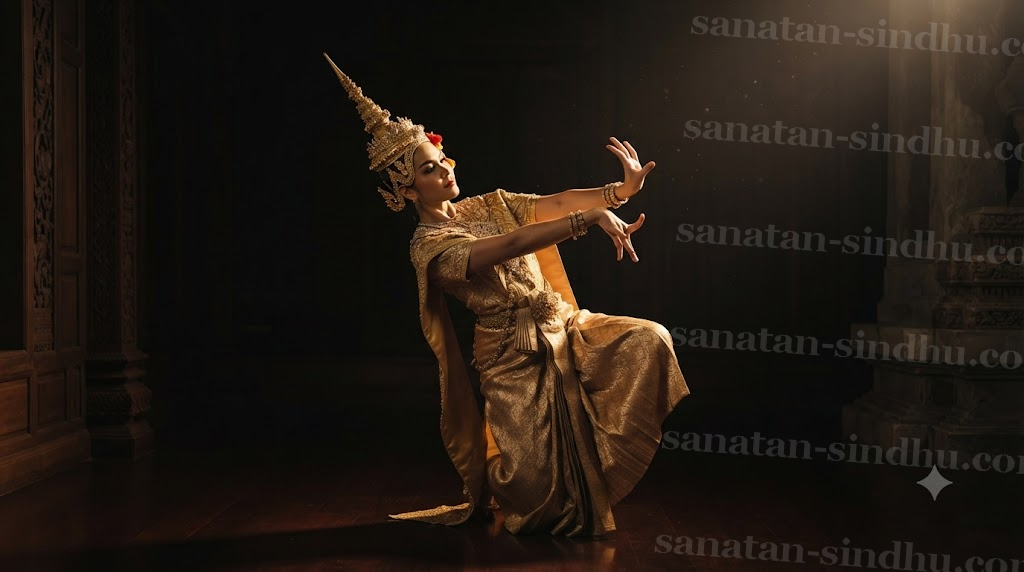
On the mainland, the Thai and Khmer courts turned the same epic into highly stylised royal dance: Khon in Thailand, Robam Preah Ream in Cambodia.
The body is bent into gravity-defying angles to suggest a cosmic geometry rather than ordinary humanity. Dancers train from early childhood to flex fingers, wrists, elbows and knees backward, echoing the poses of Indian temple sculpture so that they read as celestial beings — Apsarās moving through air rather than across a floor.
And as in Kathakali or Bharatanatyam, the vocabulary is literal. Every tilt of the head, curl of a finger and placement of a foot is a word: a gesture held near the heart says love; a sharp stamped heel says anger.
The sacred mask and the gold-threaded silk
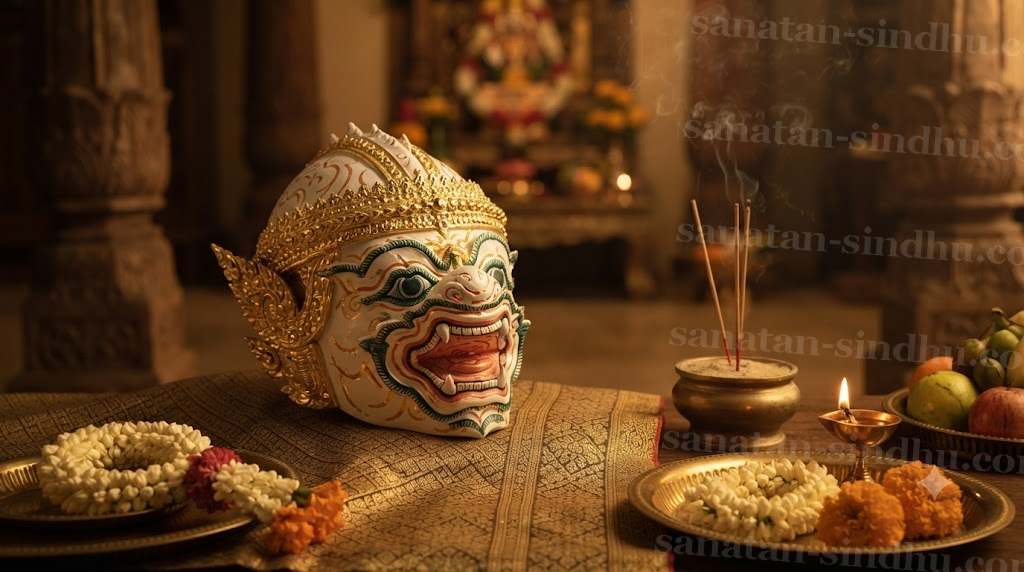
In Thai Khon, the demon and monkey characters wear lacquered masks treated as genuinely sacred objects. Before a performance the company performs Wai Kru, the reverencing of the teacher, addressing the masks and asking permission to channel Hanumān or Rāvaṇa through them.
The costumes are heavy silk worked with real gold thread, so that the stage becomes a shimmering heavenly court rather than a theatre set.
The unbroken thread
From the silent empty thrones of Bali, to the rhythmic human chant of the Kecak, to the gold-tipped fingers of a Thai court dancer, Sanātana Dharma across the oceans is not dead history.
It survived because it stayed fluid: it let the islands of Indonesia and the valleys of Siam breathe their own spirit into the stories of Rāma, Lakṣmaṇa and Śiva. For the stones and shadows of the same world, see Shadows of the Rāmāyaṇa and stones of the gods.