
The morning after the lamps
Govardhana Pūjā is commonly kept on Kārttika śukla pratipadā, the first lunar day of the bright fortnight after Dīpāvalī's new moon. In the familiar five-day sequence it is the day after Diwali; Bhai Dooj follows on Dvitīyā. These are lunar days, however, not fixed twenty-four-hour intervals: local pañcāṅga rules can place the observances differently on the civil calendar.
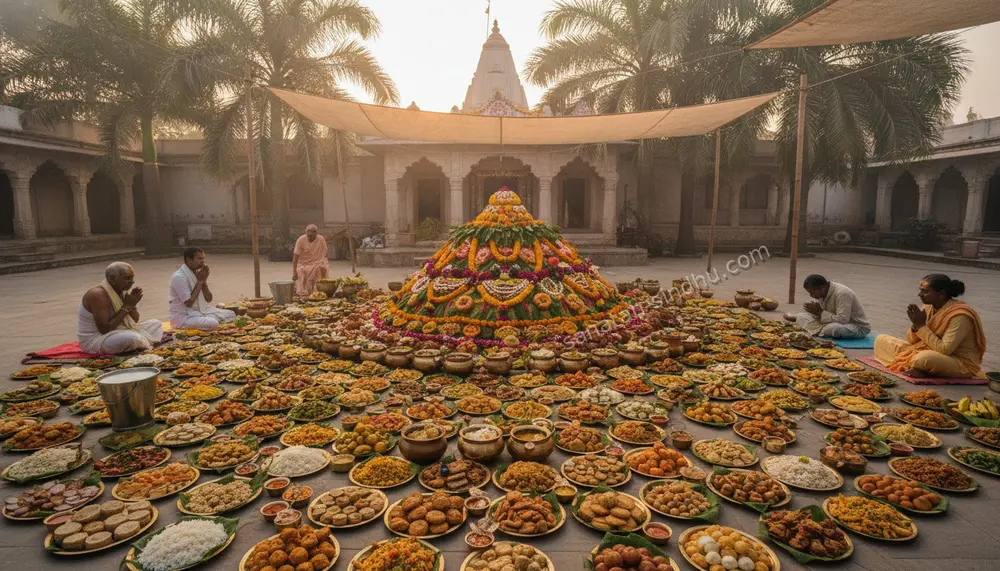
The change of scene is striking. After a night of lamps, families and temples turn toward food, cattle and a hill. In many homes a small Govardhana is shaped from cow dung and decorated with flowers; in temples a great array of dishes becomes Annakūṭa, a 'heap of food'. At the heart of both is a story in which Kṛṣṇa asks his community to look closely at what sustains it.
Govardhana is not an imaginary mountain inserted into a moral tale. It is a place of pilgrimage in Braj, near Mathurā, walked around and loved as Girirāj, the king of hills. The Purāṇic narrative and the living landscape meet there, although devotional belief and historical verification remain different kinds of claim.
What sustains the cowherds?
Vraja is preparing a sacrifice to Indra when the young Kṛṣṇa questions Nanda, his father. Why this offering? What does it accomplish? In Bhāgavata Purāṇa 10.24, Nanda explains that rain nourishes the land and makes life possible. Kṛṣṇa answers with a deliberately unsettling argument about work, livelihood and the particular world of the cowherds.
They live by their cattle, forests and hills. Rather than simply repeat the inherited ceremony, he asks them to honour the cows, the brāhmaṇas and Govardhana with the very provisions gathered for Indra:
तस्माद् गवां ब्राह्मणानामद्रेश्चारभ्यतां मखः। य इन्द्रयागसम्भारास्तैरयं साध्यतां मखः॥
tasmād gavāṃ brāhmaṇānām adreś cārabhyatāṃ makhaḥ | ya indrayāgasambhārās tair ayaṃ sādhyatāṃ makhaḥ ||
Therefore, let a sacrifice for the cows, the brāhmaṇas and the hill begin. With the provisions gathered for Indra's sacrifice, let this sacrifice be carried out.
This is not simply a rejection of ritual in favour of a modern idea of nature worship. Kṛṣṇa proposes another makha, a sacrifice, and the Bhāgavata's larger story reveals his divine purpose. Yet the question is wonderfully concrete: can reverence notice the grass, milk, shelter and labour on which an ordinary household depends? That is a reading of the episode, not a separate command in the verse.
A mountain of food
Annakūṭa gives that gratitude a visible form. Kṛṣṇa's instructions are not austere: they call for a generous meal.
पच्यन्तां विविधाः पाकाः सूपान्ताः पायसादयः। संयावापूपशष्कुल्यः सर्वदोहश्च गृह्यताम्॥
pacyantāṃ vividhāḥ pākāḥ sūpāntāḥ pāyasādayaḥ | saṃyāvāpūpaśaṣkulyaḥ sarvadohaś ca gṛhyatām ||
Let many kinds of dishes be cooked, including soups and sweet rice; let there be saṃyāva, cakes and śaṣkulīs, and let all the milk produce be gathered.
The food names belong to an older culinary world; their exact recipes should not be assumed to match today's sweets. The verses that follow include feeding others, giving grass to the cows and circling the hill. The offering is not only a display for the eye: it belongs to the whole community.
Later temple practice makes this abundance into elaborate Annakūṭ offerings. Many temples celebrate with chappan bhog, fifty-six preparations; others offer different numbers and arrangements. The word Annakūṭ and a fixed count of fifty-six do not occur in the quoted verse. They belong to the festival's ritual and devotional development, not to a recipe list prescribed here.
When the rain becomes a threat
Indra, honoured as the giver of rain, takes the change as an affront. In Bhāgavata 10.25 he sends the destructive Saṃvartaka clouds against Vraja. What had nourished life now threatens it. The cowherds and cattle, battered by wind, cold and rain, turn to Kṛṣṇa.
Before lifting the hill, Kṛṣṇa states his purpose:
तस्मान्मच्छरणं गोष्ठं मन्नाथं मत्परिग्रहम्। गोपाये स्वात्मयोगेन सोऽयं मे व्रत आहितः॥
tasmān maccharaṇaṃ goṣṭhaṃ mannāthaṃ matparigraham | gopāye svātmayogena so 'yaṃ me vrata āhitaḥ ||
Therefore, by my own power I shall protect the cowherd community, which has taken shelter in me, has me as its lord and is under my care. I have undertaken this vow.
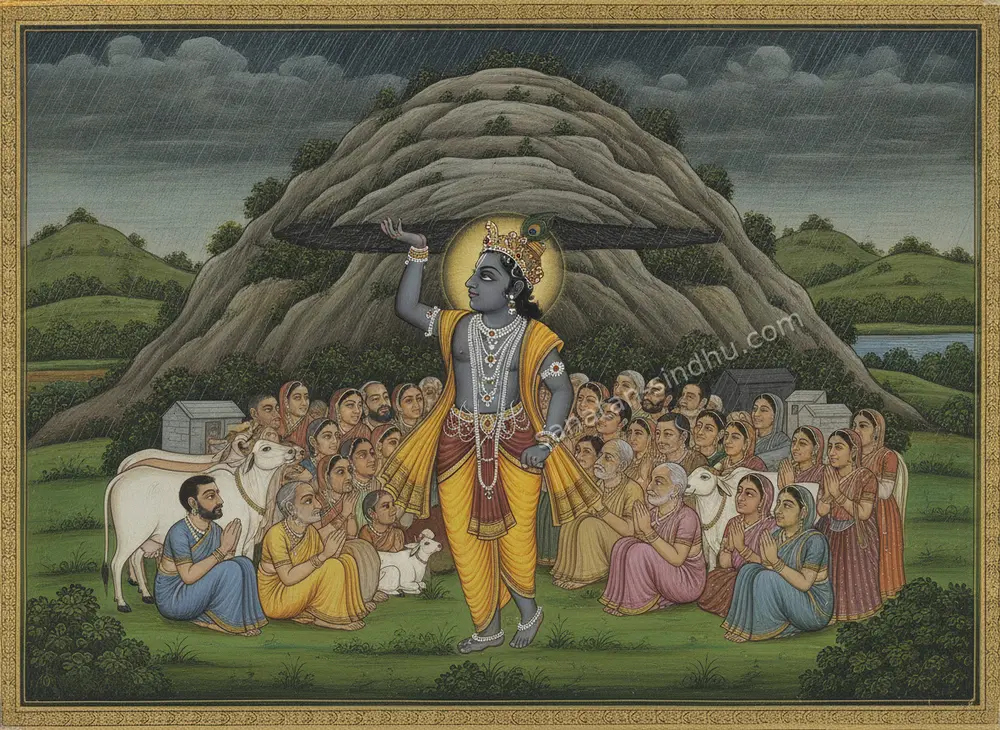
He raises Govardhana and invites the people beneath it with their cattle and belongings. The text describes seven days of shelter. When the storm ends, the community emerges and Kṛṣṇa sets the hill down. Traditional images show the hill balanced on his little finger; the immediate lifting verse, 10.25.19, speaks of one hand. The familiar painted detail should not be mistaken for the exact wording of that verse.
The mountain has become a roof. Divine power is shown not through a larger storm, but through the safety of frightened families and animals.
Indra's pride and Kṛṣṇa's care
Govinda is the name that comes into focus after the storm. In Bhāgavata 10.27, Indra approaches Kṛṣṇa, acknowledges his arrogance and asks forgiveness. Surabhi, the divine cow, honours Kṛṣṇa, and the chapter describes his consecration as Govinda.
For Vaiṣṇava readers, the episode reveals that even a powerful deva is not beyond pride, and that Kṛṣṇa is the refuge of those entrusted to him. It is not a licence to mock Indra or dismiss every inherited observance: the narrative includes his repentance rather than ending with his humiliation.
A further ethical reading is possible. Authority is tested by what it protects. The rain-giver who endangers a village has forgotten the purpose of his power; the child who shelters it fulfils that purpose. The essay offers this as reflection on the story, not as a quotation from scripture.
One Pratipadā, many observances
Girirāj Pūjā in Braj brings the hill itself into the centre of devotion. Pilgrims perform parikramā, walking around Govardhana; households worship small representations of it; temples offer food that is later shared as prasāda. The details vary by family, temple and Vaiṣṇava lineage.
The same post-Diwali Pratipadā has other identities. In Maharashtra and parts of the south it is associated with Bali Pratipadā or Balipāḍyami, remembering King Bali. In Gujarat it is also associated with the new year. These observances share a place in the festival season, but the Bali narrative is not the Govardhana narrative, and a Gujarati new-year greeting is not itself a Govardhana rite.
Holding these distinctions makes the festival richer, not thinner. One lunar morning can honour a hill, remember a generous king and open a new year without requiring every family to tell the same story.
Sources
- Primary narrative and quotations: Bhāgavata Purāṇa 10.24–25; quoted verses 10.24.25, 10.24.26 and 10.25.18, checked against the Sanskrit and transliteration in the Bhaktivedanta Book Trust's online Śrīmad-Bhāgavatam on Vedabase. English glosses here are fresh, close renderings, not quotations of its published translation. 10.24.25 · 10.24.26 · 10.25.18.
- Lifting and reconciliation: Bhāgavata 10.25.19 and chapter 10.27, in the same online edition. Chapter 25 · Chapter 27.
- Present-day calendar: Drik Panchang's Govardhan Puja guide, used for the Pratipadā observance, not as a primary scripture.
- Living practice: household Govardhana forms, Braj pilgrimage, Annakūṭ and chappan bhog are described as regional and temple traditions; the quoted verses do not fix fifty-six dishes.
- Limits: no printed critical edition was collated for this essay. The Bhāgavata passages supply the story and food offering, not a complete modern festival calendar or ritual manual.