
The second day after Diwali
Bhai Dooj, also called Bhaiya Dooj, falls on Kārttika śukla dvitīyā, the second lunar day of the bright fortnight following Dīpāvalī's new moon. In the familiar five-day celebration it comes after Govardhan Puja and brings the season to a close with a visit, a blessing and a meal. Local lunar-day timings can shift the civil dates; 'second day' names the tithi, not an inflexible forty-eight-hour interval after Lakṣmī Pūjā.
The name is intimate rather than grand. Bhai is brother; dooj is the second lunar day. A sister welcomes her brother, marks his forehead and prays for his well-being. He offers gifts, affection and his own wishes for her happiness. The centre of the day is not the price of the gift, but the act of turning up.
Its older devotional name is Yama Dvitīyā. That name leads to a surprising guest: the lord of death, who is also somebody's brother.
When Yama comes home
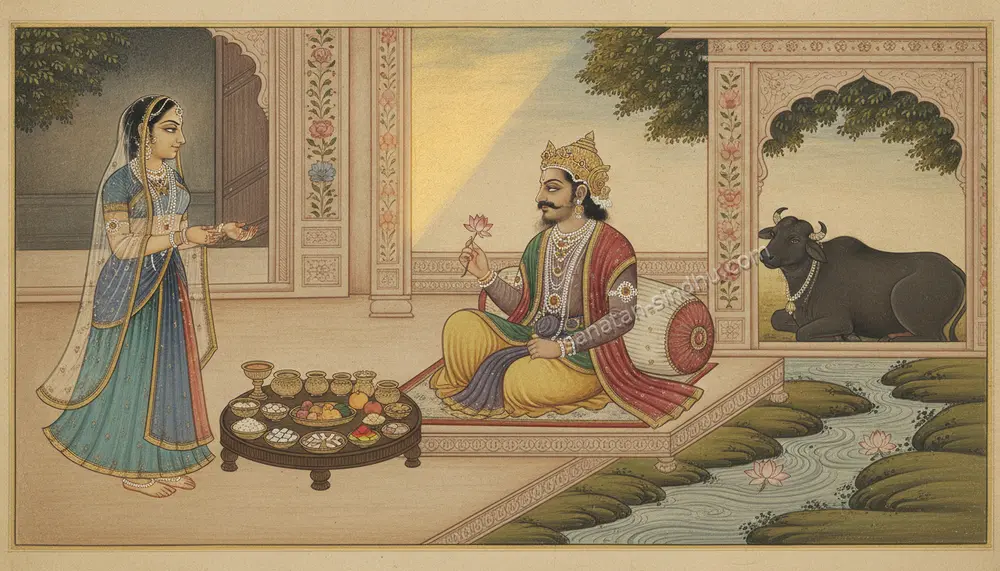
Yamunā keeps asking Yama to come and eat at her house. He keeps postponing the visit: today, tomorrow, the day after. His duties leave him little leisure. This wonderfully recognisable family situation appears in the Skanda Purāṇa's Vaiṣṇava-khaṇḍa, Kārttikamāsa-māhātmya, chapter 11.
At last, on Dvitīyā, he comes with his attendants. Yamunā welcomes him, prepares his bath, gives him garments and ornaments, and cooks a generous meal. The chapter names the day directly:
कार्तिके शुक्लपक्षे तु द्वितीयायां तु शौनक। यमो यमुनया पूर्वं भोजितः स्वगृहेऽर्चितः॥
kārtike śuklapakṣe tu dvitīyāyāṃ tu śaunaka | yamo yamunayā pūrvaṃ bhojitaḥ svagṛhe 'rcitaḥ ||
O Śaunaka, on the second lunar day of Kārttika's bright fortnight, Yama was formerly fed by Yamunā and honoured in her own home.
After eating, Yama honours his sister in return and asks her to choose a boon. She asks him to visit every year and asks happiness for those who eat from their sisters' hands on this day. The narrative extends her compassion beyond her own home: she asks that those suffering in hell be released that day.
The text's promises of release from death and suffering belong to the devotional language of the māhātmya, a work praising the sacred observance. They are not a medical guarantee of longevity or a promise that performing a rite prevents bereavement.
The sister is not only the host
Satkāra, honouring someone, runs in both directions. The Skanda chapter does not merely ask a sister to serve a brother. It instructs the visiting brother to greet her respectfully, and its ritual speech has him bow to her. After the meal he honours her with clothes and ornaments; an elder sister gives him her blessings.
The chapter also preserves a striking detail: in verses 16–18, the sister's invitation asks him to eat at her house for her longevity. Later passages praise the good that comes to the visiting brother. The meal therefore should not be reduced to a one-way arrangement in which only his life matters. Both are recipients of care.
This does not make a traditional household text identical to a modern statement of equality. It does show that the source gives the sister dignity, a voice and a claim upon her brother's attention. Yama's authority outside the home does not exempt him from answering her invitation.
An older prayer for siblings
Saumanasya, concord of hearts, is the theme of Atharvaveda 3.30. Long before the festival's familiar household forms, the hymn speaks of peace within a family:
मा भ्राता भ्रातरं द्विक्षन्मा स्वसारमुत स्वसा। सम्यञ्चः सव्रता भूत्वा वाचं वदत भद्रया॥
mā bhrātā bhrātaraṃ dvikṣan mā svasāram uta svasā | samyañcaḥ savratā bhūtvā vācaṃ vadata bhadrayā ||
Let no brother hate a brother, nor a sister a sister. United, of one accord, speak words of goodwill.
The verse mentions neither Bhai Dooj nor Yama Dvitīyā. It is offered here as an older ethical companion, not proof that the festival itself is Vedic. Its demand is harder than exchanging sweets: speak kindly, refuse hatred, and seek a shared purpose.
A family can keep a festival perfectly and still fail this prayer. Conversely, a sincere conversation, an apology or a renewed visit can carry its spirit even when distance makes the usual ceremony impossible.
Tilak, food and the work of care
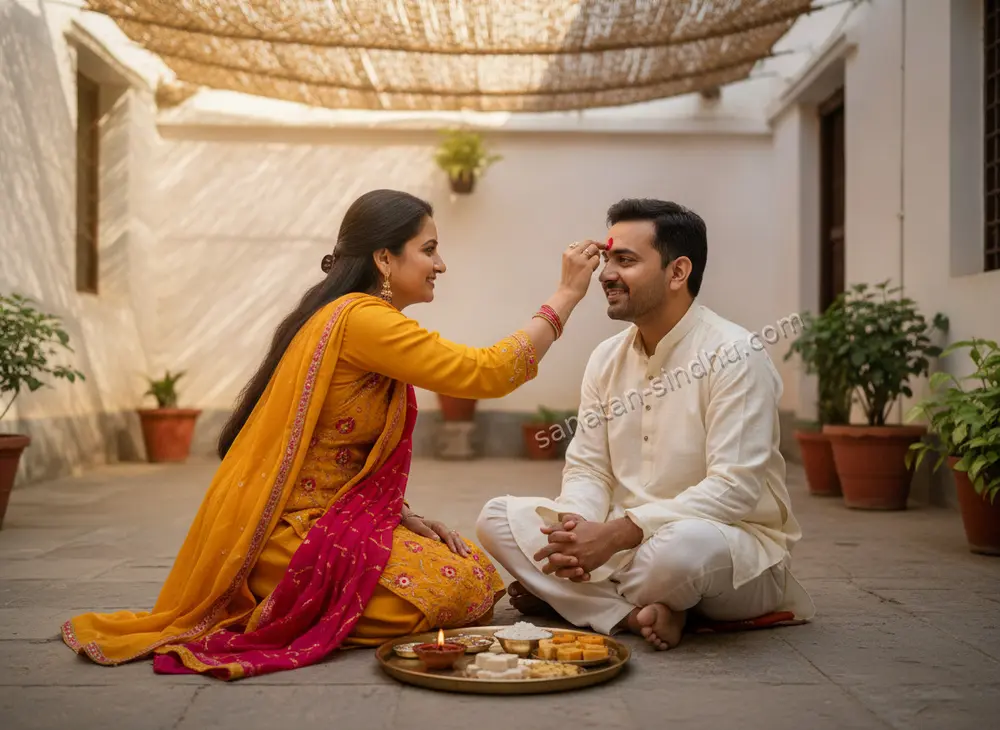
Tilaka is the visible sign most people recognise. A sister prepares a tray with a lamp, rice, a forehead-marking substance and sweets; she applies the mark, offers ārati according to her family's practice and prays for her brother. The meal and the exchange of gifts follow. Ingredients, sequence and prayers differ across regions.
The checked Skanda chapter supports the sister's meal, hospitality and reciprocal honour. It does not establish every present-day tilak pattern, ingredient or family mantra as an unchanged ancient prescription. Those belong to living practice and should be named that way.
Bhai Dooj is also not simply Rakṣā Bandhan moved to another month. Rakṣā Bandhan is associated with Śrāvaṇa's full moon and the protective thread; Bhai Dooj with Kārttika's Dvitīyā, the forehead mark and the sister's welcome. Their emotional worlds overlap, but their calendars and central rites differ.
Today many households extend the celebration to cousins, chosen siblings and family members who cannot travel. Those are contemporary ways of keeping affection alive, not rules claimed here from the Purāṇa. Care need not become an obligation to spend beyond one's means or to ignore a painful or unsafe relationship.
Many names for a homecoming
Bhaiya Dooj in the Hindi-speaking north is one name among several.
- Bengal: Bhāi Phoṇṭā, commonly written Bhai Phonta, centres on the sister's forehead mark and her wishes for her brother's well-being.
- Maharashtra and Goa: Bhāūbīj brings the sibling visit into the closing days of the Diwali celebration.
- Nepal: Bhai Tika concludes Tihar with elaborate sibling honours, often including a multicoloured tika and flower garlands. Its local calendrical rules and ritual details should be followed rather than assumed identical to every Indian observance.
- The Yamunā region: Yama Dvitīyā also has a river-pilgrimage dimension. The Skanda chapter associates bathing in Yamunā with the observance; families also remember her welcome of Yama at home.
These names do not erase one another. The same bond can be expressed through a mark, a garland, a shared meal or a journey to the river. What remains recognisable is the wish that a loved one's life should go well.
A return that matters
Yama is usually imagined at the boundary of life. Bhai Dooj brings him across a different threshold: his sister's doorway. He arrives not only as a judge, but as a guest who can be fed, welcomed and loved.
The story does not deny death. It places relationship beside it. Yamunā's affection becomes a prayer for happiness, release from suffering and the chance to meet again.
After Dīpāvalī's lamps and Govardhana's shelter, this is a fitting close to the season: not a grand victory, but someone making time to come home. The tilak may fade; the work of keeping the bond alive continues.
Sources
- Festival narrative: Skanda Purāṇa, Vaiṣṇava-khaṇḍa, Kārttikamāsa-māhātmya, chapter 11, 'The Efficacy of Yamadvitīyā'. The date and meal are in 11.31; reciprocal honour in 11.15–24; the extended Yama–Yamunā visit and boon in 11.42–53. The Sanskrit quotation was checked against the online Sanskrit witness at 2.4.11.31, and the narrative independently corroborated in G. V. Tagare's English translation reproduced on Wisdomlib, where verses 31–32 are grouped. Numbering is specific to this arrangement of the text.
- Older ethical passage: Atharvaveda, Śaunaka recension 3.30.3, checked against the TITUS Śaunaka text; Vedic accents omitted in the display. The English gloss is a fresh rendering. This is a thematic parallel, not a festival-origin claim.
- Living practice: tilak, ārati, regional gift customs, Bhai Phonta, Bhāūbīj and Nepal's Bhai Tika are presented as household and regional traditions, not as details proved by the two quoted verses.
- Edition and dating limits: the Skanda Purāṇa is a layered textual collection. No critical edition was collated, and a secure pre-sixteenth-century date for this particular Kārttika chapter has not been established here. It is cited as the received Purāṇic account, not as a securely dated early witness or proof of the festival's earliest origin. No unverified Bhaviṣya or Padma Purāṇa attribution is added.