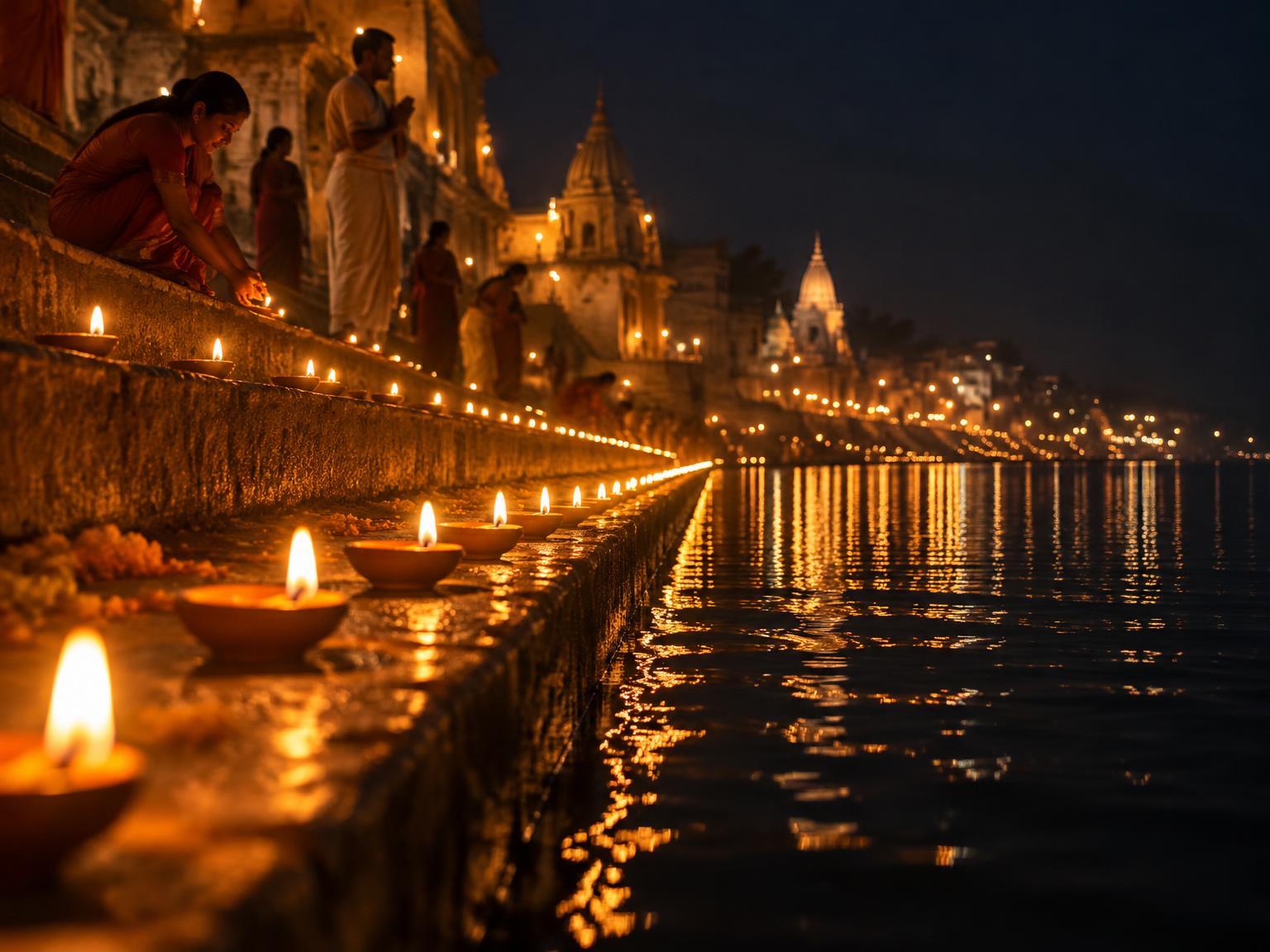
A row of lamps
Dīpāvalī is two plain Sanskrit words joined together: dīpa, a lamp, and āvali, a row or line. The name describes what people do, not a single story. That matters, because Dīpāvalī falls on the amāvāsyā — the new-moon night — of the month of Kārttika (Āśvina in the amānta calendar), the darkest night of the autumn. The festival answers that darkness with the simplest thing a household owns: a clay lamp with oil and a cotton wick.
Across India the same night carries different meanings. In much of the north it remembers Rāma's return to Ayodhyā; in the south the day before remembers Kṛṣṇa's victory over Narakāsura; in Bengal the same night is Kālī Pūjā; Jains mark Mahāvīra's nirvāṇa; Sikhs mark Bandi Chhor Divas. This essay looks first at the ideas the oldest texts give us, then at the stories, and keeps the differences visible.
From darkness to light
The Vedic texts do not describe Dīpāvalī. What they give is the idea the festival later made visible. The best-known form of it is a three-line prayer from the Bṛhadāraṇyaka Upaniṣad:
असतो मा सद्गमय । तमसो मा ज्योतिर्गमय । मृत्योर्मा अमृतं गमय ॥
asato mā sad gamaya | tamaso mā jyotir gamaya | mṛtyor mā amṛtaṃ gamaya ||
Lead me from the unreal to the real; lead me from darkness to light; lead me from death to immortality.
The Upaniṣad itself explains the lines: the unreal is death, the real is immortality; darkness is death, light is immortality. Light here is not decoration — it stands for knowledge and for what does not die.
The Kaṭha Upaniṣad goes further and says that every light we see is borrowed:
न तत्र सूर्यो भाति न चन्द्रतारकं नेमा विद्युतो भान्ति कुतोऽयमग्निः । तमेव भान्तमनुभाति सर्वं तस्य भासा सर्वमिदं विभाति ॥
na tatra sūryo bhāti na candra-tārakaṃ nemā vidyuto bhānti kuto 'yam agniḥ | tam eva bhāntam anubhāti sarvaṃ tasya bhāsā sarvam idaṃ vibhāti ||
There the sun does not shine, nor the moon and stars, nor these lightnings — how then this fire? Everything shines only after that which shines; by its light all this is lit.
In the Bhagavad Gītā, Kṛṣṇa uses the image of a lamp directly:
तेषामेवानुकम्पार्थमहमज्ञानजं तमः । नाशयाम्यात्मभावस्थो ज्ञानदीपेन भास्वता ॥
teṣām evānukampārtham aham ajñānajaṃ tamaḥ | nāśayāmy ātmabhāvastho jñānadīpena bhāsvatā ||
Out of compassion for them, I, dwelling in their hearts, destroy the darkness born of ignorance with the shining lamp of knowledge.
Read together, these passages explain why a row of small lamps on the darkest night felt right to so many communities: each lamp is a small, repeatable picture of the movement from tamas to jyoti.
Lakṣmī on the new-moon night
For most households the centre of the night is Lakṣmī Pūjā. The oldest hymn to Śrī–Lakṣmī is the Śrī Sūkta, preserved as a khila (supplementary hymn) attached to the Ṛgveda. It opens by asking Agni, the fire, to bring her:
हिरण्यवर्णां हरिणीं सुवर्णरजतस्रजाम् । चन्द्रां हिरण्मयीं लक्ष्मीं जातवेदो म आवह ॥
hiraṇyavarṇāṃ hariṇīṃ suvarṇarajatasrajām | candrāṃ hiraṇmayīṃ lakṣmīṃ jātavedo ma āvaha ||
O Jātavedas (Agni), bring to me Lakṣmī — golden in colour, lovely as a deer, wearing garlands of gold and silver, radiant as the moon, made of gold.
तां म आवह जातवेदो लक्ष्मीमनपगामिनीम् । यस्यां हिरण्यं विन्देयं गामश्वं पुरुषानहम् ॥
tāṃ ma āvaha jātavedo lakṣmīm anapagāminīm | yasyāṃ hiraṇyaṃ vindeyaṃ gām aśvaṃ puruṣān aham ||
Bring to me, O Jātavedas, that Lakṣmī who does not leave — through whom I may gain gold, cattle, horses and people.
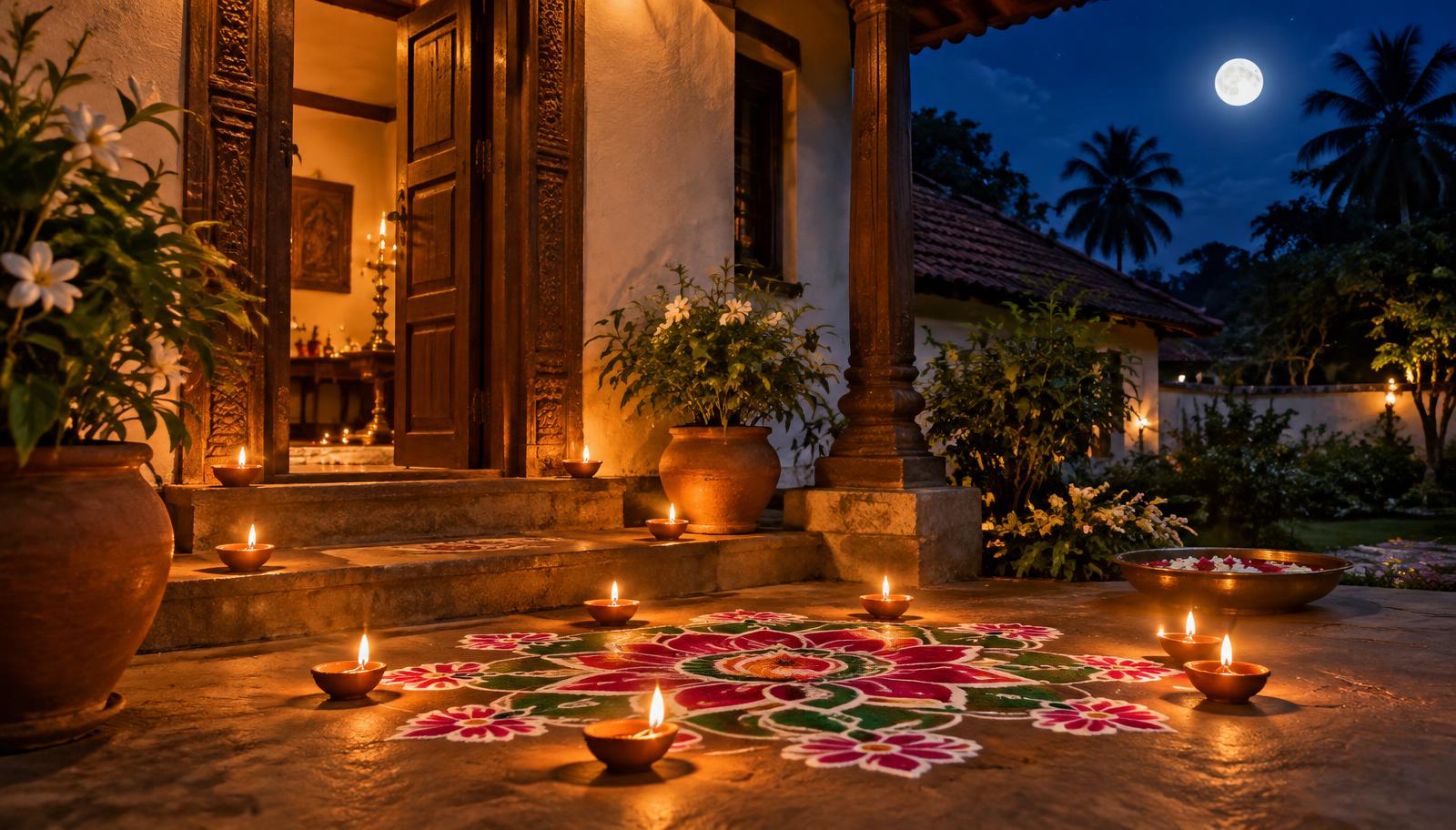
Two details are worth noticing. The goddess is invited through fire — the same element as the household lamp. And the prayer asks for a Lakṣmī who is anapagāminī, 'one who does not go away': prosperity that stays, not a passing windfall. That is why homes are cleaned, doors are left open and lamps are kept burning through the night.
The Śrī Sūkta does not name Kārttika or the new moon. The rules that fix Lakṣmī Pūjā to this particular night come from later Purāṇic and ritual-digest (nibandha) literature, and these differ by region. We have not yet checked those passages against a critical edition, so we do not quote verse numbers for them here.
Many stories, one night
Dīpāvalī is usually kept as five days, and each day has gathered its own story:
- Dhanteras (Dhana Trayodaśī) — new utensils or metal are bought, and in many homes a lamp is set out for Yama.
- Naraka Caturdaśī — remembers Kṛṣṇa (with Satyabhāmā, in many tellings) defeating Narakāsura of Prāgjyotiṣa and freeing the women he held captive. The Bhāgavata Purāṇa tells the battle in Skandha 10, chapter 59.
- Amāvāsyā — Lakṣmī Pūjā; in Bengal and Assam, Kālī Pūjā on the same night.
- Bali Pratipadā / Govardhana Pūjā — remembers King Bali, whom Vāmana sent to the underworld but blessed for his generosity (Bhāgavata Purāṇa, Skandha 8, chapters 18–23), and Kṛṣṇa lifting Govardhana.
- Bhāī Dūj (Yama Dvitīyā) — remembers Yamunā welcoming her brother Yama; sisters pray for their brothers.
The most popular story — Ayodhyā lighting lamps for Rāma's return — needs an honest note. Vālmīki's Rāmāyaṇa describes the return and the joyful coronation in the Yuddha Kāṇḍa, with the city decorated and the people celebrating. It does not, as far as we have checked, describe a row of lamps or tie the return to Kārttika amāvāsyā. The link between Rāma's homecoming and Dīpāvalī belongs to later regional and devotional tradition, which is a living part of the festival — but it should be called that, not attributed to Vālmīki.
Where traditions differ
Jain tradition: For Jains, Dīpāvalī marks the nirvāṇa of Mahāvīra at Pāvāpurī on this new-moon night. The Kalpasūtra records that the assembled kings lit lamps, saying that since the light of knowledge had gone, they would make an illumination of material light (Kalpasūtra, Life of Mahāvīra, §§127–128 in Hermann Jacobi's 1884 translation). Jains do not treat the night as a Lakṣmī festival in the same way, and they do not accept Vedic authority — this is a distinct tradition sharing a date, not a version of the Hindu story.
Sikh tradition: Sikhs observe Bandi Chhor Divas, remembering Guru Hargobind's release from Gwalior Fort, and the Harmandir Sahib in Amritsar is lit. This is a historical remembrance from the Sikh tradition; it is not drawn from the Guru Granth Sahib and does not depend on the Purāṇic stories.
Śākta Bengal: The same night is given to Kālī rather than Lakṣmī. The fierce mother who removes fear and the gentle mother who brings plenty are worshipped on the same date in neighbouring regions — a reminder that one festival can hold quite different theologies.
None of these is the 'real' Dīpāvalī. They share a night and a lamp; the meaning each community gives it is its own.
Sources and caveats
- Primary scripture: Bṛhadāraṇyaka Upaniṣad 1.3.28; Kaṭha Upaniṣad 2.2.15; Bhagavad Gītā 10.11; Śrī Sūkta 1–2 (Ṛgveda Khila 2.6); Bhāgavata Purāṇa 8.18–23 and 10.59; Vālmīki Rāmāyaṇa, Yuddha Kāṇḍa (return and coronation).
- Jain source: Kalpasūtra, Life of Mahāvīra, §§127–128, tr. Hermann Jacobi, Jaina Sūtras Part I (Sacred Books of the East 22, 1884).
- Not quoted: the Purāṇic and nibandha passages that fix Lakṣmī Pūjā to Kārttika amāvāsyā, and the Skanda and Padma Purāṇa passages on lamp-offering (dīpa-dāna) in Kārttika — they exist in several recensions and we have not yet checked verse numbers against a critical edition.
- Calendar note: months are named in the pūrṇimānta system used in most of north India; in the amānta system the same night falls at the end of Āśvina.