Nine forms, one goddess
The Devī Māhātmya — the core of the Mārkaṇḍeya Purāṇa, recited today as the Durgā Saptaśatī or Caṇḍī — frames itself as a story told to two grieving men. King Suratha, driven from his kingdom, and Samādhi, a merchant driven from his own house, meet in a forest and are led to the sage Medhas, who tells them of the goddess's three great victories: over Madhu and Kaiṭabha, over the buffalo-demon Mahiṣāsura, and over the generals Śumbha and Niśumbha. It is this telling — a story offered to two ordinary men in distress, not a private revelation to ascetics — that gives Navrātri its shape as a festival anyone can keep.
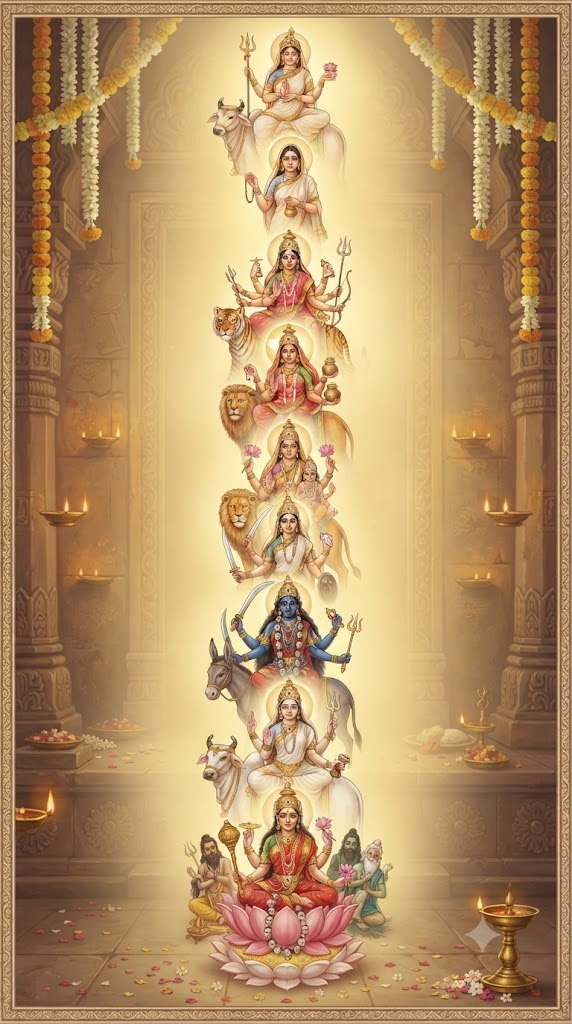
Alongside the Māhātmya sits a shorter text recited with it, the Devī Kavacham — the goddess's "armour" — in which Brahmā names nine forms of the goddess for Mārkaṇḍeya: Śailaputrī, Brahmacāriṇī, Candraghaṇṭā, Kūṣmāṇḍā, Skandamātā, Kātyāyanī, Kālarātri, Mahāgaurī and Siddhidātrī. In festival practice today, one form is invoked on each of Navrātri's nine nights, in this order — a convention widely followed across North and Central India, though it is the names that come from the Devī Kavacham, not necessarily a verse-by-verse nine-day calendar spelled out in the text itself. That distinction is worth keeping honest: the Navadurgā are textually named; their one-per-night assignment is how the living tradition has organised that naming into nine actual nights of worship.
Twice a year, revealed
Most of India keeps Navrātri twice a year — Chaitra Navrātri in spring and Śarad Navrātri in autumn — and this essay follows that framing. The fuller calendar is slightly larger: Hindu tradition actually counts four Navrātris, adding a Māgha and an Āṣāḍha occurrence. The two spring-and-autumn observances are called Prakaṭ — revealed, public, for everyone — while Māgha and Āṣāḍha are Gupt — hidden, kept mostly by tāntric practitioners in a deliberately quiet, non-public setting. Naming the fuller calendar here is not a correction of the "twice a year" framing so much as a footnote to it: for the overwhelming majority of households, Navrātri genuinely is a twice-yearly observance, and the Gupt occasions are a separate, narrower practice this essay doesn't otherwise cover.
An untimely awakening — why autumn, not spring
If both Chaitra and Śarad are Prakaṭ, why has autumn become the one nearly everyone means when they say "Navrātri"? Tradition answers with a story about Rāma. Before his battle with Rāvaṇa, Rāma is said to have invoked the goddess for victory — but the goddess's natural season of worship was spring, and Rāma needed her in autumn. His invocation is remembered as Akāl Bodhan — the untimely awakening — waking the goddess out of season because the moment demanded it, not because the calendar offered it. Autumn falls within Dakṣiṇāyana, the sun's southward course, traditionally read as a time when the gods are in their night; invoking the goddess then is itself read as the exceptional act that Akāl Bodhan names.
The Devī Māhātmya's own frame story supplies the other half of the reason: Suratha and Samādhi's worship, narrated to them by Medhas, is set in autumn. Later texts — the Kālikā Purāṇa, the Bṛhaddharma Purāṇa, and the Devī Purāṇa — describe the autumn worship in the fuller detail that Bengal's Durgā Pūjā still follows, and name the tenth day Vijayā Daśamī — the day of victory — shared with the North Indian Dussehra that closes the Rāma Līlā on the same date. Two different stories — Rāma's war and Durgā's — converge on the same day of the year without either needing to borrow from the other.
One festival, many names
The nine nights are kept differently enough, region to region, that a visitor moving from Kolkata to Chennai to Ahmedabad during Navrātri could be forgiven for not immediately recognising the same festival.
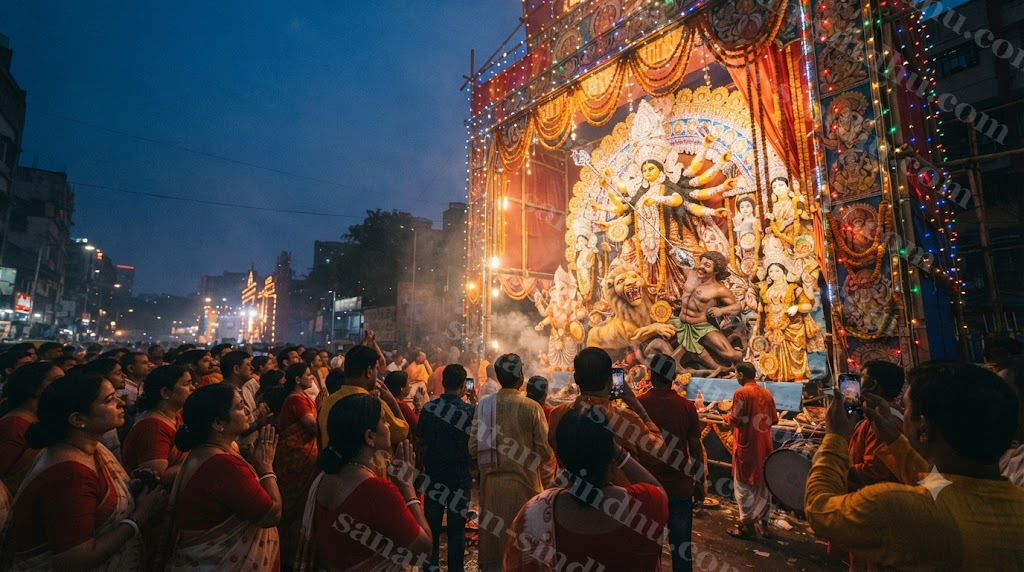
Bengal's Durgā Pūjā is the most publicly monumental form: elaborate clay mūrtis of Durgā slaying Mahiṣāsura, housed in temporary paṇḍals built anew each year by local committees, worshipped for five days and then immersed in a river or the sea on Daśamī — the goddess returning to the waters she is understood to have come from. Kolkata's Durgā Pūjā is now recognised by UNESCO as Intangible Cultural Heritage, though its detailed household ritual form is far older, laid out in the Bṛhaddharma and Kālikā Purāṇas described above.
Tamil Nadu's Golu (Bommai Koḷu — "doll arrangement") takes a different form entirely: households build stepped, odd-numbered tiers and fill them with dolls and figurines — gods, everyday scenes, whole miniature stories — assembled by the women of the house and visited by neighbours over the nine nights. The custom is traceable to the Vijayanagara court of the fourteenth century, where royal doll displays doubled as a way of telling stories and teaching them to children — a devotional practice built from the practical work of narration, not from a Puranic prescription for how a doll shelf should look.
Gujarat's Garba turns Navrātri outward into the street: circular community dance around a central lamp or an image of Ambā Mātā — an aspect of Durgā — performed nightly, often followed by Dāṇḍiyā Rās with sticks. Garba itself is thought to derive from garbha, womb — the dance built, etymologically, around fertility and the feminine as source, not only as warrior.
North India's Kanyā Pūjā closes the circle back to where this essay began. On Aṣṭamī or Navamī, a household invites young unmarried girls — traditionally nine, one for each of the Navadurgā — and honours them with washed feet, new clothes, and a meal, understanding each girl in that moment to embody a portion of the goddess's own śakti on earth. The nine forms named in the Devī Kavacham, invoked one per night through the festival, arrive at Kanyā Pūjā as nine living children in front of the family performing the rite.
Sources
- Primary scripture. Devī Māhātmya / Durgā Saptaśatī (Mārkaṇḍeya Purāṇa), for the Suratha–Samādhi frame story and the three-victory structure; Devī Kavacham, for the nine Navadurgā names as given by Brahmā to Mārkaṇḍeya; Kālikā Purāṇa, Bṛhaddharma Purāṇa and Devī Purāṇa, for the autumn worship and Vijayā Daśamī, consulted via named secondary summaries rather than critical editions of each Purāṇa directly — the same limitation flagged in this series' first essay, and true here too.
- Itihāsa cross-reference. The Rāma Akāl Bodhan narrative, connecting the Rāmāyaṇa tradition to autumn Navrātri and to Vijayā Daśamī / Dussehra.
- Regional and folk documentation. Golu's Vijayanagara-era court origin; Garba's garbha etymology and its performance history in Gujarati village life; Kanyā Pūjā's nine-girls convention as a living enactment of the Navadurgā; Kolkata Durgā Pūjā's UNESCO Intangible Cultural Heritage recognition — all consulted via general historical and ethnographic sources rather than a single named academic study, flagged here rather than dressed up as more rigorously sourced than it is.
A note on what this essay leaves for the reader to notice rather than stating outright: the nine-form Navadurgā (one goddess theologically, nine names liturgically) and the nine-girl Kanyā Pūjā are the same underlying structure, worked out in text and in a living-room ritual respectively. This essay names both but leaves the reader to make that connection rather than over-explaining it.