Textual stratigraphy and sectarian synthesis
The literary and theological evolution of Hanumān across Hindu scriptures represents a complex synthesis of classical Sanskrit epics, Purāṇic texts, and medieval vernacular literatures. In the earliest stratum, specifically the Vālmīki Rāmāyaṇa (composed circa 3rd century BCE), Hanumān is depicted primarily as a highly intelligent, eloquent, and powerful vānara minister who serves as the prime messenger for the exiled prince Rāma. His extraordinary capabilities are attributed directly to his parentage as the spiritual offspring of Vāyu, the Vedic wind deity.
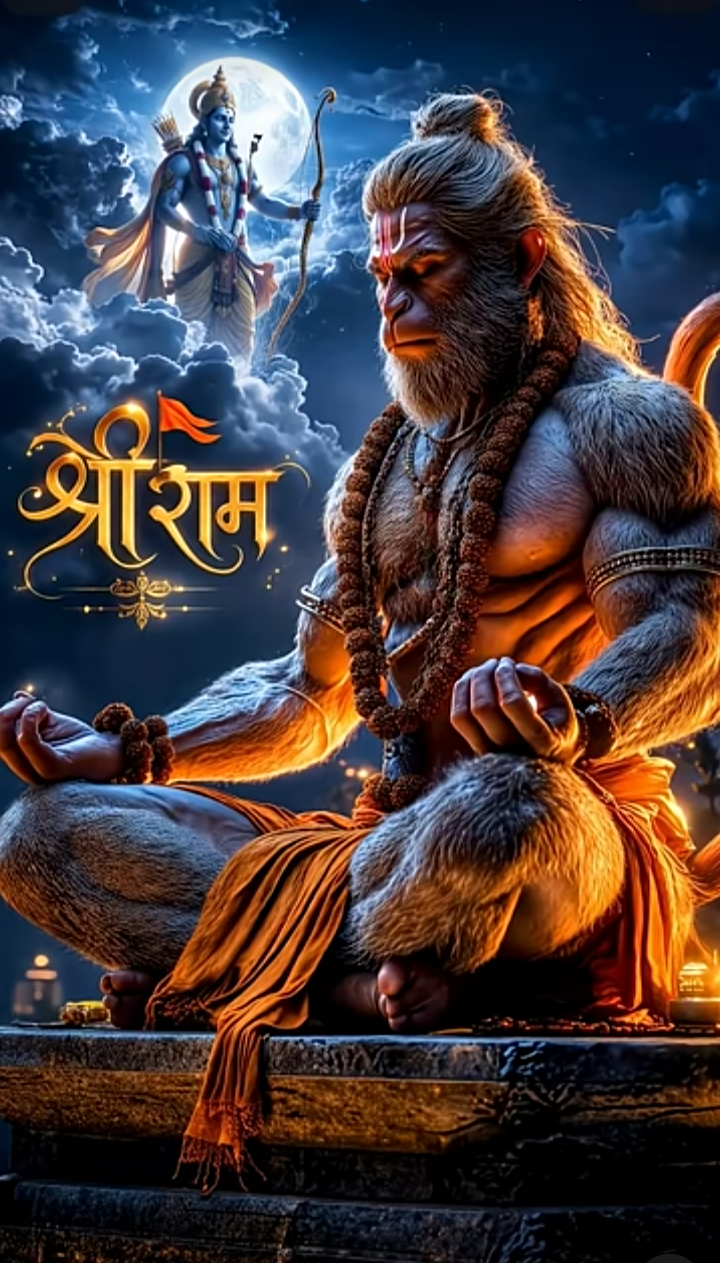
During the medieval period, the expansion of the Bhakti movement precipitated a profound theological development. Later Sanskrit and vernacular texts — including the Śiva Purāṇa, Adhyātma Rāmāyaṇa, Ānanda Rāmāyaṇa, and the 16th-century Rāmcharitmānas by Goswāmī Tulsīdās — revealed deeper dimensions of Hanumān's identity. Hanumān is understood as an incarnation of Lord Śiva, specifically a Rudra avatāra. This synthesis harmonises Śaiva cosmology with Vaiṣṇava devotion: the highest form of Śaiva energy (Rudra-śakti) finds its ultimate expression in absolute service (Dāsa-bhakti) to the Vaiṣṇava divine.
An essential aspect of Indic history is its cyclical and timeless nature. Long before colonial historians sought to fit Sanātana Dharma into a sterile, linear Western timeline, the ancient Rishis understood that spiritual realities transcend rigid dates and geographical limitations. In the Indic mind, Rāma and Hanumān are timeless, universal presences whose stories repeat across infinite cosmic cycles.
Upaniṣadic anchors — Hanumān as the top-tier Vedic scholar
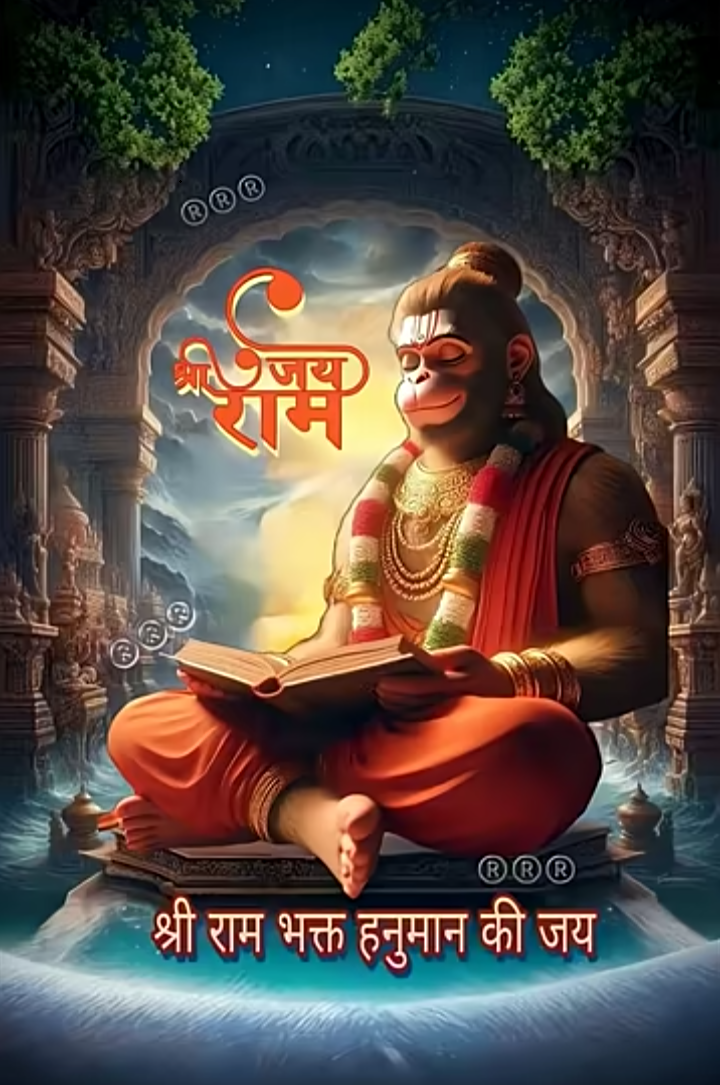
While popular folklore often emphasises Hanumān's physical strength, the Sanskrit scriptures highlight his unmatched mastery over language, grammar, and philosophy. He is revered as a premier Vedic scholar (Vyākaraṇāchārya).
This is beautifully demonstrated in the Muktikā Upaniṣad, where the entire canon of 108 Upaniṣads is introduced through a profound, sacred dialogue between Lord Rāma (the teacher) and Hanumān (the student). When Hanumān inquires about the different forms of liberation (Mukti), Rāma guides him through the study of Vedānta, stating that even a single verse read with devotion leads to ultimate union.
Furthermore, the Rāmarahasya Upaniṣad explains that Lord Rāma is the Brahma Tāraka and expounds upon various mantras and sacred geometric yantras used for His worship, placing Hanumān as a vital protective presence within these mystical configurations.
The Pañchamukhī avatar and the Pātāla Loka rescue
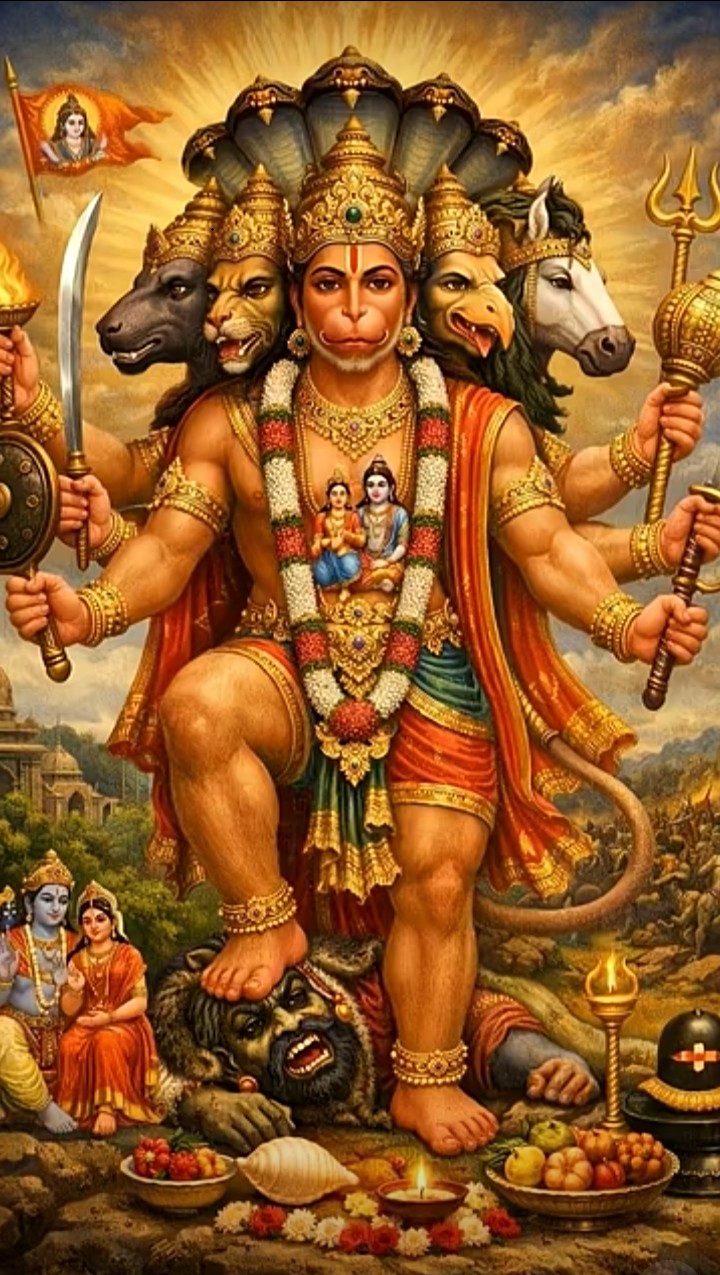
The narrative of the Pañchamukhī (five-faced) form of Hanumān is detailed in late medieval regional texts and Āgamas — most notably the 15th-century Bengali Krittibās Rāmāyaṇa, the Ānanda Rāmāyaṇa, and the highly detailed Parāśara Saṃhitā.
During the war of Laṅkā, Rāvaṇa sought the aid of Mahirāvaṇa (also known as Ahirāvaṇa), the sorcerer-king of Pātāla Loka (the netherworld). Despite Hanumān constructing a protective fortress with his tail around Rāma and Lakṣmaṇa, Mahirāvaṇa used dark magic to put the army to sleep, abducting the princes to Pātāla.
Upon descending into Pātāla Loka to rescue them, Hanumān discovered that Mahirāvaṇa's life-force was bound to five mystical lamps burning in five different directions; the demon could only be slain if all five lamps were extinguished simultaneously. To achieve this, Hanumān manifested his colossal Pañchamukhī form — five distinct heads looking in five directions: Hayagrīva (upward, knowledge and progeny), Hanumān (centre, courage and devotion), Narasiṃha (east, victory and fearlessness), Varāha (north, wealth and planetary balance), and Garuḍa (west, toxin removal). By breathing outward simultaneously from all five faces, He blew out the five lamps, destroyed Mahirāvaṇa's source of power, and rescued the princes.
This narrative serves as the direct scriptural source for the Pañchamukhī Hanumān iconography widely worshipped across India. The liturgical hymn Pañchamukha Hanumat Kavacham, preserved in the Hanumat Rahasyam, is chanted as a protective shield against physical, mental, and spiritual afflictions.
A note on this section's sourcing, added on later review: the Krittivāsī Rāmāyaṇa attribution above is solid — the episode is well documented in that 15th-century Bengali text's Lankā Kāṇḍa. The "Ānanda Rāmāyaṇa" and "Parāśara Saṃhitā" attributions are repeated widely across secondary and devotional sources, but this site has not independently traced either to a specific chapter or verse, and the Parāśara Saṃhitā's authorship-by-the-sage-Parāśara is a traditional naming convention rather than a scholarly-dated claim. There is also a real open question this essay hasn't resolved: whether the five-faced iconographic detail — the specific four additional faces named above — was already part of Krittivāsa's medieval narrative, or was merged into retellings of it later from the separate Pañchamukha Hanumat Kavacham tradition named in the paragraph above, which has its own distinct dating question. Both are treated here as established for readability; a reader checking sources closely should know that distinction is not yet settled. Separately: a different demon also named Mahīrāvaṇa — Rāvaṇa's own elder brother, defeated not by Hanumān but by Sītā in her form as Kālī — appears in the unrelated Adbhuta Rāmāyaṇa tradition; the two are not the same figure despite the shared name, and this site's story of both, told as the two separate episodes they are, is linked here rather than conflated with the account above.
The astrological pact with Śani Dev (Saturn)
The relationship between Hanumān and Śani Dev is detailed in the Skanda Purāṇa and various regional folk Rāmāyaṇas. Rāvaṇa, a master of astrology, had bound all nine celestial planets (Navagrahas) to his throne. Śani Dev was placed face-down in a dark cell to suppress his destructive glance (Śani Dṛṣṭi).
During his search for Sītā, Hanumān discovered Śani Dev in this state and freed him. Out of gratitude, Śani promised that those who worship Hanumān would be protected from the severest hardships of Saturn's transits (Sāḍe Sātī or Śani Ḍhaiyā).
A popular North Indian folk legend describes Śani Dev directly challenging Hanumān's spiritual energy. In response, Hanumān wrapped Śani Dev within his powerful tail and began leaping across mountains, crushing Śani's pride against the rocks. Recognising the futility of confronting Hanumān's pure devotion, Śani begged for mercy. Upon releasing him, Hanumān applied warm mustard oil to Śani's bruised body, immediately alleviating his suffering. Moved by this kindness, Śani established a permanent pact: anyone who worships Hanumān and offers mustard oil, especially on Saturdays, will have the harsh effects of their karmic cycles significantly pacified.
The origin of the sindūr offering
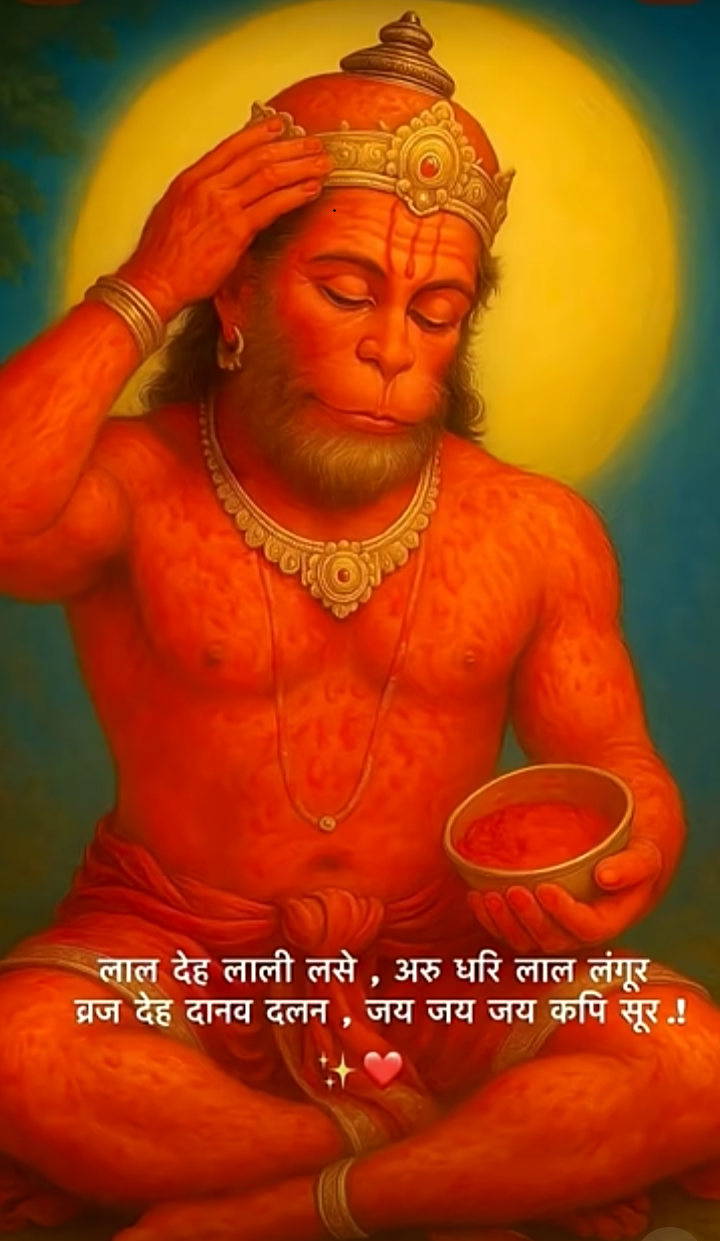
A beloved regional anecdote describes Hanumān entering Sītā's chambers in Ayodhyā and observing her applying a streak of red sindūr (vermillion) to her forehead. Upon inquiring about the purpose of this ritual, Sītā explained that applying vermillion was a symbol of her love and a prayer for the longevity, health, and prosperity of her husband, Lord Rāma.
Hanumān, possessed by a simple yet absolute devotion, reasoned that if a tiny pinch of vermillion on Sītā's forehead could protect Rāma, then smearing his entire body with sindūr would guarantee his Lord's absolute immortality. He proceeded to cover himself completely in orange-red vermillion and presented himself at the royal court. Highly amused and deeply touched by his pure, unadulterated bhakti, Rāma blessed Hanumān, declaring that from that day forward, anyone who offers sindūr to Hanumān will be freed from obstacles and blessed with deep spiritual strength.
The Hanumad Rāmāyaṇa and the humility of devotion
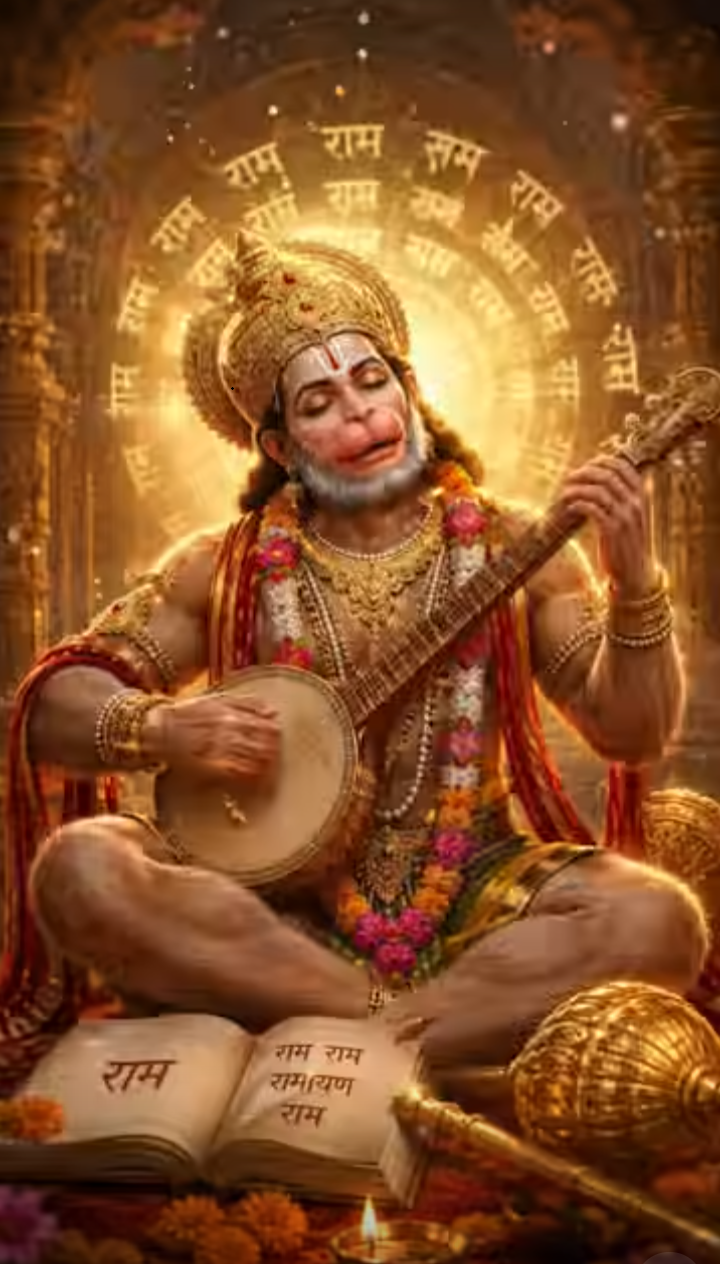
Following the coronation of Rāma in Ayodhyā, Hanumān travelled to the Himalayan peaks (often identified as Kadalī-vana) to perform penance. During his periods of contemplation, he scratched the epic story of Rāma's journey onto seven broad banana leaves using his sharp fingernails. This work became known as the Hanumad Rāmāyaṇa.
Sometime later, Sage Vālmīki travelled to the Himalayas to show Hanumān his own newly completed Sanskrit epic. Upon reading the inscriptions carved by Hanumān, Vālmīki was struck by their sublime poetic beauty, perfect grammar, and emotional depth. He began to weep, realising that his own monumental work would be completely overshadowed by the sheer brilliance of Hanumān's writing.
Seeing the sage's despair, Hanumān immediately picked up the seven banana leaves and threw them into the ocean, letting the waves carry his work away. When a shocked Vālmīki asked why he did so, Hanumān replied that Vālmīki had written his Rāmāyaṇa so that the world would remember Vālmīki, whereas Hanumān had written his solely so that he could remember Rāma. This narrative, preserved in the oral traditions of the Adhyātma and Ānanda Rāmāyaṇa motifs, is the ultimate scriptural demonstration of Niṣkāma Karma — action performed completely free of ego and desire for recognition.
Pre-natal and educational anecdotes
The cosmological stage for Hanumān's birth was set through two major pre-natal events recorded in the Viṣṇu Purāṇa and the Śiva Purāṇa.
Nārada's curse on Viṣṇu. The sage Nārada, infatuated with a princess, prayed to Lord Viṣṇu to grant him Hari-mukha — a term that translates both to the face of Viṣṇu and the face of a monkey. Viṣṇu, acting to preserve the sage's spiritual vows, granted him the face of a monkey. Furious, Nārada cursed Viṣṇu that in a future earthly incarnation he would be completely dependent on monkeys (vānaras) to reclaim his lost wife. Viṣṇu accepted this curse as a divine boon, as it paved the way for Hanumān's birth to assist his Rāma incarnation.
Nandīśvara's curse on Rāvaṇa. When Rāvaṇa travelled to Mount Kailāśa, he mocked Śiva's primary attendant, the bull-deity Nandīśvara, calling him a monkey due to his appearance. Nandīśvara cursed Rāvaṇa, declaring that monkeys resembling his own face would eventually destroy Rāvaṇa's armies, burn his kingdom, and obliterate his pride.
Vālī's metallic missile and Hanumān's earrings. A rare narrative preserved in the regional Bhāvārtha Rāmāyaṇa describes the early rivalry between the vānara king Vālī and the unborn Hanumān. Learning that Añjanā was pregnant with a child destined to possess unparalleled strength, Vālī forged a missile of five heavy metals — gold, silver, copper, iron, and tin — and launched it into her womb while she slept. Protected by the divine energies of Śiva and Vāyu, the unborn Hanumān absorbed the five molten metals into his ears, transforming the missile into two indestructible golden earrings (Kuṇḍalas) and a protective chest shield (Kavacha) with which he was born.
The chasing of Sūrya. When Hanumān sought a spiritual preceptor, he chose Sūrya, the Sun God. Sūrya initially declined, stating that he was constantly in motion. Undeterred, Hanumān used his Mahimā (size-expansion) siddhi. He grew to a colossal size, placed his left foot on the eastern mountain and his right foot on the western mountain, keeping his face directed toward Sūrya's moving chariot, and travelled backward at the exact speed of the Sun's transit. Impressed by this immense discipline, Sūrya accepted him as a student, teaching him the entirety of the four Vedas, the Vedāṅgas, the Upaniṣads, and the various Darśanas.
Metaphysical and cosmological interpretations
The Śaiva-Vaiṣṇava synthesis. During the medieval period, Hinduism experienced significant tension between the worshippers of Śiva (Śaivas) and the worshippers of Viṣṇu (Vaiṣṇavas). The theological revelation of Hanumān acted as a perfect solvent for this divide. By defining Hanumān as a Rudra avatāra (an incarnation of Śiva) who exists solely to serve Rāma (an avatāra of Viṣṇu), the Purāṇic texts established that the highest form of Śaiva energy finds its ultimate expression in absolute service to the Vaiṣṇava divine. This synthesis is elegantly summarised in the Śatarudrīya Saṃhitā of the Śiva Purāṇa, which explains that Śiva took the form of Hanumān because he wished to experience the sweetness of serving his own Lord, Viṣṇu.
The metaphysics of cyclical time. The narrative of Hanumān travelling to Pātāla Loka (or Nāga Loka) to retrieve Rāma's dropped ring, only to find a mountain of identical rings, is a profound representation of Hindu cosmology. Hindu metaphysics views time as entirely cyclical, composed of infinite recurring cosmic days known as Kalpas. Vāsuki's explanation to Hanumān — that in every Tretā Yuga across hundreds of thousands of Kalpas, a Rāma is born, his ring falls through the crack, and a monkey follows it — conveys that death and departure are not historical terminations, but structural transitions within an eternal cosmic loop.
Conclusion — the integration of power and humility
The vast body of Hanumān literature, understood through Sanskrit and regional scriptures, reveals a structured system of theology, cosmology, and psychology. Hanumān transcends his role as a helper to become the ultimate symbol of the integration of power and humility. Through tales such as the humbling of Dvārakā's proud residents, the creation and sacrifice of the Hanumad Rāmāyaṇa, and the cyclical revelation of the ring in Pātāla Loka, these narratives consistently instruct the seeker that true spiritual liberation is found not in the acquisition of power, but in the absolute dissolution of the ego.