The fourteenth day of the dark fortnight
Naraka Caturdaśī falls on the fourteenth lunar day (caturdaśī) of the dark fortnight of Kārttika, as months are counted in the pūrṇimānta calendar of north India (Āśvina in the amānta calendar of the south and west — the same night, named differently). It sits between Dhanteras and the new-moon night of Dīpāvalī, and much of north India simply calls it Choṭī Dīvālī, "little Diwali".
The name is unusual for a festival. Naraka means hell, and it is also the name of an asura king. The day is remembered for his death — and, in the same breath, for a lamp lit to keep away hell itself. This essay follows both threads: the Purāṇic story of Narakāsura, and the much older idea of naraka as a state a person walks into through their own choices.
The son of the earth who became a tyrant
The main telling is in the Bhāgavata Purāṇa, Skandha 10, Chapter 59, with an earlier and shorter version in the Viṣṇu Purāṇa, Book 5, Chapter 29. Naraka, also called Bhauma — "son of Bhūmi, the Earth" — rules from the fortress city of Prāgjyotiṣa, usually placed in present-day Assam. He has grown so powerful that he takes the earrings of Aditi, mother of the gods, and the royal parasol of Indra, and he holds thousands of young women captive in his palace.
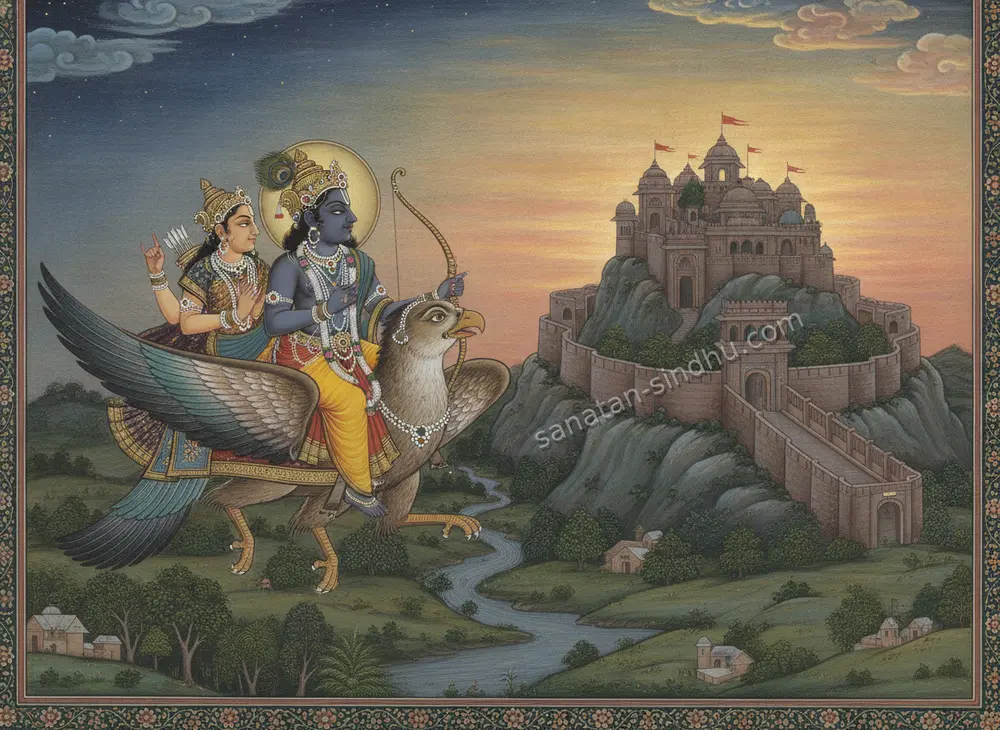
Indra comes to Dvārakā to ask Kṛṣṇa for help. Kṛṣṇa rides out on Garuḍa, breaks through the city's rings of mountains, weapons, water, fire and wind, and kills Naraka's ally Mura (which is why one of his names is Murāri, "enemy of Mura"). He then kills Naraka with his discus. Bhūmi herself comes forward, returns Aditi's earrings, and asks Kṛṣṇa to protect Naraka's son Bhagadatta. The women — sixteen thousand one hundred in the Bhāgavata's count — are freed, and Kṛṣṇa marries them so that none of them is turned away by a society that would otherwise shame them.
We have not checked the exact Sanskrit of these chapters against a critical edition, so we give chapters rather than quote verses here. Neither Purāṇa, as far as we can find, ties this battle to the fourteenth day of Kārttika; that link comes from later ritual literature and living practice, described below.
Did Satyabhāmā fight?
In both Purāṇas, Satyabhāmā rides with Kṛṣṇa to Prāgjyotiṣa — the Bhāgavata says so plainly — and the journey ends with her asking for the pārijāta tree from Indra's garden. But in these texts it is Kṛṣṇa's discus that kills Naraka.
A widely loved retelling, strong in south India and in Odisha and Goa, gives the final blow to Satyabhāmā herself. In it, Naraka had been granted that he could only die at his mother's hand; Satyabhāmā is understood as an incarnation of Bhūdevī, the Earth, so the boon is fulfilled when she kills him. Some versions add that Naraka, dying, asked that the day of his death be celebrated with light.
This is a real and old stream of the living tradition — this site's essay on Satyabhāmā's martial agency explores it — but it is a regional and devotional reading, not the Bhāgavata's own account. We name both, and do not choose one as "the" story.
Naraka as a door, not only a demon
Long before the Purāṇas give Naraka a fortress, the Bhagavad Gītā speaks of naraka as something closer to home. In Chapter 16, describing the qualities that bind a person, Kṛṣṇa names three gates:
त्रिविधं नरकस्येदं द्वारं नाशनमात्मनः। कामः क्रोधस्तथा लोभस्तस्मादेतत्त्रयं त्यजेत्॥
trividhaṃ narakasyedaṃ dvāraṃ nāśanam ātmanaḥ | kāmaḥ krodhas tathā lobhas tasmād etat trayaṃ tyajet ||
Threefold is this gate of hell, destroying the self: desire, anger and greed. Therefore one should give up these three.
Read beside the Purāṇic story, the verse gives the day a second meaning. Naraka the king takes what is not his, holds people captive and grows drunk on power — a picture of desire, anger and greed with a crown on. Many teachers, especially in Vaiṣṇava traditions, draw this parallel: the outer victory is remembered so that the inner one can be attempted. That is an interpretation, not a claim made by the Purāṇas themselves, and we offer it as one.
The Gītā also gives the reason Kṛṣṇa takes up arms at all:
परित्राणाय साधूनां विनाशाय च दुष्कृताम्। धर्मसंस्थापनार्थाय सम्भवामि युगे युगे॥
paritrāṇāya sādhūnāṃ vināśāya ca duṣkṛtām | dharmasaṃsthāpanārthāya sambhavāmi yuge yuge ||
To protect the good, to end those who do harm, and to set dharma firmly in place, I come into being age after age.
In the Naraka story the "protection of the good" is concrete: the freed women, and a mother — Bhūmi — who asks mercy for her grandson even as her son falls.
The bath before dawn
The day's best-known custom is abhyaṅga snāna, an oil bath taken before sunrise, while the stars are still out. The body is rubbed with sesame oil and often with ubṭan, a paste of gram flour, turmeric and herbs; in parts of Maharashtra and the south a twig of apāmārga (the prickly chaff-flower plant) is passed around the head during the bath. Some families crush a bitter fruit underfoot, standing in for Naraka.
Later ritual digests (nibandhas) and pañcāṅga literature give this bath its explanation: whoever bathes before dawn on this day is said not to see naraka. These texts often attribute the rule to the Padma or Skanda Purāṇa. We have not been able to trace that attribution to a specific chapter and verse, so readers should treat it as a ritual-manual teaching rather than a pinned scriptural one.
In western India the day is also called Rūp Caudas, the "fourteenth of beauty", and the bath doubles as a day of grooming and self-care before Dīpāvalī.
Lamps for Yama
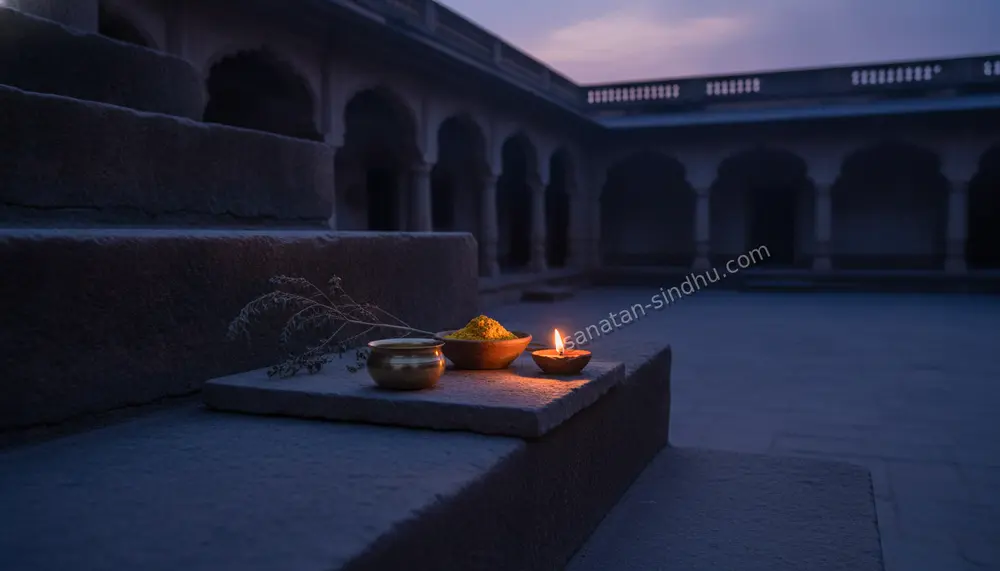
As on Dhanteras, a lamp is set out for Yama, the lord of death — on this night often fourteen lamps, one for each of the lunar days, placed at doorways, wells and dark corners. Some households also offer water to Yama (Yama-tarpaṇa), reciting his many names. The custom sits comfortably beside the bath: one keeps away naraka, the other honours the one who judges who goes there.
Yama is not only a figure of fear in the older texts. In the Kaṭha Upaniṣad he is a teacher, who explains to the boy Naciketas the choice every person faces:
श्रेयश्च प्रेयश्च मनुष्यमेतस्तौ सम्परीत्य विविनक्ति धीरः। श्रेयो हि धीरोऽभि प्रेयसो वृणीते प्रेयो मन्दो योगक्षेमाद्वृणीते॥
śreyaś ca preyaś ca manuṣyam etas tau samparītya vivinakti dhīraḥ | śreyo hi dhīro 'bhi preyaso vṛṇīte preyo mando yogakṣemād vṛṇīte ||
The good and the pleasant both come to a person. The wise one looks at both and tells them apart; the wise chooses the good over the pleasant, while the foolish chooses the pleasant for the sake of getting and keeping.
The Upaniṣad says nothing about this festival. But a lamp lit for Yama, on a night named for a gate of hell, sits naturally beside his own teaching: the line between śreyas and preyas is the same line the Gītā draws between the three gates and the path away from them.
One night, many names
Few festival days change their character as much from region to region:
- Goa and coastal Karnataka: large effigies of Narakāsura are built by neighbourhoods and burned before dawn, followed by the oil bath and fireworks.
- Tamil Nadu and much of the south: this pre-dawn bath on Naraka Caturdaśī is itself "Deepavali" — the main day of the festival, with new clothes, sweets and crackers — rather than the evening Lakṣmī Pūjā of the north.
- Bengal: the night is Bhūt Caturdaśī. Fourteen lamps are lit for the ancestors, and fourteen kinds of leafy greens (coddo śāk) are eaten, the evening before Kālī Pūjā.
- Gujarat: it is Kālī Caudas, a night associated with protective worship of Kālī and Hanumān and with warding off harm.
- Parts of north India: some traditions keep this day as Hanumān Jayantī, a date that other traditions place in Caitra instead.
- Many north Indian homes: Choṭī Dīvālī, with a smaller round of lamps before the main night.
These are not deviations from a single "correct" festival. They are the living stream of the tradition doing what it has always done — taking one night and filling it with local memory.
Sources
- Primary scripture: Bhagavad Gītā 16.21 and 4.8; Kaṭha Upaniṣad 1.2.2; Bhāgavata Purāṇa 10.59 (Narakāsura, by chapter); Viṣṇu Purāṇa 5.29 (by chapter). Gītā and Upaniṣad verses as given in the Gita Press editions.
- Ritual literature: nibandha and pañcāṅga teaching on abhyaṅga snāna and Yama-tarpaṇa; the Padma/Skanda Purāṇa attributions these sources give are not independently traced here.
- Regional and oral tradition: Satyabhāmā as the slayer of Naraka (south India, Odisha, Goa); Goan Narakāsura effigies; Bengali Bhūt Caturdaśī; Gujarati Kālī Caudas.
- Not verified: exact verse numbers within Bhāgavata 10.59 and Viṣṇu Purāṇa 5.29, which we cite by chapter until checked against a critical edition.