
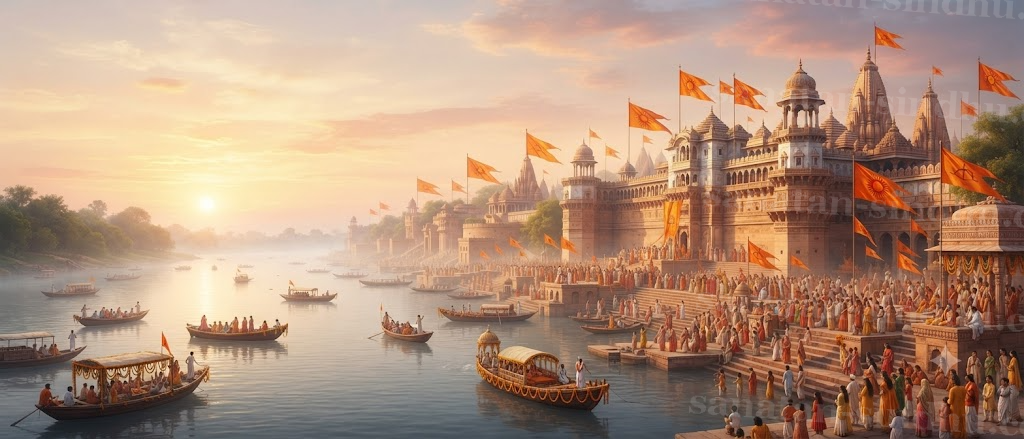
Fourteen years, to the day
Bharata had said he would enter fire if Rāma was not back on the first day of the fifteenth year. Hanumān reaches him with hours to spare.
What Vālmīki lingers on is not the celebration but the handover. For fourteen years Bharata has ruled from Nandigrāma rather than Ayodhyā, with Rāma's sandals on the throne and himself in bark cloth beside them — a regent who refused every comfort of the office he was performing. He returns the kingdom the way a man returns something borrowed.
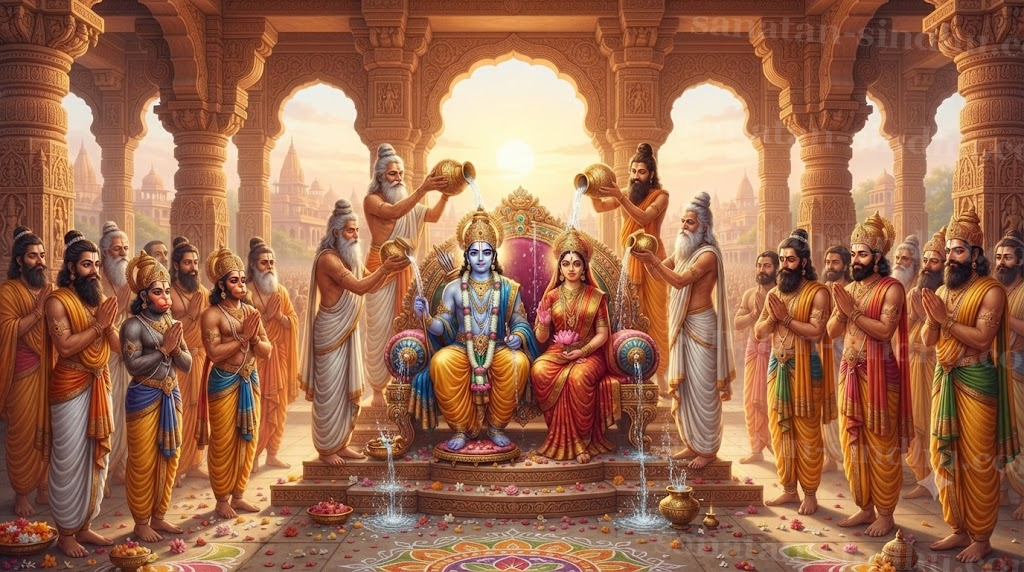
The abhiṣeka is performed with water carried from the four oceans and five hundred rivers; Vasiṣṭha pours, and Sītā is beside him. The vānaras and Vibhīṣaṇa stand among the ministers of Ayodhyā, which is itself part of the point: the court that begins this reign is not made of Ayodhyā's own people alone.
What the text actually says
The famous passage is short. In the closing sargas of the Yuddha Kāṇḍa, Vālmīki describes the reign in a handful of verses, and they are almost entirely negative — a list of things that stopped happening.
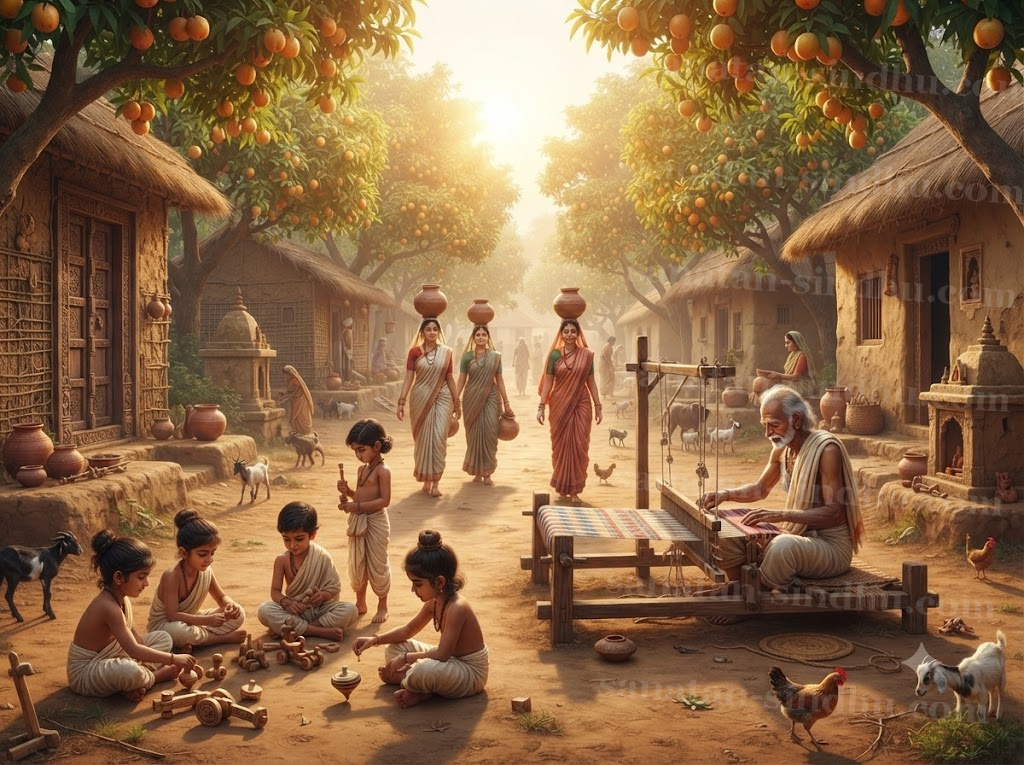
No widow grieved. No one feared disease, or wild animals, or thieves. No one drowned, no one burned, no fever came. The old did not perform the funerals of the young. Trees bore fruit continually, the rains came when they were needed and by night, the wind was pleasant to the touch. Men did not covet and women were devoted; both were, in the text's blunt phrase, dharma-parāyaṇa — set toward dharma as their aim.
It is worth noticing what is absent. No conquests. No expansion. No monuments. The measure of the golden age, in the epic's own accounting, is entirely the absence of preventable suffering among ordinary people.
Tulsīdās rewrites the ideal
Five hundred years ago, in Avadhi, Tulsīdās took that passage and made it central. The Uttar Kāṇḍ of the Rāmcaritmānas is where most of India actually learned what Rāma Rājya means, and it shifts the emphasis.
दैहिक दैविक भौतिक तापा। राम राज नहिं काहुहि ब्यापा॥
daihika daivika bhautika tāpā, rāma rāja nahiṁ kāhuhi vyāpā
'The threefold affliction — of the body, of fate, of the world outside — touched no one in Rāma's reign.'
He adds that each followed their own dharma within the bounds of varṇa and āśrama, that there was no premature death and no sickly body, that the trees gave freely and the ocean kept to its shore. He also inserts something Vālmīki does not dwell on: the king who is beloved is also the king who listens. Tulsīdās's Rāma holds open court and takes the temperature of his people constantly. The ideal is not a benevolent absence — it is attention.
An idea that left the text
Rāma Rājya became, over centuries, the default Indian shorthand for legitimate government — invoked by kings in inscriptions, by poets against kings, and by movements against empires.
Gandhi used it constantly and defined it carefully, because he was aware of what could be smuggled inside it. For him Rāma Rājya meant sovereignty of the people founded on moral authority; he said explicitly that it did not require belief in Rāma, that it meant the same thing as the kingdom of God on earth, and that its test was whether the weakest had the same standing as the strongest. Others have read the same phrase as majoritarian, and the argument has not ended.
That argument is possible because the source is genuinely thin. Twenty-odd verses of an ideal, stated mostly as absences, function as a mirror as much as a blueprint.
The cost the epic records
There is a reason this sits uneasily as a triumph, and Vālmīki is the one who put the discomfort there.
The same Uttara Kāṇḍa that describes the perfect reign describes what the reign cost. A washerman's remark about the queen's years in Laṅkā reaches the king, and the king who has just been praised for listening to his subjects listens — and sends his pregnant wife into the forest. The passage on universal happiness and the passage on Sītā's exile sit in the same book, a few sargas apart.
The epic does not reconcile them. It sets the ideal and its price side by side and leaves the reader holding both. Any honest reading of Rāma Rājya has to account for the fact that its own scripture immediately shows us who paid for it.
The episode is told in full in the story The Washerman's Doubt — Sītā's second exile.
Sources
- Vālmīki Rāmāyaṇa, Yuddha Kāṇḍa sarga 128 (the coronation and the description of the reign) and Uttara Kāṇḍa (the reign, the exile of Sītā, and her final departure).
- Tulsīdās, Rāmcaritmānas, Uttar Kāṇḍ — the Avadhi retelling through which the phrase entered popular usage.
- M. K. Gandhi, collected writings and speeches on Rāma Rājya, consulted through standard published compilations rather than a critical edition.