Venus's day, the goddess's day
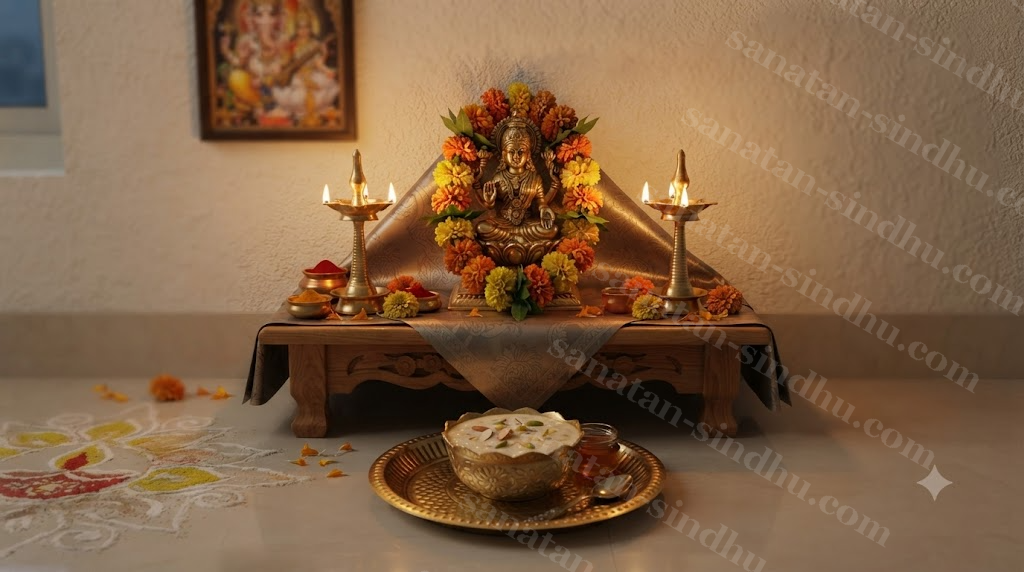
Shukravār — Friday — is Venus's day astrologically and, across most of North and West India, Lakṣmī's day devotionally. The Vaibhav Lakshmi vrat follows the general shape laid out in the previous essay of this series: a weekly fast, typically broken with a single meal, worship of Lakṣmī (regionally also Durgā), and its own vrata-kathā recited during the observance, promising prosperity and a settled household in return. Textually, this is unremarkable within the Purāṇic vrata genre — a deity, a day, a kathā, a result — sitting comfortably alongside the Ekādaśī and Śivarātri fasts described in the overview essay.
A goddess the Purāṇas don't know
Here the evidence changes shape, and the honest thing to do is say so plainly rather than pick a side.
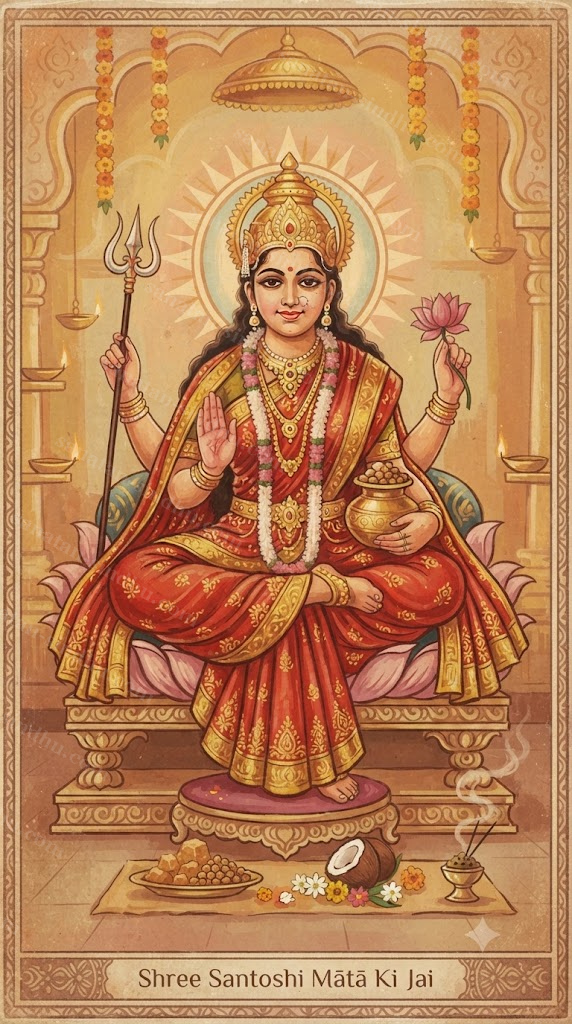
Santoshi Mātā has a faint trace in the textual record from the medieval period — roughly 100 to 1500 CE — but she was not, in that period, a widely known or worshipped figure. Her rise as a popular goddess is specifically datable: worship spread by word of mouth and by cheap vrata-pamphlet literature starting in the early 1960s, and was then carried to mass, pan-Indian devotional status by a single event — the *1975 film Jai Santoshi Maa***. The film's own screenings became devotional occasions in their own right, audiences removing their shoes and treating the cinema hall as a temple, and shrines to Santoshi Mātā began appearing across North India directly in its wake.
The story most of her worshippers know today — that she is Gaṇeśa's daughter, connected to Rakṣā Bandhan — is not found in any Purāṇa. It is the film's own invention, which then folded back into popular belief and is now widely assumed to be traditional.
Same day, different weight
None of this is a case for setting the fast aside. Millions of households keep it in good faith, and a folk or modern devotional emergence is exactly as real a stream of a living tradition as an ancient Purāṇic one — this series holds that position throughout, not only when it is convenient. But treating Santoshi Mātā's textual pedigree as equivalent to Ekādaśī's, or blending both fasts into one undifferentiated "Friday is the goddess's day" paragraph, would be the kind of quiet flattening this whole series exists to avoid. The honest version is simpler: one fast is a minor but continuous thread inside the older Purāṇic vrata tradition; the other is, by its own well-documented history, a twentieth-century devotional emergence that most of today's practitioners assume is ancient. Both are worth keeping. Neither needs the other's pedigree borrowed to be worth keeping.
Return to What Is a Vrata? — the textual foundations of Hindu fasting for the shared basis this essay builds on, and for the rest of the fasting series as each piece is added.
Sources
- Modern scholarship and documented history. Wikipedia's Santoshi Mata and Jai Santoshi Maa entries, cross-checked against each other for the 1960s-emergence and 1975-film-popularisation timeline and for the specific claim that no Purāṇa names her as Gaṇeśa's daughter.
- Folklore and oral tradition. The Friday vrata-pamphlet literature that both predates and postdates the 1975 film — referenced here, not yet directly examined; flagged for a follow-up pass.
A note on what this essay doesn't claim: several devotional sources assert a direct Purāṇic origin for Santoshi Mātā without naming a specific Purāṇa or verse. That claim doesn't survive a "which text, which edition" check and isn't repeated here as established fact. Equally, a documented modern origin is not presented here as a reason to dismiss the practice — see "Same day, different weight," above.