
What the texts actually describe
Stripped of the modern festival apparatus, Gaṇeśa Caturthī is textually a single occasion: the Vinayaka Caturthī — the waxing-moon monthly fast for Gaṇeśa — that happens to fall in the month of Bhādrapada (roughly August–September). The Gaṇeśa and Mudgala Purāṇas, the Gāṇapatya tradition's own scripture, supply the vrata's basic shape: fasting, worship of a Gaṇeśa mūrti, an offering of modaka, concluding the same day rather than carrying the moonrise-breaking requirement of the other monthly Gaṇeśa fast, Sankaṣṭī Caturthī — see this series' own piece on that vrata for the fuller distinction between the two, including the moon-avoidance custom specific to this Bhādrapada occasion. Nothing in that textual layer describes a public festival, a procession, or an idol built to be immersed in a river — those are all later additions, and naming them as later is not a criticism of them, just an accurate description of where they come from.
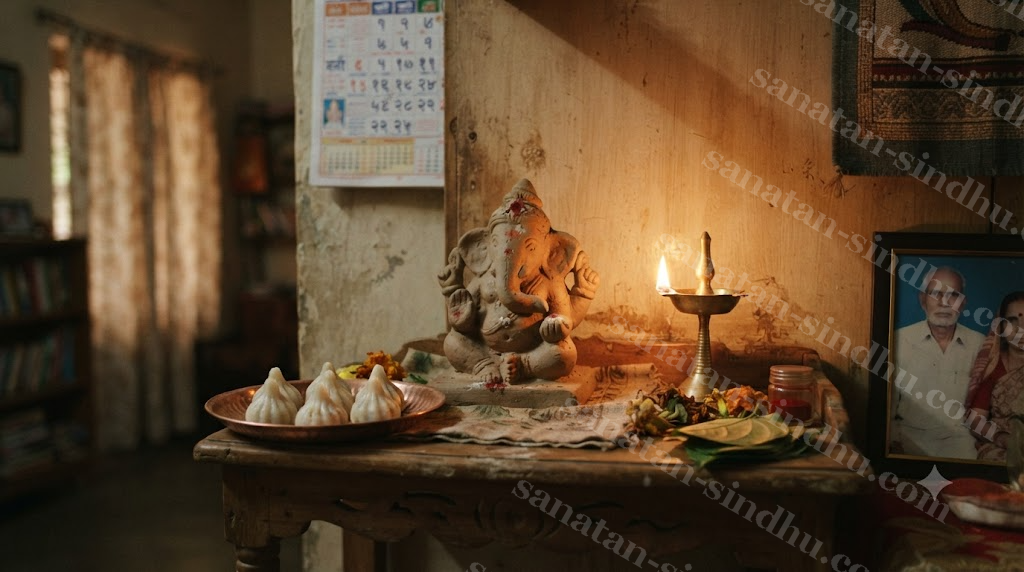
From household altar to royal patronage
For most of its documented history, the observance stayed at the scale the texts describe: a household vrata, kept privately, with a clay mūrti made and dissolved again within the same short observance. The one significant pre-modern expansion of scale is well documented in Maharashtra: the Peshwas, the Maratha Empire's ruling ministers based in Pune, gave Gaṇeśa Caturthī state patronage at their court in the eighteenth century, elevating it to a formal occasion at Shaniwarwada without yet making it a public, mass-participation event. That distinction — state patronage versus public mobilisation — matters for what follows.
1893 — a specific, documented decision
The transformation into the festival most people now picture has an exact date and a named architect: 1893, and Bal Gangadhar Tilak. Writing and organising through his newspaper Kesari, Tilak reshaped Gaṇeśa Caturthī from a private household and court observance into Sarvajanik Ganeshotsav — a public festival, celebrated in shared pandals rather than only at home, explicitly designed to draw Indians of different castes and backgrounds into one shared, sanctioned public gathering under British colonial rule, at a time when the colonial administration restricted overtly political assembly but could not restrict a religious festival on the same terms. This is documented political and social history, not legend — Tilak's own writing on the strategy survives, and the date is not in dispute among historians of the period. Naming it plainly serves the festival, not the other way round: the public, community-scale Gaṇeśa Caturthī now taken as timeless is, by the tradition's own documented record, barely a hundred and thirty years old, layered on top of a vrata that is genuinely ancient. Both are true at once, and neither needs to borrow the other's antiquity to matter.
From Pune to Lalbaugcha Raja
What Tilak began in Pune spread first across Maharashtra and then well beyond it. Twentieth-century Mumbai produced the festival's most visible modern landmarks — pandals such as Lalbaugcha Raja, drawing crowds numbering in the millions over the festival's ten days — and the observance now travels with the Indian diaspora to installations on every continent. The structure Tilak set in 1893 is still legible in the modern form: a shared public mūrti, open participation across community lines, and a closing visarjan — immersion — that returns the clay to water at the festival's end, the same basic gesture the household vrata always made, just performed now at civic rather than domestic scale.
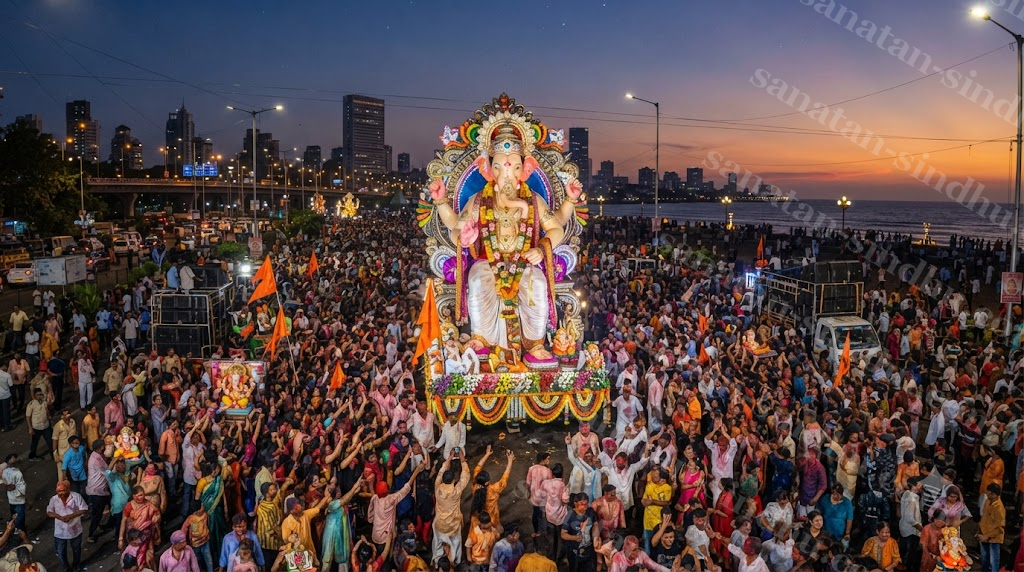
A live tension: what the mūrti is made of
One genuine, unresolved tension belongs in this account rather than being smoothed over. The traditional material for a Gaṇeśa mūrti is unfired river clay (shāḍu maṭṭī), chosen precisely because it dissolves cleanly back into water at immersion — the material and the ritual gesture were designed together. Twentieth-century mass production shifted much of the festival's public-scale mūrti-making to Plaster of Paris, cast faster and cheaper, but which does not dissolve the way clay does and is typically finished with synthetic paints; immersed at the scale of thousands of large public mūrtis, this has become a documented source of water pollution in Indian rivers and coastal waters. A visible countermovement — municipal restrictions in some cities, artisan and civic campaigns promoting a return to clay and natural pigment — is active and ongoing as of this writing, not a settled resolution. This is a live disagreement inside the tradition's own present-day practice, between festival scale and the ritual material's original ecological logic, and it belongs in an honest account of where the festival stands today rather than in only its history.
Sources
- Primary scripture: the Gaṇeśa and Mudgala Purāṇas, for the textual basis of the Bhādrapada Vinayaka Caturthī vrata itself.
- Documented political and social history: the 1893 Sarvajanik Ganeshotsav reorganisation under Bal Gangadhar Tilak, including his own writing in Kesari — well-established, undisputed modern historical record, consulted via named secondary historical accounts rather than a primary archival search of Kesari itself, which this session could not undertake directly.
- Pre-modern court history: Peshwa-era state patronage of the festival at Pune — referenced at the level of general historical record rather than a specific court chronicle citation.
- Contemporary practice and environmental reporting: the shāḍu maṭṭī-versus-Plaster-of-Paris immersion debate, consulted via general documentation of ongoing municipal and civic campaigns rather than a single named study; presented here as a live, unresolved question rather than a settled outcome.
- Cross-link, per this essay's own brief: see The First Principle — Gaṇeśa as Omkāra for the esoteric Gāṇapatya reading of Gaṇeśa this historical account doesn't cover, and Sankaṣṭī Chaturthī — Gaṇeśa's Monthly Vow for the other monthly Gaṇeśa fast this one is often conflated with.