How old are these hymns?
Most of what people say about metals in the Vedas is secondhand. This essay does something simpler: it shows the actual verses, in Sanskrit and in translation, and states plainly what they do and don't say.
The Ṛgveda is the oldest surviving book in India, and among the oldest in any Indo-European language.
Scholars who study the language of the hymns generally place their composition in the second half of the second millennium BCE — commonly given as roughly 1500 to 1000 BCE for the main body, with some proposing a wider window of about 1900 to 1200 BCE. One anchor point: the Mitanni documents from northern Syria and Iraq (about 1450–1350 BCE) name Vedic gods including Varuṇa, Mitra and Indra, which suggests the Vedic world and that one overlapped in time.
These hymns were not written down for a very long time after they were composed. They were carried by memory, teacher to student, through a recitation system built so precisely that errors could be caught and corrected. Scholars disagree about when writing first entered the picture — that argument is genuinely unsettled — but the accuracy of the oral chain is not seriously disputed. The tonal accent of the hymns survives to this day.
One more thing worth saying plainly. Within the tradition itself, the Vedas are apauruṣeya — not composed by any person at all, and therefore not "dated" in the way described above. That is a statement about what kind of thing the Veda is, not a competing historical estimate. Both views can sit on the same page; neither cancels the other.
One word that causes all the arguments
Almost every dispute about metals in the Vedas comes down to a single Sanskrit word: *अयस् (ayas)*.
Does it mean copper? Bronze? Iron? Scholars have argued all three, for over a century — and the argument matters because people use it to date the Ṛgveda. If ayas means iron, the hymns must be later. If it means copper, they can be earlier.
Here is how unsettled it really is. Two published commentaries translate the same six words from the same verse as follows:
- *अयस् (ayas)* — one commentary says iron; another says bronze
- *श्याम (śyāma)* — one says black iron; another says iron
- *लोह (loha)* — both agree: copper
Same verse, three metals shuffled between two translations. The honest position — the one this essay takes — is: name the word, show the verse, don't guess the element. When a translator has chosen a metal name, that is noted as their choice, not as this essay's own conclusion.
Gold: the metal everyone agrees about
*हिरण्य (hiraṇya)*, gold, is the one metal term nobody argues about. It appears constantly in the oldest layer.
Here is Rudra wearing a *निष्क (niṣka)* — a neck-ornament — while carrying his bow:
अर्हन्बिभर्षि सायकानि धन्वार्हन्निष्कं यजतं विश्वरूपम् । अर्हन्निदं दयसे विश्वमभ्वं न वा ओजीयो रुद्र त्वदस्ति ॥
arhan bibharṣi sāyakāni dhanvārhan niṣkaṃ yajataṃ viśvarūpam | arhann idaṃ dayase viśvam abhvaṃ na vā ojīyo rudra tvad asti ||
Worthy, you bear arrows and a bow; worthy, you wear an adorable and many-formed necklace; worthy, you preserve all this vast universe — there is none more powerful than you.
And the verse just before it describes him gleaming with gold ornaments (śukrebhiḥ pipiśe hiraṇyaiḥ) — Ṛgveda 2.33.9.
The smith at his forge
This is the single most revealing verse about metalworking in the whole Ṛgveda — and it is easy to miss, because it appears inside a hymn about Soma.
कारुरहं ततो भिषगुपलप्रक्षिणी नना । नानाधियो वसूयवोऽनु गा इव तस्थिमेन्द्रायेन्दो परि स्रव ॥
— Ṛgveda 9.112.3 (the verse that follows)
The one we want is Ṛgveda 9.112.2, which Griffith renders:
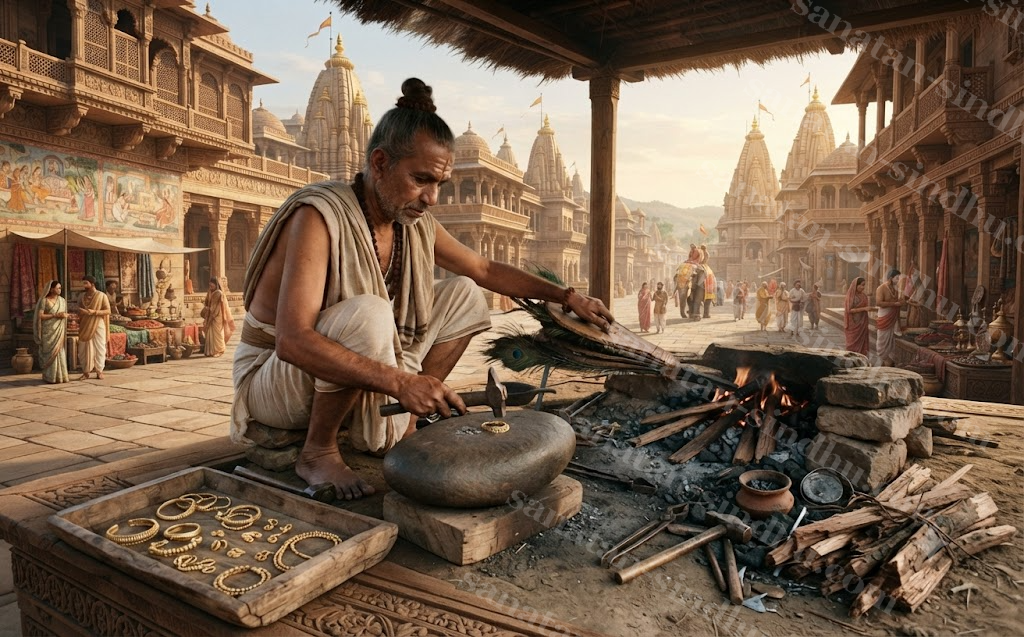
"The smith with ripe and seasoned plants, with feathers of the birds of air, with stones, and with enkindled flames, seeks him who hath a store of gold."
Read it slowly. In one line you have: seasoned wood (fuel), birds' feathers (the bellows), stones (the anvil or grinding-stone), fire — and a craftsman looking for a customer with gold to spend. That is an entire workshop.
What makes it remarkable is the tone. The hymn lists the smith alongside the poet, the physician, and the woman grinding corn — ordinary people with ordinary trades. Nobody marvels at him. A society only mentions a smith that casually when smiths are everywhere.
The word used is *कर्मार (karmāra)* — craftsman, smith.
A warrior's armour, a metal-tipped arrow
Ṛgveda 6.75 is a hymn addressed to the weapons themselves — nineteen verses blessing a warrior's full kit. It opens with armour:
जीमूतस्येव भवति प्रतीकं यद्वर्मी याति समदामुपस्थे । अनाविद्धया तन्वा जय त्वं स त्वा वर्मणो महिमा पिपर्तु ॥
jīmūtasyeva bhavati pratīkaṃ yad varmī yāti samadām upasthe | anāviddhayā tanvā jaya tvaṃ sa tvā varmaṇo mahimā pipartu ||
His appearance is like a thundercloud when he, clad in armour, enters the midst of battle. May you conquer with an unwounded body; may the greatness of your armour carry you through.
The word for armour is *वर्मन् (varman)*. Verse 18 adds: "your vital parts I cover with your armour" — fitted body protection, covering specific areas.
Then the bow:
धन्वना गा धन्वनाजिं जयेम धन्वना तीव्राः समदो जयेम । धनुः शत्रोरपकामं कृणोति धन्वना सर्वाः प्रदिशो जयेम ॥
dhanvanā gā dhanvanājiṃ jayema dhanvanā tīvrāḥ samado jayema | dhanuḥ śatror apakāmaṃ kṛṇoti dhanvanā sarvāḥ pradiśo jayema ||
With the bow let us win cattle, with the bow the battle, with the bow let us win fierce encounters. The bow brings grief to the enemy — with the bow may we win all directions.
And at 6.75.15 comes an arrow described as *अयोमुख (ayomukha) — literally "ayas-mouthed," a shaft with a metal head. Griffith translates it "with iron mouth"; the verse itself says ayas*, and you now know why that distinction matters.
One curious absence. There is no sword anywhere in the Ṛgveda or the Atharvaveda — only knives. Some scholars have built dating arguments on that gap. Whether or not those arguments hold, the absence itself is a fact you can check.
The hymn ends with a turn that is worth the whole reading. After eighteen verses about armour, bows, arrows and chariots, the last line says the nearest and closest armour is prayer.
Six metals in one breath
The Chamakam — part of the Śrī Rudram, found at Taittirīya Saṃhitā 4.7.5 in the Kṛṣṇa Yajurveda and Vājasaneyi Saṃhitā 18.13 in the Śukla — contains the oldest clear list of separate metals:
अश्मा च मे मृत्तिका च मे गिरयश् च मे पर्वताश् च मे सिकताश् च मे वनस्पतयश् च मे हिरण्यं च मे ऽयश् च मे श्यामं च मे लोहं च मे सीसं च मे त्रपु च मे यज्ञेन कल्पन्ताम् ॥
aśmā ca me mṛttikā ca me girayaś ca me parvatāś ca me sikatāś ca me vanaspatayaś ca me hiraṇyaṃ ca me 'yaś ca me śyāmaṃ ca me lohaṃ ca me sīsaṃ ca me trapu ca me yajñena kalpantām ||
May stone and clay, hills and mountains, sand and forest trees, gold and ayas, śyāma and loha, sīsa and trapu — may these be granted to me through the sacrifice.
Six distinct metal-words: हिरण्य hiraṇya, अयस् ayas, श्याम śyāma (literally "dark"), लोह loha (literally "red"), सीस sīsa, त्रपु trapu.
Forget for a moment which modern element each one is. The point stands regardless: these people distinguished six different metals and had separate names for each. You cannot do that without handling them, working them, and knowing how each behaves. That is the practical foundation on which alloying rests.
Notice too that the list sits among stone, clay, sand and timber — it is a survey of usable materials. This is a prayer written by people who thought in terms of what can be made.
The rivers these singers knew
Here is where the geography gets interesting.
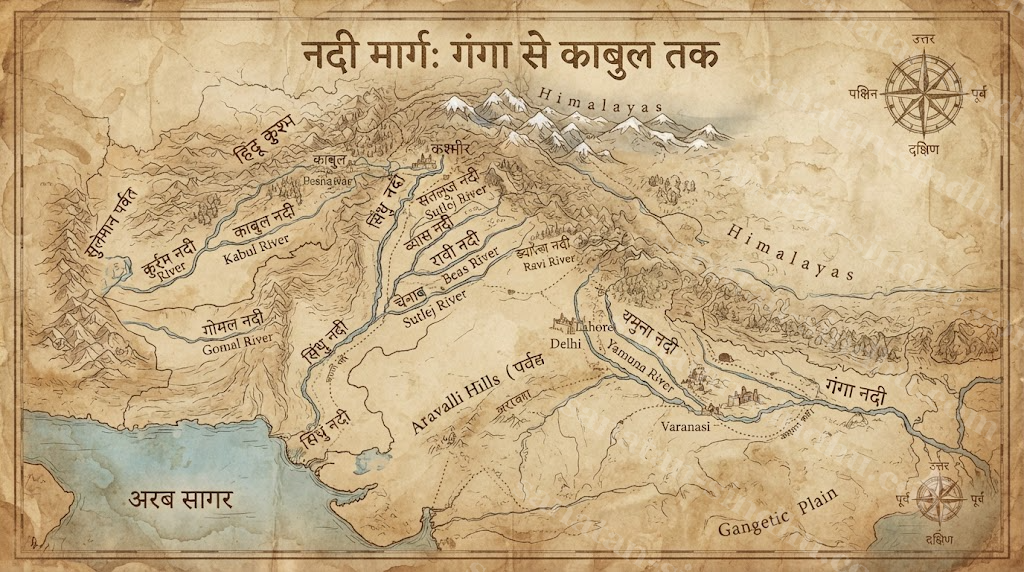
The Nadīstuti Sūkta — the Hymn in Praise of Rivers, Ṛgveda 10.75 — names rivers one after another. Verse 5 runs east to west:
इमं मे गङ्गे यमुने सरस्वति शुतुद्रि स्तोमं सचता परुष्ण्या । असिक्न्या मरुद्वृधे वितस्तयार्जीकीये शृणुह्या सुषोमया ॥
imaṃ me gaṅge yamune sarasvati śutudri stomaṃ sacatā puruṣṇyā | asiknyā marudvṛdhe vitastayārjīkīye śṛṇuhyā suṣomayā ||
O Gaṅgā, Yamunā, Sarasvatī, Śutudrī, together with Paruṣṇī — join yourselves to this my hymn. O Asiknī, O Marudvṛdhā, O Vitastā, O Ārjīkīyā with Suṣomā — hear me.
Those are, in order: the Ganga, the Yamuna, the Sarasvatī, the Sutlej, the Ravi, the Chenab, the Jhelum, and two more in the northwest.
Then verse 6 keeps going west:
तृष्टामया प्रथमं यातवे सजूः सुसर्त्वा रसया श्वेत्या त्या । त्वं सिन्धो कुभया गोमतीं क्रुमुं मेहत्न्वा सरथं याभिरीयसे ॥
tṛṣṭāmayā prathamaṃ yātave sajūḥ susartvā rasayā śvetyā tyā | tvaṃ sindho kubhayā gomatīṃ krumuṃ mehatnvā sarathaṃ yābhir īyase ||
First you set out with Tṛṣṭāmā, with Susartu, with Rasā, with bright Śvetyā. O Sindhu, with Kubhā you journey to Gomatī, with Mehatnu to Krumu — with whom you move together as if in one chariot.
Now look at what those names are on a modern map:
- सिन्धु Sindhu — the Indus
- कुभा Kubhā — the Kabul river, Afghanistan
- क्रुमु Krumu — the Kurram, Afghanistan–Pakistan
- गोमती Gomatī — the Gomal, Afghanistan–Pakistan
- गङ्गा Gaṅgā — the Ganga
One hymn, one sweep of the singer's arm, and it reaches from the Ganga in the east to the rivers of what is now Afghanistan in the west. These were not distant rumours to him. He names them the way you name the roads near your home.
The composer of this hymn inhabited a world considerably wider than the borders on any current map.
The people called Bharata
The name is in the Ṛgveda — not yet as a land, but as a people.
The *भरत (Bharata) are a clan in the oldest layer of the text. Their king सुदास (Sudās) fights the famous Dāśarājña, the Battle of Ten Kings, in Ṛgveda 7.18* — a confederation of ten tribes against him on the banks of the Paruṣṇī (the Ravi). The Bharatas are named repeatedly across the hymns; they are one of the peoples whose priests composed this book.
The land-name *भारतवर्ष (Bhāratavarṣa)* — "the country of the Bharatas" — comes later, in the Purāṇas and the epics, where it names a whole territory.
So the sequence in the texts runs: a people named Bharata, singing these hymns → later, a land named after them. The name that a fifth of humanity now lives under first appears as the name of a clan in a Bronze Age hymn, in a world stretching from the Ganga to the Kabul river.
What was there before the hymns is a separate question, and an open one. The Indus–Sarasvatī cities — Harappa, Mohenjo-daro, Dholavira and the rest — were flourishing by 2600 BCE, older than any proposed date for the Ṛgveda, with planned drainage, standard weights, and metalwork of real sophistication. Their writing has never been deciphered. Until someone reads those seals, nobody can say what those cities called themselves, or what they believed. Anyone who tells you they know for certain — in either direction — is telling you more than the evidence does.
What we can fairly conclude
From the verses above, without stretching anything:
- These hymns were composed by people who worked metal as a matter of routine — a smith is an ordinary tradesman, not a wonder.
- They distinguished at least six metals by name and knew how each behaved.
- They made armour fitted to the body, composite arrows with metal heads, gold ornaments, and the tools to make all of it.
- Their world ran from the Ganga to the rivers of modern Afghanistan — far wider than the subcontinent as drawn today.
- The name Bharata belongs to a people singing inside that world, long before it became the name of a country.
- And the transmission system that carried these hymns to us, word-perfect and accent-perfect, across three thousand years without writing, is itself one of the most impressive pieces of engineering in the whole record.
Sources
Verses quoted, with Sanskrit verified
- Ṛgveda 2.33.9 and 2.33.10 — wisdomlib (Sanskrit with Sāyaṇa-based translation); Griffith at sacred-texts.com.
- Ṛgveda 9.112.2–3 — Griffith at sacred-texts.com; Sanskrit at siva.sh.
- Ṛgveda 6.75.1, 6.75.2, 6.75.15, 6.75.18 — accented Sanskrit at vedapath.app; Griffith translation at IntraText.
- Ṛgveda 10.75.5 and 10.75.6 — accented Sanskrit and IAST at vedapath.app; river identifications after Max Müller and Griffith.
- Taittirīya Saṃhitā 4.7.5 / Vājasaneyi Saṃhitā 18.13 (Chamakam) — Sanskrit and IAST at vedapath.app and Dharmawiki. The two conflicting word-by-word translations of the contested six words are from Shlokam and Manblunder.
Mentioned but not individually verified for this draft
- Ṛgveda 7.18 (Battle of Ten Kings) and the wider Bharata references — the identification is standard but the individual verses were not checked line by line here.
- The specific ayas verses elsewhere in the Ṛgveda (Indra's vajra, the ayasī strongholds).
Dating and archaeology
- Michael Witzel, "Vedas and Upaniṣads," in Flood (ed.), The Blackwell Companion to Hinduism.
- Rakesh Tewari, Antiquity 77 (2003) — iron artefacts, furnaces and slag in Uttar Pradesh dated c. 1800–1000 BCE, arguing for independent Indian development of iron-working.
- Suraj Bhan's caution that the stratigraphy at those sites is not beyond doubt.
- A. A. Semenenko, on the absence of the sword from the Ṛgveda and Atharvaveda.
Not used
- Exam-prep and quiz sites that flatly assert ayas "means copper" — the identification is exactly the contested point.
- Sources on any side that use the metals evidence mainly to prove a predetermined conclusion about origins or migration.
Part 2 of this series, Building by the Rope, takes up measured building: the fire-altars of the Brāhmaṇa texts and the geometry of the Śulbasūtras.