
A problem you cannot solve by eye
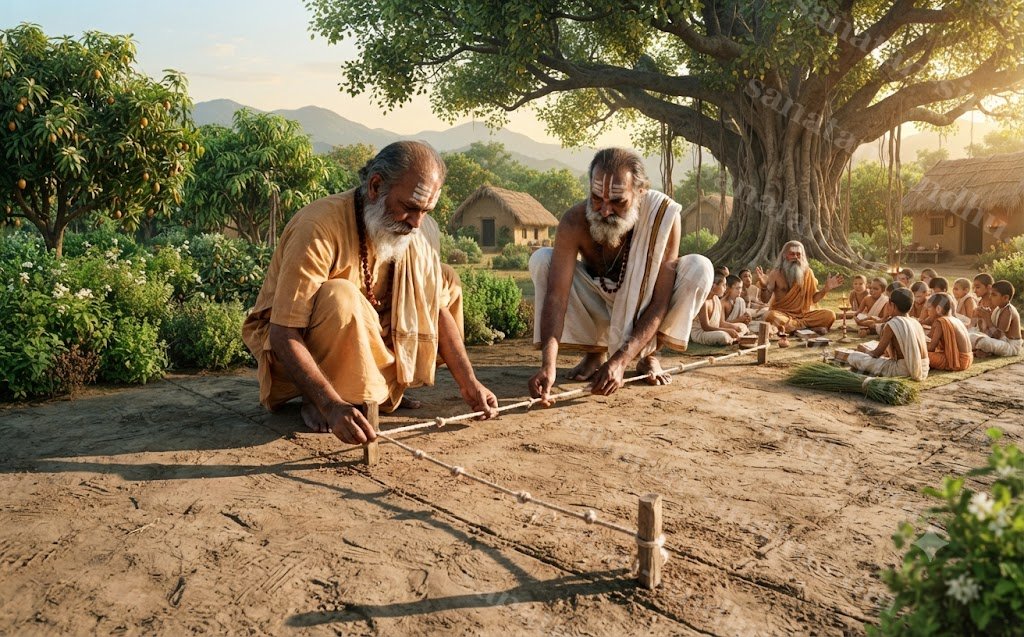
Part 1 of this series ended with a smith at his forge. This one starts with a priest holding a rope.
Vedic ritual required fire altars. Not approximate ones — altars of a stated shape, built to a stated area, with bricks of stated sizes laid in a stated pattern. A household had three: one circular, one semicircular, one square. And here is the catch that changes everything: in certain rites, these three different shapes were required to have the same area.
Sit with that for a moment. Make a circle and a square that cover exactly the same amount of ground. You cannot do it by eye. You cannot do it by trial. You need a method — and if you need that method reliably, year after year, in different places, by different priests, you need to write the method down.
That is why India's oldest mathematical texts are ritual manuals.
The falcon made of bricks
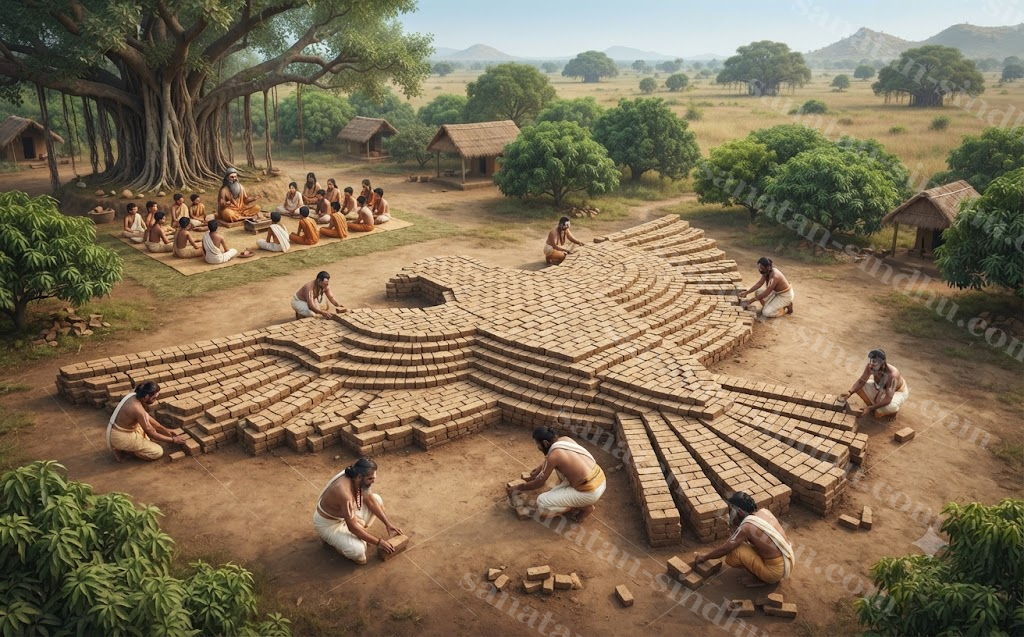
The most demanding of these constructions is the *अग्निचयन (Agnicayana)* — the "piling of the fire" — a twelve-day rite in which a great altar is built in the shape of a bird.
The falcon form is called *श्येनचिति (śyenaciti), from śyena*, falcon or hawk. The Śatapatha Brāhmaṇa of the Śukla Yajurveda devotes several whole books to it, presenting the construction as a human re-enactment of Prajāpati's assembling of the cosmos.
The specifications are exacting:
- The altar is built in five layers of kiln-fired bricks.
- Layers one, three and five share one pattern; layers two and four share a different one.
- The first layer of the falcon altar takes 200 bricks of five different shapes; the second layer also takes 200, but needs five additional brick types.
- Bricks are laid so that no brick rests directly on another of the same size and shape — the joints must be staggered between layers.
- Each brick is placed with its own mantra.
Estimates of the total brick count vary by tradition and altar type — commonly cited figures run from around 1,000 for the bird-shaped upper altar to 10,800 across the full construction, the larger number being tied to the count of muhūrtas in a year.
The Śatapatha describes the body (ātman) of the bird as a square measuring about four man-lengths on each side — roughly forty feet. The ground is ploughed, watered and sown with seeds before a single brick goes down.
This is a building project. Someone has to size ten different brick shapes so that two hundred of them tile a falcon exactly, with no gaps and no overlaps, and then do it again differently for the next layer.
The rule that makes it hard
If the requirement were only "build a falcon," a skilled mason could manage. The requirement that turns it into mathematics is about area.
Every layer of the altar had to come to a prescribed area — commonly seven and a half square puruṣa, where a puruṣa is the height of a man with arms raised. The area is fixed. The shape is fixed. The bricks must fill it without remainder.
And then the rite adds a further demand that is genuinely hard: in the repeated performances, the altar must be enlarged by one unit of area each time while keeping exactly the same shape.
Think about what that asks. Not "make it bigger" — make it bigger by a precise amount, in a shape with wings and a tail, so that the total is exactly one square puruṣa more than last time. That is a problem in scaling and area-preservation, and there is no way to fake it.
The Śulba texts therefore work out, as a matter of professional necessity:
- how to build a square equal in area to two given squares combined
- how to build a square equal in area to the difference of two squares
- how to turn a rectangle into a square of the same area
- how to turn a square into a circle of the same area, and back again
Every one of those is a genuine geometrical theorem. None of them is presented as a theorem. They are presented as instructions.
Enter the rope-stretchers
The manuals are called the *शुल्बसूत्र (Śulbasūtra)* — and the name tells you everything about the method.
*शुल्ब (śulba) means a cord, rope, or string, from a root meaning to measure*. These are the Rope Rules. The instrument of this entire geometry is a marked cord, pegged to the ground and stretched.
Four main texts survive, all attached to schools of the Yajurveda:
- Baudhāyana Śulbasūtra — the oldest and most systematic
- Āpastamba Śulbasūtra — elaborates several of Baudhāyana's rules
- Kātyāyana Śulbasūtra
- Mānava Śulbasūtra
Scholars generally assign them to roughly 800–500 BCE, with the caveat — stated in the academic literature itself — that they are likely older, and that the procedures they record must have been in use well before anyone wrote them into sūtra form. The texts clearly predate Pāṇini, so composition before the 6th century BCE is on firm ground.
The diagonal rule
Here is the sentence. It is the earliest surviving verbal statement anywhere of what the world now calls the Pythagorean theorem, and it appears in a manual about building altars.
दीर्घचतुरश्रस्याक्ष्णयारज्जुः पार्श्वमानी तिर्यङ्मानी च यत्पृथग्भूते कुरुतस्तदुभयं करोति ॥
dīrghacaturaśrasyākṣṇayārajjuḥ pārśvamānī tiryaṅmānī ca yatpṛthagbhūte kurutas tad ubhayaṃ karoti ||
The rope stretched along the diagonal of a rectangle produces by itself both the areas which the side and the breadth produce separately.
You will see this sūtra printed two ways: चतुरश्र or चतुरस्र, and तिर्यङ्मानी or तिर्यग् मानी. These are spelling and sandhi variants of the same line, not different readings.
Read it as a builder would. You have a rectangle pegged out on the ground. Stretch a rope corner to corner. The square you could build on that rope equals the two squares you could build on the two sides, added together. No symbols, no proof — a working instruction, stated in terms of rope and ground.
The text then lists the side-lengths where this comes out in whole numbers:
- 3 and 4
- 12 and 5
- 15 and 8
- 7 and 24
- 12 and 35
- 15 and 36
Those are Pythagorean triples, set down as a practical lookup table for people who needed to peg out right angles on a field.
Baudhāyana gives the square case too: the rope stretched across a square produces twice its area.
Other results stated in the Śulba texts, all in the same plain-instruction register:
- the diagonals of a rectangle cut each other in half
- the diagonals of a rhombus cut each other in half at right angles
- joining the midpoints of a square's sides gives a square of half the area
The number they needed most
If you are doubling a square, you immediately need the length of its diagonal — which is the side times √2. There is no way around it, and √2 is irrational. So they computed it.
समस्य द्विकरणी। प्रमाणं तृतीयेन वर्धयेत् तच्च चतुर्थेनात्मचतुस्त्रिंशोनेन सविशेषः ॥
samasya dvikaraṇī. pramāṇaṃ tṛtīyena vardhayet tac ca caturthenātmacatustriṃśonena saviśeṣaḥ ||
The doubler of a square: increase the measure by its third, and that by its fourth, less the thirty-fourth part of that. This is its diagonal, approximately.
Unpack the instruction step by step:
1 + ⅓ + (1 / 3×4) − (1 / 3×4×34)
Work it out and you get 1.4142157...
The true value is 1.4142136... — so the Śulba figure is correct to five decimal places, using nothing but a sum of unit fractions a priest could hold in his head.
The word *सविशेष (saviśeṣa) at the end is not a vague "approximately." In the tradition of the śulbavids — those who knew the rope-rules — viśeṣa was a technical term for the extra bit left over when you double a square, and saviśeṣa* named the diagonal-value itself. They had a vocabulary for the error term.
Note what that means: they knew the figure was not exact, and they said so in the text. That is a mathematically mature thing to do.
Making a circle from a square
The hardest of the altar requirements — a circle and a square of the same area — gets this instruction from Baudhāyana:
चतुरश्रं मण्डलं चिकीर्षन्नक्ष्णयार्धं मध्यात्प्राचीमभ्यापातयेत् । यदतिशिष्यते तस्य सह तृतीयेन मण्डलं परिलिखेत् ॥
caturaśraṃ maṇḍalaṃ cikīrṣann akṣṇayārdhaṃ madhyāt prācīm abhyāpātayet | yad atiśiṣyate tasya saha tṛtīyena maṇḍalaṃ parilikhet ||
Wishing to turn a square into a circle: let half the diagonal be carried from the centre towards the east–west line. With whatever is left over, together with a third of it, describe the circle.
In plain terms: take half the square's diagonal, notice how much longer it is than half the side, add one third of that excess, and swing your circle with the result as radius.
The circle you get is very close to the right size, though not exact — squaring the circle is impossible in principle, as was proved only in the nineteenth century. Different Śulba constructions imply different working values for π, including 676/225 (≈ 3.004), 900/289 (≈ 3.114) and 1156/361 (≈ 3.202).
That spread is worth noticing honestly. These are not one canonical value of π; they are several rules of thumb, each good enough for the particular construction it belongs to. The Śulba authors were building altars, not chasing a constant. A sharper value — 3.1416 — comes later, with Āryabhaṭa around 499 CE.
What kind of knowledge is this?
A few things follow from the texts above, and they are worth stating carefully, because this subject attracts overstatement from every direction.
These are genuinely the oldest surviving geometry manuals. The Baudhāyana Śulbasūtra is the earliest extant written work of Indian geometry, and its statement of the diagonal rule is the earliest known verbal formulation of that theorem anywhere. That is a real claim, and it holds.
But "earliest written statement" is not "first ever known." The underlying relationship was known to the Old Babylonians before this, and they had their own value for √2 — reached by a different route and differing in its error, which is why scholars rule out any borrowing between the two. Two traditions, working separately, needed the same number and found it their own way.
The mathematics is applied, not abstract. The Śulba texts give constructions and results; they do not give proofs, and they do not generalise. This is the mathematics of people with a job to do — and their job was to build an altar that satisfied a ritual requirement to the inch.
Which is the most interesting part. Nobody here set out to found geometry. They set out to build a falcon of two hundred bricks, five layers deep, covering seven and a half square puruṣa, enlargeable by exactly one unit next time. Geometry is what you get when you take that requirement seriously enough, for long enough.
A rope, some pegs, level ground, and a specification that will not bend. That is the whole toolkit.
Sources
Primary texts
- Baudhāyana Śulbasūtra — the diagonal rule (1.12/1.48), the √2 rule (1.61–62), and the square-to-circle rule. The Sanskrit text is on Sanskrit Wikisource at बौधायनशुल्बसूत्रम्; the Devanagari reproduced here was taken from reference sources drawing on that text rather than read off Wikisource directly, so the wording should be confirmed against the Wikisource page or a critical edition (Sen and Bag's 1983 edition with text, translation and commentary is the standard one) before treating any single character of it as final. Orthographic variants (चतुरश्र/चतुरस्र, तिर्यङ्मानी/तिर्यग् मानी) circulate for the diagonal rule.
- Āpastamba Śulbasūtra 1.6 — elaboration of the √2 rule.
- Kātyāyana and Mānava Śulbasūtras — named as the other two principal texts.
- Śatapatha Brāhmaṇa (Śukla Yajurveda), Kāṇḍa 8 onward — the fire-altar construction; Eggeling's translation in the Sacred Books of the East series.
- Taittirīya Saṃhitā — the falcon altar as the rite for one who desires heaven.
Modern scholarship
- Frits Staal, on the brick counts, shapes and layer configurations of the Nambudiri altar traditions still performed in Kerala, and on the area constraint of seven and a half square puruṣa.
- The arXiv survey literature on the Śulbasūtras for the dating range (800–500 BCE, likely older), the list of theorems, and the π values.
- On √2: the technical sense of viśeṣa and saviśeṣa in the śulbavid tradition, and the argument from differing error values that the Indian and Babylonian figures are independent.
Handled with care
- Several popular and exam-oriented sites state flatly that Baudhāyana lived 800–740 BCE and "discovered the Pythagoras theorem." The dates are conventional rather than established, and "earliest surviving written statement" is the defensible claim — which is impressive enough without inflation. Those sites are not cited here for any specific fact.
Part 1 of this series, What the Oldest Hymns Say About Metal, covers gold, ayas and the metalworkers of the Vedic world. Part 3 will look at the geography and the name: where the Vedic world reached, and where the name Bhārata first appears.