The attribute everyone explains, confidently
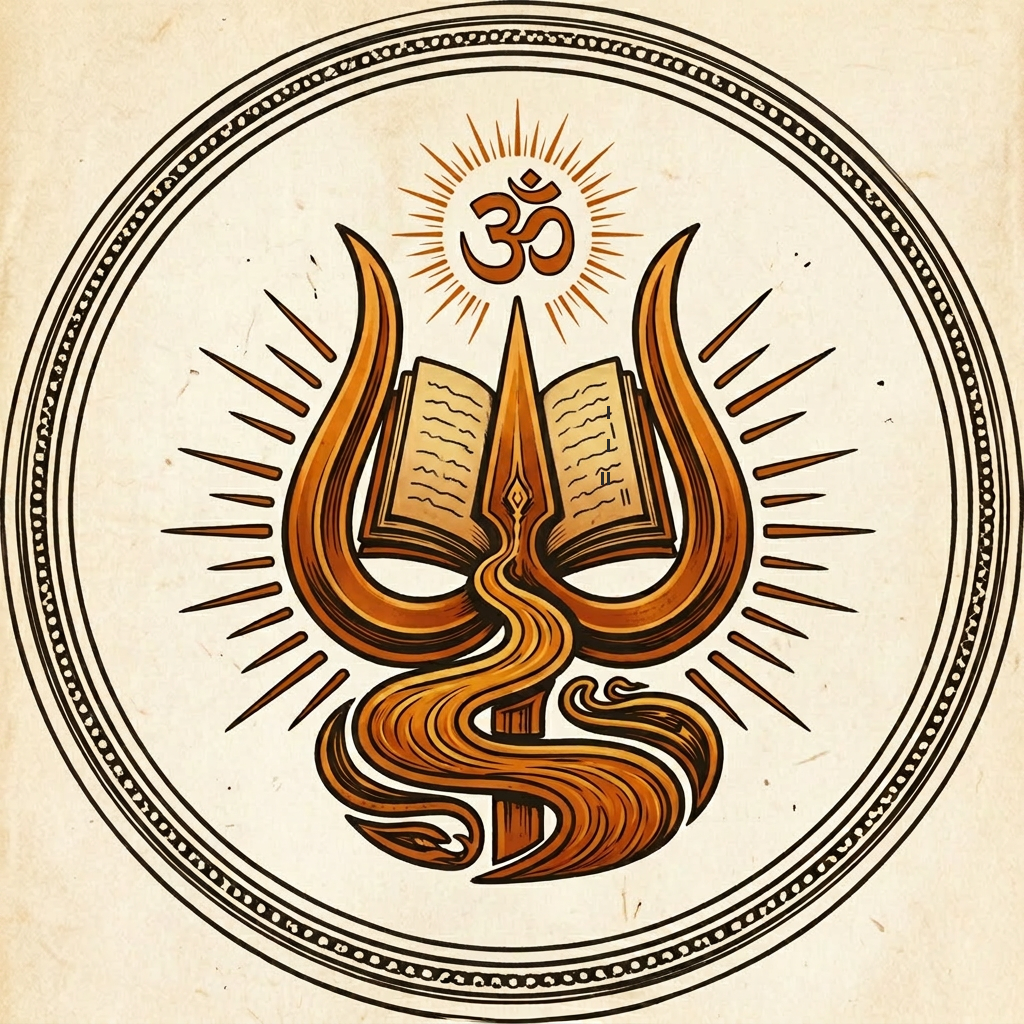
Of all Śiva's iconographic attributes, the triśūla — the three-pronged trident he carries, plants, or wields in nearly every depiction — is probably the single most confidently "explained" symbol in popular Hindu iconography writing. Nearly every retail site, devotional blog, and museum placard offers a crisp, three-item reading of the three prongs. This piece does something slightly different from the usual retelling: it actually goes looking for the verse each explanation is supposedly quoting — and reports honestly on what it found, and didn't.
The most common reading: the three guṇas
The most frequently repeated interpretation maps the trident's three prongs onto the three guṇas of Sāṃkhya-Vedāntic thought — sattva (clarity/balance), rajas (activity/passion), and tamas (inertia/darkness) — the three qualities said to compose all of material nature (prakṛti). Secondary and devotional sources attribute this reading to the Śiva Purāṇa, specifically its Vāyavīya Saṃhitā, but a direct chapter-and-verse citation assigning the guṇa-triad to the trident's three prongs specifically could not be independently verified in this research. The guṇa doctrine itself is entirely real and central to Sāṃkhya philosophy; what's unverified is the specific move of mapping it onto this particular object's three points.
Creation-preservation-destruction, and past-present-future
Two more readings circulate just as widely: the three prongs as creation, preservation, and destruction (the functions distributed across the Trimūrti of Brahmā, Viṣṇu, and Śiva, here folded into Śiva alone as the deity who ultimately performs all three in his own cosmology), and the three prongs as past, present, and future. Both are coherent extensions of ideas that are independently well-grounded — Śiva's identity as destroyer-and-regenerator is solid scripture, and triadic time is a genuine theme elsewhere in the tradition — but neither reading, applied specifically to the trident's three points, turned up a locatable primary-text citation either. These read as reasonable, longstanding folk-devotional extrapolations rather than verses anyone can point to.
The stronger candidate: the three śaktis
One reading has firmer philosophical ground beneath it than the rest, even though it still can't be pinned to the trident's prongs by an exact Āgamic verse: the triad of icchā-śakti (will), jñāna-śakti (knowledge), and kriyā-śakti (action) from Śaiva Tantra — well-attested doctrine in Kashmir Śaivism and Śaiva Siddhānta describing the three fundamental powers through which Śiva, as the source of all, wills, knows, and acts to bring about the universe. Several serious sources map this triad onto the trident specifically. It's a real doctrine, cited by real texts — the open question is only whether this specific object's three prongs is where the Āgamas themselves locate it, or whether that mapping is a later, reasonable application of the three-śakti doctrine to a convenient three-pronged object.
What this essay won't claim
The trident is, honestly, a layered folk-and-philosophical symbol with no single canonical reading that this research could confirm to a specific chapter and verse — and that's worth saying plainly rather than picking the most popular explanation and presenting it with false confidence. What is solid: Śiva's identity as the one who destroys in order for creation to renew is scripturally rock-solid on its own terms, independent of the trident. What's a real, citable doctrine applied to the trident with reasonable but not verse-level certainty: the three-śakti reading. What's widely repeated but unverified at the primary-source level: the guṇa, creation-preservation-destruction, and past-present-future readings. A reader is better served knowing which is which than being handed one tidy, unsourced answer.
Read alongside
Paired with this piece: Trinetra: What Scripture Actually Says About Śiva's Third Eye, which traces the better-and-worse-sourced versions of Śiva's other best-known attribute the same way.
Sources
- Well-attested independently of the trident: Śiva's role as destroyer-regenerator (general Śaiva doctrine); the icchā/jñāna/kriyā-śakti triad (Kashmir Śaivism, Śaiva Siddhānta).
- Unverified at the primary-source level in this research: the three-guṇa, creation-preservation-destruction, and past-present-future readings of the trident's three prongs specifically — widely repeated in secondary/devotional literature (commonly, if loosely, attributed to the Śiva Purāṇa's Vāyavīya Saṃhitā) but not confirmed here to an exact chapter and verse.
- Explicitly not claimed: that any one of the above readings is ‘the’ correct or sole scriptural meaning of the triśūla — the honest state of the evidence is multiple circulating interpretations of varying textual strength, not one settled answer.