Ritual and philosophical discourse, open to both
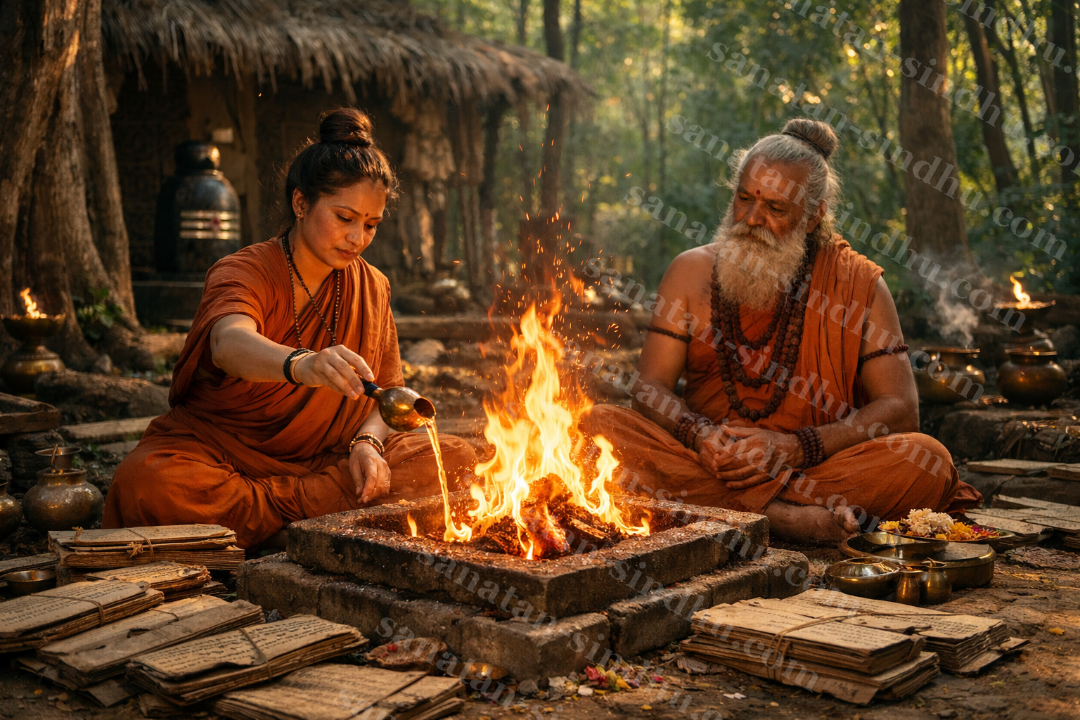
In the foundational texts of Sanātana Dharma — the Śruti, "that which is heard" — the intellectual and spiritual capacity of women was not treated as inherently different from that of men. The Vedic era (c. 1500–500 BCE) was one in which women took part in ritual sacrifice (yajña) and in philosophical discourse, not as onlookers but as participants.
This is the first of five pieces tracing how that standing was held, narrowed, reasserted, and fought for again across the long arc of Indian religious history — from the Vedic seers through the Smṛti and epic age, the Śramaṇa paths of Buddhism and Jainism, the Bhakti and Tantric movements, and the reform traditions of Sikhism and the Ārya Samāj.
The Ṛṣikās — female seers of the Ṛgveda
The Ṛgveda attributes several hymns directly to female seers — Ṛṣikās, or Brahmavādinīs. Ghoṣā, Lopāmudrā, Maitreyī, and Vāk Āmbhṛṇī are among the most prominent.
The clearest of these is the Devī Sūkta (Ṛgveda 10.125), composed by the sage Vāk Āmbhṛṇī — one of the earliest declarations of non-dual reality (Advaita) and of the divine as feminine. She does not speak as a worshipper addressing a separate power; she speaks as that power itself:
"I am the Queen, the gatherer-up of treasures, most thoughtful, first of those who merit worship... By me alone all eat the food that feeds them..."
Later tradition identifies Vāk, speech itself personified, with Sarasvatī — though the Ṛgvedic hymn stands on its own terms, centuries before that identification hardens into an iconographic one.
Gārgī and Maitreyī — philosophical giants of the Upaniṣads
In the Bṛhadāraṇyaka Upaniṣad (c. 800 BCE), the court of King Janaka hosts one of the great philosophical debates of the age. The sage Yājñavalkya defeats scholar after scholar, until he is challenged by a woman: Gārgī Vācaknavī. She questions him on what the universe itself is woven upon, pressing him past the point where his other opponents had stopped. Gārgī is not merely tolerated in this exchange — she is treated as an arbiter of the highest knowledge (brahma-vidyā).
In the same Upaniṣad, Yājñavalkya's own wife Maitreyī is offered a division of his wealth before he leaves for the life of a renunciant. She turns it down, asking instead: "What shall I do with that by which I do not become immortal?" She wants liberation (mokṣa), not property — and the text treats that want as entirely legible, the same aspiration a man might have.
A narrower material world
None of this made the wider society symmetrical. The spiritual domain was strikingly open; the material and lineal one was not. Prayers for the birth of heroic sons recur through the Atharvaveda, a plain record of preference for male heirs — even as the same Veda (11.5.18) advocates for the Upanayana, the sacred-thread ceremony that opened a daughter's own formal education. The Vedic era does not resolve into a single, tidy verdict on women's standing. It holds a real elevation in the spiritual sphere alongside a real asymmetry in the domestic one, and both are visible in its own texts, not read into them from outside.
Continue to Reverence and Restriction for how that balance shifts as the Smṛtis and epics take shape.