
Reverence and restriction, in the same text
As Vedic society gave way to a more settled, agrarian world, the fluidity of the early period hardened into the codified era of the Smṛtis — remembered law texts — and the Itihāsas, the two great epics. Nowhere is the resulting contradiction sharper than in the Manusmṛti, the Laws of Manu: a text that can sound, within the space of a few verses, both reverent and severely restrictive toward women.
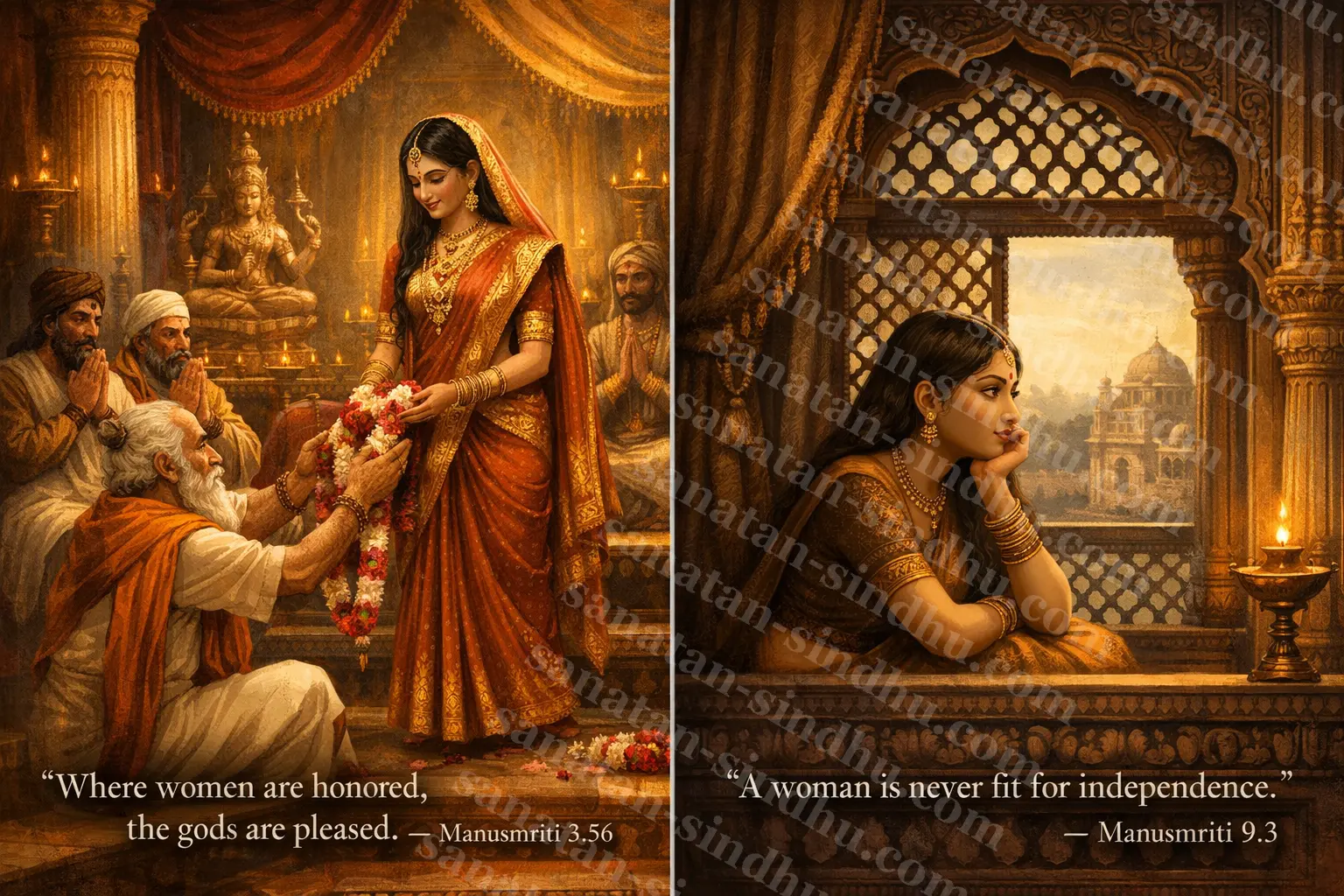
The reverential voice is unambiguous:
Yatra nāryas tu pūjyante ramante tatra devatāḥ — "Where women are honoured, there the gods are pleased; but where they are not honoured, no sacred rite bears fruit." (Manusmṛti 3.56)
"If the wife is radiant, the whole house is radiant; but if she is without beauty, all will appear dismal." (Manusmṛti 3.62)
The restrictive voice, elsewhere in the same text, is just as unambiguous:
Na strī svātantryam arhati — "Her father guards her in childhood, her husband in youth, her sons in old age; a woman is never fit for independence." (Manusmṛti 9.3)
The text also gradually narrows women's access to the Upanayana, replacing it with marriage as the primary rite of passage — closing off the same formal path to Vedic study that the Ātharvaṇic verse in the previous piece had once advocated.
Reform movements, the Ārya Samāj foremost among them, read this contradiction as evidence of prakṣipta — later interpolation into an originally more consistent text, added as feudal society hardened around it. The Ārya Samāj's own reading of what "back to the Vedas" means for women is the subject of the last piece in this series.
Draupadī — dharma interrogated in the assembly hall
Tightening law did not produce passive women in the epics that sit alongside it. In the Mahābhārata, when Draupadī is dragged into the Kuru assembly, she does not weep in silence. She interrogates the assembly's own greatest lawgivers — Bhīṣma, Droṇa — on the legal nature of dharma itself, asking whether a husband who has already staked and lost his own freedom possessed the standing to stake hers. The question is never cleanly answered in the text; it is left hanging over the men who could not answer it.
Sītā — duty, and the latent Śakti beneath it
Sītā is often flattened into a passive figure, but the Vālmīki Rāmāyaṇa presents her as a fierce adherent to her own dharma — she chooses the forest, not because she is compelled to, but because that is where her duty places her. Later tradition takes this further still: in the Adbhuta Rāmāyaṇa and in Śākta retellings, Sītā takes the form of Mahākālī to slay a thousand-headed Rāvaṇa — a way of saying, in narrative rather than argument, that the domestic wife already holds the latent power of the supreme destroyer. Read the fuller telling of Rāma and Sītā's story.