Guru Nānak and the dismantling of subjugation
Centuries of invasion and social decay — female infanticide, child marriage, strict purdah — had settled over the same society the last four pieces in this series have traced. Sikhism, founded in the 15th century, set out to dismantle that settlement directly rather than work around it.
Guru Nānak, the first Guru, wrote against the degradation of women in terms that leave no room for softening. In the Guru Granth Sāhib (Ang 473):
"From woman, man is born; within woman, man is conceived; to woman he is engaged and married... Why call her bad, from whom kings are born?" (so kyo mandā ākhiye jit jammeh rājān)
Sikh tradition abolished satī and the veil as a matter of doctrine, not merely of individual conscience.
Mātā Khīvī and Mai Bhāgo — women in Sikh history
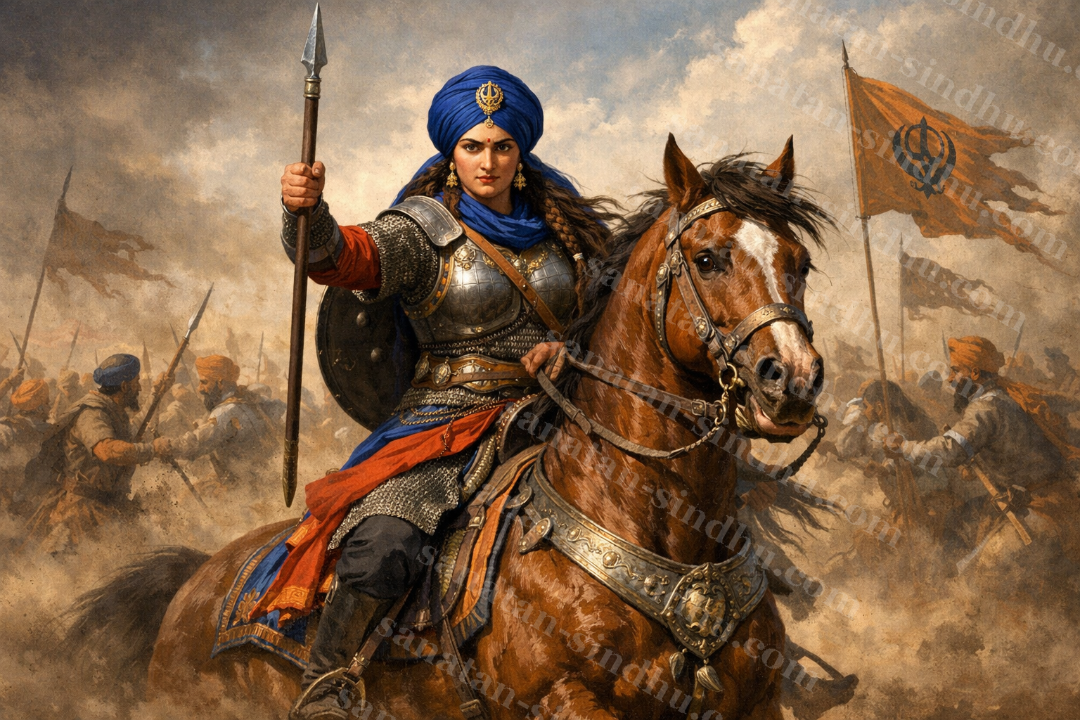
That doctrine had names attached to it. Mātā Khīvī was placed in charge of the Laṅgar, the free communal kitchen that remains one of Sikhism's most distinctive institutions. Mai Bhāgo was a Sikh warrior who led soldiers into battle against the Mughals in 1705 — not a symbolic figure but a commanding one, on the field.
Ārya Samāj — reclaiming the Vedic woman
In the 19th century, Swami Dayānanda Sarasvatī founded the Ārya Samāj on the call "back to the Vedas" — treating the Śruti alone as authoritative and setting aside the later Smṛtis he considered corrupted by interpolation, the same reasoning the Manusmṛti piece in this series describes being applied to that text's harsher verses.
In his Satyārtha Prakāśa ("The Light of Truth"), Dayānanda argued that gender discrimination had no Vedic basis. He pressed for women's right to wear the sacred thread, recite the Gāyatrī Mantra, and study the Vedas directly — and the Ārya Samāj went on to open Gurukuls specifically for girls, reviving the ancient ideal of the Brahmavādinī and helping trigger a broad wave of women's education in pre-independence India.