
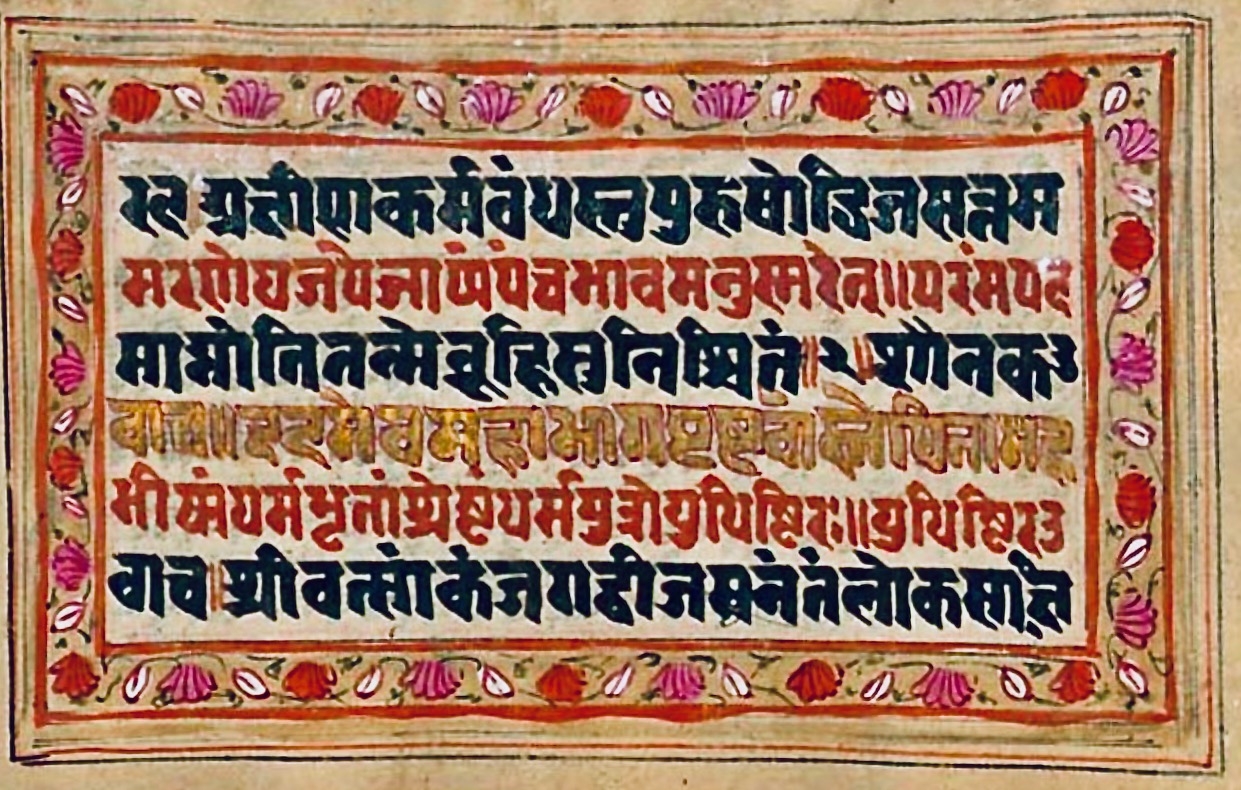
§ 1 · The verse
कर्मण्येवाधिकारस्ते मा फलेषु कदाचन।
मा कर्मफलहेतुर्भूर्मा ते सङ्गोऽस्त्वकर्मणि॥
karmaṇy-evādhikāras te mā phaleṣu kadācana /
mā karma-phala-hetur bhūr mā te saṅgo 'stv akarmaṇi //
§ 2 · Translation
"To action alone hast thou a right and never at all to its fruits; let not the fruits of action be thy motive; neither let there be in thee any attachment to inaction."
§ 3 · Perspectives — three schools
Advaita (Śaṅkara)
Action is enjoined only so long as the seeker has not realised the Self; the verse counsels detachment as preparation for jñāna, not as an end.
Vishishtādvaita (Rāmānuja)
Karma is offered to the Lord as kainkarya; the renunciation enjoined is of fruits, not of the act itself, which remains an act of worship.
Dvaita (Madhva)
The agent is dependent on Hari; the prohibition of attachment to fruits aligns the soul with the Lord's will, by which alone results arise.
Sources: Śaṅkara's Gītā Bhāṣya; Rāmānuja's Gītā Bhāṣya; Madhva's Gītā Bhāṣya. Editorial summaries; full texts available below.
§ 4 · Editorial note
The verse is the cornerstone of the doctrine of niṣkāma karma — action performed without craving for its outcome. It does not counsel idleness; the second hemistich pre-empts that misreading by forbidding attachment to akarman as well.
Grammar is decisive here. अधिकारः (adhikāra) denotes rightful claim, not merely permission; the verse hands the agent a domain — the act — and withdraws from that domain the fruit. The three Vedānta schools differ on what kind of agency remains after that withdrawal.
For a longer survey, see the entry Niṣkāma karma — acting without attachment.
The full essay built on this verse and the four that follow it — Karma Yoga — the discipline of acting without craving the fruit — covers samatva, buddhi-yoga, “skill in action”, and svadharma.
Gītā Bhāṣya — Ādi Śaṅkara, a short sample
Editorial synthesis, not a verbatim translation — expands on the Advaita summary in § 3 above.
Śaṅkara reads adhikāra and phala as two separate domains that the verse deliberately pulls apart. The seeker's adhikāra — rightful claim — extends only to the act itself; the fruit belongs to a causal order the agent does not control and should not claim as a motive.
On this reading, the verse is not a counsel against action but a redirection of why one acts. Karma remains obligatory for as long as the seeker has not realised the Self; performed without craving for its result, it purifies the mind (citta-śuddhi) and becomes preparation for jñāna, rather than a path to liberation in its own right. Renunciation, in the Advaita reading, is ultimately renunciation of the sense of doership — not of the act.
The full Bhāṣya — verse by verse, with Sanskrit and a facing English translation — is still being prepared for the library.