

Two fasts, one worry
Ahoi Aṣṭamī and Jīvitputrikā are usually mentioned in the same breath — both are fasts a mother keeps for her child's (traditionally, her son's) long life, both fall within a few weeks of each other in the autumn festival season, and both are kept mostly by women in North India, Bihar and Nepal. It would be easy, following the pattern this series used for Karva Chauth's regional kin, to treat them as one underlying fast in two regional costumes.
That would be inaccurate, and this essay says so plainly rather than smoothing it over for a tidier structure. Ahoi Aṣṭamī falls on the eighth day of Kārtika's waning fortnight, close on the heels of Karva Chauth; Jīvitputrikā (also called Jītiyā) is a three-day observance across the seventh to ninth days of Āśvina's waning fortnight, weeks earlier. Their origin stories share no character, no plot, and — as the next two sections show — not even the same kind of textual foundation. They are grouped in this one essay because they share a purpose and a season, not because one is a variant of the other.
Ahoi Aṣṭamī — the hedgehog and the goddess
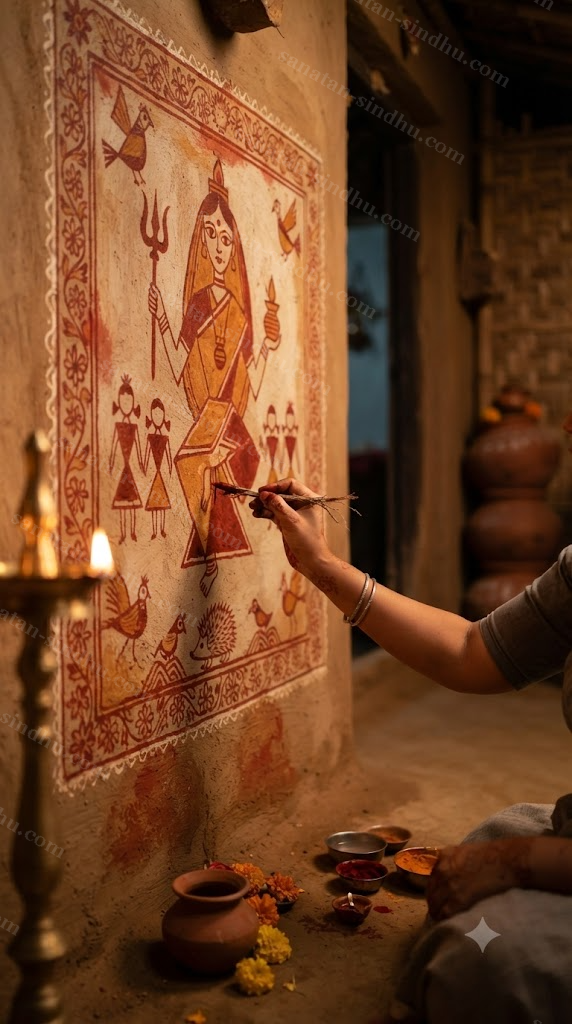
The vrata-kathā told on Ahoi Aṣṭamī describes a woman who went to dig clay from a forest bank to plaster her home for Dīvālī, and in doing so accidentally struck and killed a young hedgehog (or, in some tellings, a jackal cub) sheltering in the earth. Fearful that the death would fall as a curse on her own children, she sought the goddess Ahoi Mātā's forgiveness, drew the goddess's image with a mother hedgehog and her young beside it, and kept a fast in her honour. The goddess, moved by her devotion, protected her children's lives, and the fast has been kept ever since to secure a mother's sons.
This essay has not located a named classical Purāṇa or Dharmaśāstra text prescribing Ahoi Aṣṭamī — the fast appears to rest, as far as this research has traced it, entirely on the vrata-kathā tier: an oral and pamphlet-transmitted story, not a Sanskrit textual mandate. That places it closer to Santoshi Mātā's evidentiary footing, from earlier in this series, than to Karva Chauth's. Being folk in origin doesn't make it less real or less worth keeping — this series has said that about every fast resting mainly on the kathā tier — but it is worth being precise that Ahoi Aṣṭamī and the Purāṇically-named fasts elsewhere in this series are not sourced the same way.
Jīvitputrikā — a prince's sacrifice, retold as a mother's vow
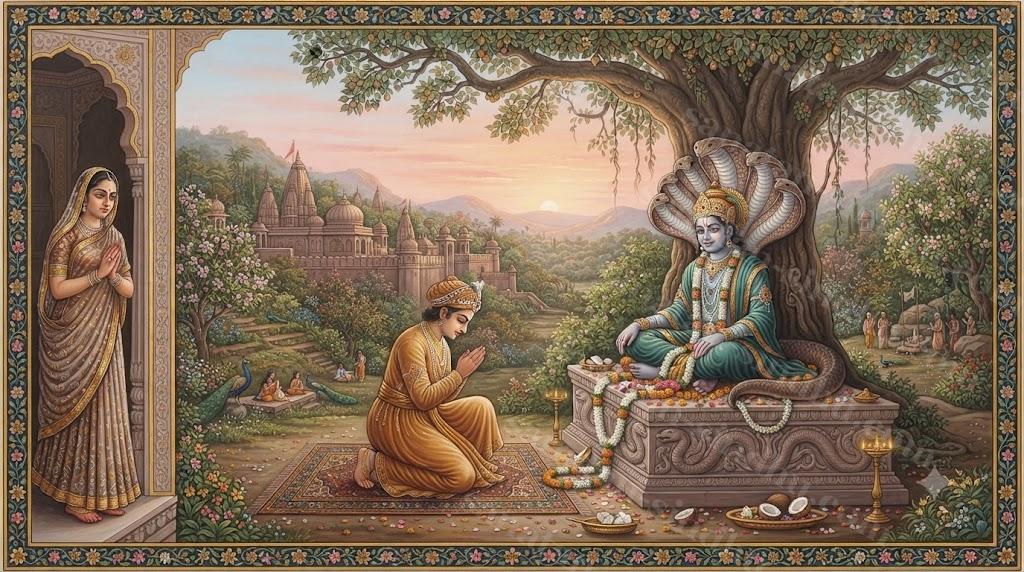
Jīvitputrikā's origin story could hardly be more different in texture, or in its documented textual history. Its central figure is Jīmūtavāhana, a prince who offers his own life to Garuḍa, the great bird who by ancient pact devours one Nāga (serpent-being) each day, in place of the young Nāga about to be taken. Moved by the prince's willingness to die for a stranger, Garuḍa spares them both, and the tale is kept in the vrata-kathā tradition as a model of the kind of protective self-sacrifice a mother invokes on her own child's behalf.
Unlike Ahoi Aṣṭamī, this story has a real and datable literary history. The Jīmūtavāhana legend survives in the eleventh-century Kathāsaritsāgara of Somadeva and the Bṛhatkathāmañjarī of Kṣemendra, both drawing on the much older, now-lost Bṛhatkathā — and, earlier than either surviving text, it was dramatized in the seventh-century Sanskrit play *Nāgānanda*, attributed to the emperor Harṣa and framed, in the scholarship that has studied it, as a Buddhist legend rather than a Purāṇic one. That is a genuinely interesting wrinkle this essay wants to name rather than flatten: a story with roots in Buddhist-inflected court drama, absorbed over centuries into a Hindu mother's household vrata, kept today mostly by communities with no particular awareness of a seventh-century play standing behind the kathā they recite. The three-day fast itself — culminating in a full waterless day on the middle tithi — is a considerably more demanding observance than Ahoi Aṣṭamī's single day.
Kept apart, not blended
Two fasts, then, that share a mother's worry and a season, but not a source: one resting on an unnamed oral kathā with no traced classical text behind it, the other resting on a genuinely old and cross-tradition literary lineage that predates most of the Purāṇic material cited elsewhere in this series by centuries. Presenting them as "the same fast, differently named" — the way this series does treat Karva Chauth's true regional kin — would erase that difference for the sake of a tidier essay. Keeping them apart, in the same essay but under separate headings, is the more honest choice.
Return to What Is a Vrata? — the textual foundations of Hindu fasting for the fuller cross-tradition treatment this series doesn't repeat in every essay, and for the rest of the fasting series as each piece is added.
Sources
- Folklore and oral tradition. The Ahoi Aṣṭamī vrata-kathā (the hedgehog/jackal-cub story), consulted via general festival-documentation sources; no classical Purāṇic or Dharmaśāstra source has been located for this fast, and that absence is stated above rather than papered over.
- Primary literature. Nāgānanda, the Sanskrit play attributed to Harṣa (7th century CE), for the earliest surviving dramatization of the Jīmūtavāhana legend.
- Classical narrative literature. Somadeva's Kathāsaritsāgara and Kṣemendra's Bṛhatkathāmañjarī (both 11th century CE), for the fuller telling of the Jīmūtavāhana story, both drawing on the lost Bṛhatkathā.
- A note on categorisation. Several popular sources describe Jīmūtavāhana's story as a "Buddhist legend" given its dramatization in a courtly Sanskrit play with Buddhist framing; this essay repeats that characterisation as reported rather than independently adjudicating a Buddhist-versus-Hindu origin for a story that, in practice, has long since been absorbed into Hindu household ritual.