Karaka Chaturthi — the textual name behind the folk one
"Karva Chauth" is a folk contraction of an older name: Karaka Chaturthī — the fourth lunar day (caturthī) of the karaka, the small earthen or brass pot central to the fast's evening ritual. The observance is named in the Nārada Purāṇa and the Vāmana Purāṇa, and its rules — which tithi, which restrictions, how the rite is performed — are set out in the same nibandha (digest) literature this series has cited before, the Dharmasindhu and Nirṇayasindhu. That places Karva Chauth in the same textual tier as Ekādaśī or Śivarātri, even though its household form today owes at least as much to regional custom as to the Purāṇic name.
One popular etymology holds that karva was also the name of a devoted woman whose story is folded into the fast's own kathā tradition; another simply reads karva as the pot itself, the vessel every version of the ritual keeps in some form. This essay doesn't adjudicate between the two — both circulate, and neither is a Purāṇic claim requiring a citation.
Draupadī's fast, retold
The version of Karva Chauth's origin most widely told today is set in the Mahābhārata. While Arjuna undertakes a long, solitary penance in the mountains, Draupadī, anxious for him, turns to Kṛṣṇa. Kṛṣṇa reminds her that Pārvatī once undertook a similar fast for Śiva's own well-being, and Draupadī, taking the same vow for Arjuna's safety, keeps it until his return.
This retelling is worth one honesty check: it is repeated across a great many vrata-kathā sources, but this essay has not traced it to a specific parva or chapter in a critical edition of the Mahābhārata. That doesn't make the story less real as tradition — it is exactly the kind of living, orally transmitted retelling this series has treated as its own primary tier since the first essay — but it is a different kind of claim than "the Nārada Purāṇa names Karaka Chaturthī," and this essay keeps that difference visible rather than letting one borrow the other's certainty.
The sieve and the moon
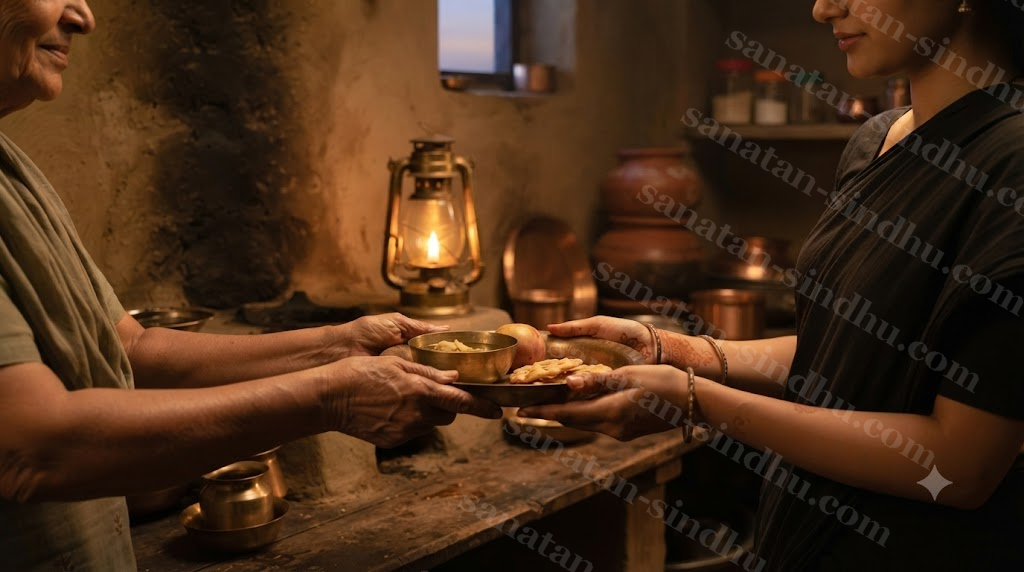
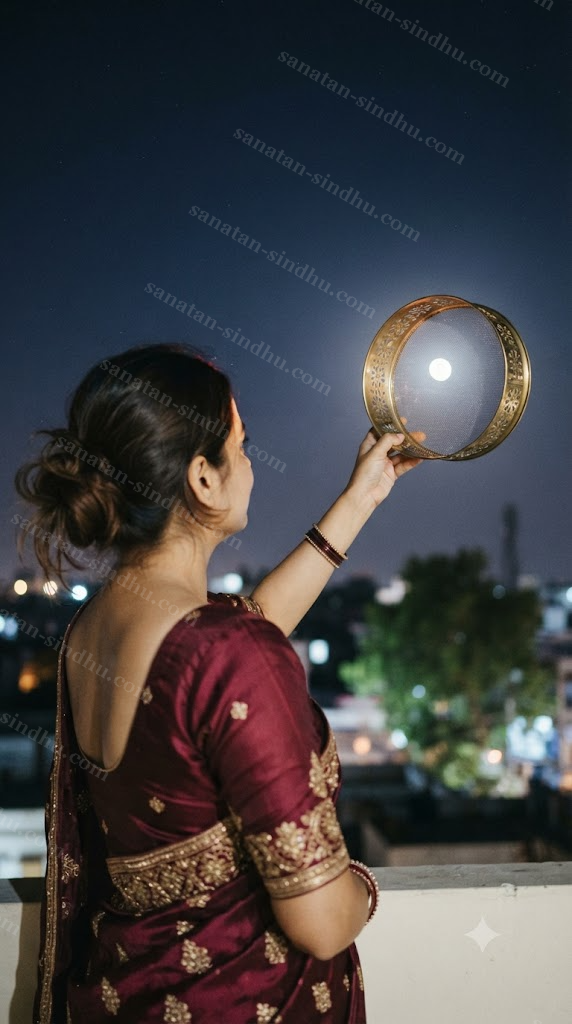
The ritual itself is nirjala — without water — from before sunrise until moonrise, one of the longer and stricter fasts in this series. The day opens before dawn with sargī, a meal (often sent by the wife's mother) eaten before first light; the rest of the day passes without food or water. In the evening, women gather to hear the vrata-kathā together, and the fast ends only after moonrise, when the wife views the moon through a chalni — a sieve — then turns the same sieve toward her husband's face, and finally takes water and food from his hand. The sieve is the ritual's own small piece of choreography: an indirect, mediated way of looking at both the distant moon and the husband standing in front of her, in the same gesture.
One fast, many regional names
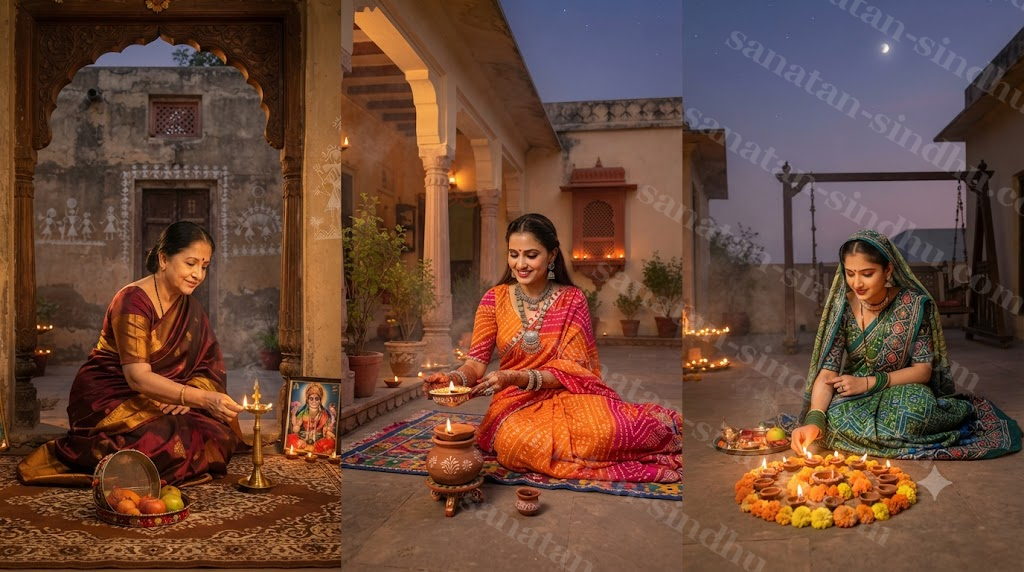
Karva Chauth's North Indian form is well known, but it is one member of a genuinely regional family, each with its own name, its own kathā, and often its own season, all sharing the same underlying shape — a wife fasting for her husband's life:
- Andhra Pradesh's Aṭla Tāddē, observed in the month of Āśvina, where women fast and pray to the goddess for a husband as good as Śiva, breaking the fast after moonrise in a mirror of the North Indian ritual.
- Tamil Nadu's Karaḍaiyān Nōṇbu, kept on the last day of the Tamil month Māsi, centred on the legend of Sāvitrī winning her husband Satyavān back from Yama — the same Sāvitrī story this series returns to in its own essay, A Wife Argues with Death — Vaṭ Sāvitrī.
- Karnataka's Bhīmana Amāvāsyē, observed on the new-moon day of Āṣāḍha, with its own local kathā and lamp-lighting ritual, distinct in name and season from both of the above.
Unlike Ahoi Aṣṭamī and Jīvitputrikā — covered together in this series' companion essay, but named there as two genuinely separate fasts rather than regional kin — these three and Karva Chauth really are the same underlying vrata wearing different regional dress: same purpose, same general shape (a wife's fast for her husband), different calendars and different local kathās layered on top.
Not every reading agrees
Contemporary discussion of Karva Chauth carries a real and ongoing critique, and this essay isn't the place to resolve it, only to name it plainly: the fast is read by many as reinforcing a husband-centred model of marriage, where a wife's devotion is expressed specifically through self-denial on his behalf, with no symmetrical practice asked of husbands for wives. That reading doesn't erase what the fast means to the women who keep it by choice and find real meaning in it — both things are true at once, and this essay isn't going to flatten either one into the other.
The sharper, doctrinal version of this critique was already named in the first essay of this series: the Sikh Rahit Maryādā doesn't merely critique this category of fast, it rejects it outright, specifically naming fasting for a husband's well-being as a practice a Khālsā Sikh should have no part in. That is a different kind of objection than the feminist critique above — one is an internal argument about what a fast means and does within Hindu practice; the other is a neighbouring tradition's flat doctrinal break from the whole category. Both belong here, held separately rather than merged into one generic "some people disagree" sentence.
Return to What Is a Vrata? — the textual foundations of Hindu fasting for the fuller cross-tradition treatment, and for the rest of the fasting series as each piece is added.
Sources
- Primary scripture. Nārada Purāṇa and Vāmana Purāṇa, for Karaka Chaturthī by name, consulted via named secondary summaries rather than critical editions — the same limitation flagged elsewhere in this series.
- Classical commentary. Dharmasindhu and Nirṇayasindhu, the same vrata-practice digests cited in this series' first essay, here specifically for Karaka Chaturthī's rules.
- Itihāsa tradition, not yet independently verified. The Draupadī–Arjuna–Kṛṣṇa retelling, widely repeated in vrata-kathā sources but not yet traced to a specific Mahābhārata parva or chapter in a critical edition — named here as tradition, not as a verified textual citation.
- Regional documentation. Aṭla Tāddē (Andhra Pradesh), Karaḍaiyān Nōṇbu (Tamil Nadu) and Bhīmana Amāvāsyē (Karnataka), consulted via general festival-documentation sources rather than a single named ethnographic study.
- Cross-tradition and critical sources. The Sikh Rahit Maryādā's explicit rejection of fasting for a husband's well-being, previously cited in this series' first essay; general contemporary discussion of the fast's gender-role critique, referenced without a single named source since this reflects a broad and ongoing discussion rather than one study's finding.