

Sāvitrī's choice
The story is told in the Mahābhārata's Vana Parva, narrated to the Pāṇḍavas by the sage Mārkaṇḍeya — an embedded telling-within-a-telling, the same structure this series noted for the Devī Māhātmya's own frame story in the Navrātri essay. Princess Sāvitrī chooses Satyavān as her husband despite the sage Nārada's warning that he is fated to die within the year — and having chosen, refuses every attempt by her father to talk her out of it. She marries him, moves to the forest hermitage where he lives with his blind, exiled father, and lives out the year knowing exactly which day it will end.
The argument with Yama
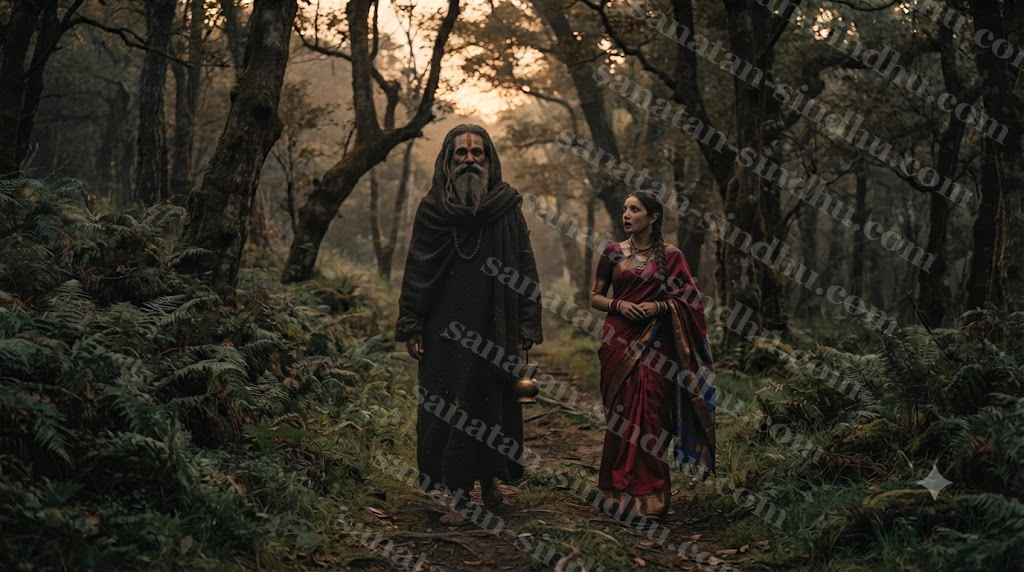
On the appointed day, Yama — the god of death himself, not a lesser messenger, a detail the text uses to signal how extraordinary Satyavān's own virtue is understood to be — comes in person to take Satyavān's soul. Sāvitrī follows him on foot as he departs, and rather than plead or fast or perform ritual austerity, she argues: precise, respectful speech about dharma, duty and the nature of righteous conduct, offered as Yama walks. Impressed rather than irritated, Yama grants her boons in sequence, each for the wisdom of what she has just said rather than in response to a request for Satyavān's life directly: the restoration of her father-in-law's eyesight and kingdom, then descendants for her own father's line, then — asked for herself — sons of her own. Yama grants it without thinking through the trap he has set for himself, and Sāvitrī, calm, points out that she cannot bear a son by any man but the one now dead beside them. Cornered by his own word, Yama restores Satyavān's life. It is worth naming plainly what kind of victory this is, against the rest of this series: not Draupadī's endurance in the Karva Chauth essay, not the hunter's unknowing accident in the Śivarātri essay — Sāvitrī wins by out-arguing Death on the ground of dharma itself.
The tree that witnessed
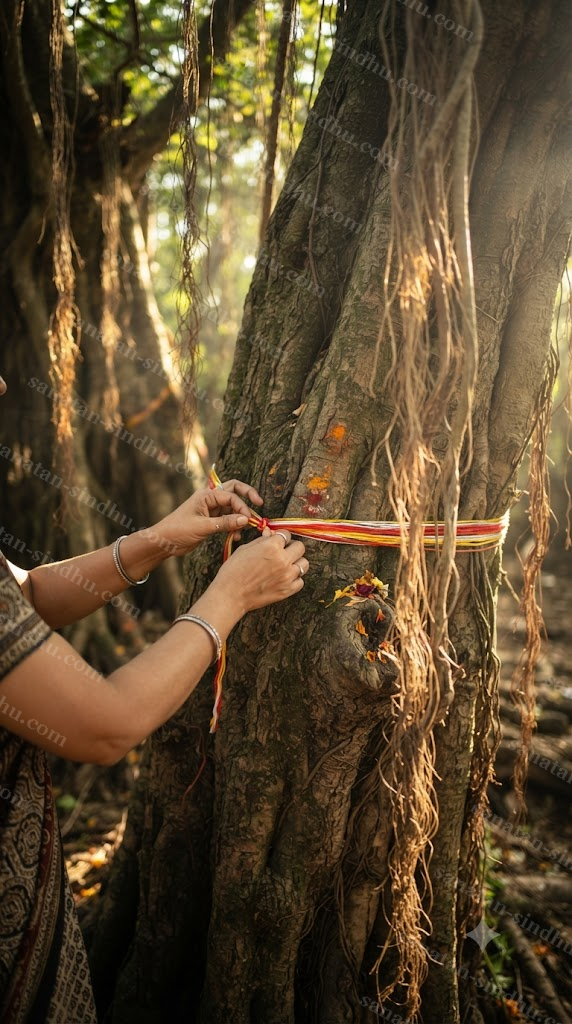
Tradition places the whole exchange beneath a vaṭa — a banyan tree — under which Satyavān had been cutting wood when he collapsed, and it is this tree the vrata takes its name from and its ritual centres on. The banyan's vast canopy and aerial roots, which can themselves take root and grow into new trunks, are read across Hindu tradition as a symbol of endurance and long life — the same association behind the Akṣaya Vaṭa, the "undying banyan," named at several pilgrimage sites. Women keeping the fast today gather at a banyan tree, tie a sacred thread around its trunk, circle it in parikramā, and recite Sāvitrī's story aloud — the tree standing in, in the ritual's own logic, for the one that stood witness to Yama's defeat.
One story, two calendars
As with several fasts already covered in this series, regional calendar convention splits Vaṭ Sāvitrī's date without splitting its meaning. North India keeps it on Jyeṣṭha Amāvasyā — the new-moon day. Maharashtra, Gujarat and parts of the South keep it roughly a fortnight later, on Jyeṣṭha Pūrṇimā — the full-moon day of the same lunar month — under the name Vaṭ Pūrṇimā. Both mark the same Sāvitrī–Satyavān story, the same banyan-tree ritual, and the same purpose — a wife's vow for her husband's long life — differing only in which of the month's two calendar conventions, amānta or pūrṇimānta, a given region's tradition follows.
A different kind of vow
This essay closes a loop this series opened in its Karva Chauth essay, which named Sāvitrī's story and promised a fuller telling in an essay of its own — this is that essay. It belongs to the same category the earlier essay named and the same critique applies without needing to be re-argued here: the Sikh Rahit Maryādā's outright rejection of fasting undertaken specifically for a husband's well-being covers Vaṭ Sāvitrī exactly as it covers Karva Chauth. What this essay adds to that earlier ground is the shape of the story itself — a wife who wins not through endurance or ritual precision but through argument, which is worth holding onto as its own distinct mode of devotion inside a series that has, by now, shown several different ones.
Return to What Is a Vrata? — the textual foundations of Hindu fasting for the fuller cross-tradition treatment, and for the rest of the fasting series as each piece is added.
Sources
- Primary scripture. Mahābhārata, Vana Parva, for the Sāvitrī–Satyavān–Yama narrative as narrated by the sage Mārkaṇḍeya to the Pāṇḍavas — consulted via named secondary summaries rather than a critical edition with a specific chapter citation, the same limitation flagged for the Draupadī retelling in this series' Karva Chauth essay.
- Regional and ritual documentation. The Jyeṣṭha Amāvasyā (North India) and Jyeṣṭha Pūrṇimā / Vaṭ Pūrṇimā (Maharashtra, Gujarat, parts of the South) calendar divergence, and the banyan-tree thread-tying and parikramā ritual, consulted via general festival-documentation sources rather than a single named ethnographic study.
- Cross-tradition sources. The Sikh Rahit Maryādā's rejection of fasting for a husband's well-being, previously cited in this series' Karva Chauth essay, applied here rather than re-argued in full.