Four days, no priest required
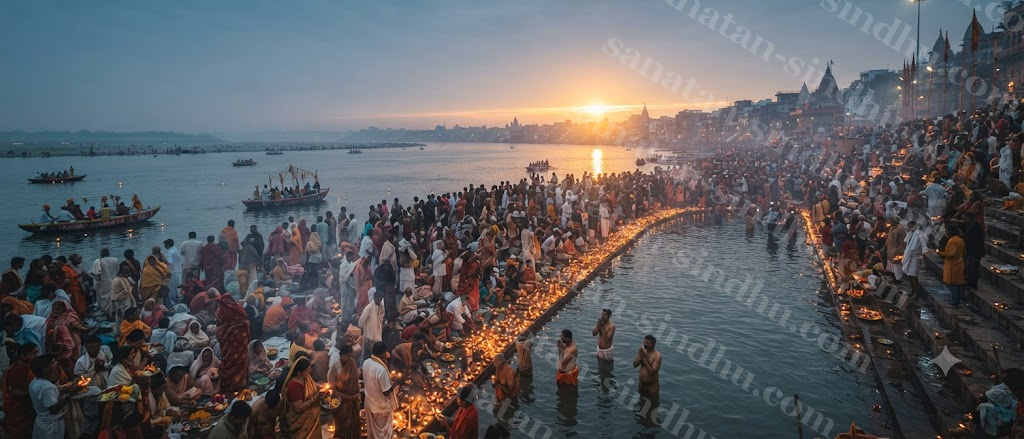
Chhaṭh closes this series on a fast that breaks its own pattern in a specific way worth naming upfront: almost everything else in this series rests, to some degree, on a named Purāṇa, a digest text, or at minimum a datable literary retelling. Chhaṭh's textual claims are thinner than any of those, and this essay says so plainly rather than borrowing a pedigree it hasn't verified. What Chhaṭh does have, unmistakably, is scale and intensity: four days, centred on the sixth day (ṣaṣṭhī) of a lunar fortnight, kept overwhelmingly in Bihar, eastern Uttar Pradesh, the Nepali Tarai, and now wherever their diaspora communities have settled — performed by the devotee directly at a riverbank or other body of water, with no priest, no elaborate mūrti, and no temple required at all.
Sun worship since the Ṛgveda — the festival's name, a separate question
Sūrya worship itself is genuinely ancient — the Ṛgveda contains real hymns to the sun, among the oldest devotional material in this series' source base. What this essay hasn't verified is a direct textual line from a specific Ṛgvedic hymn to the festival practised today under the name Chhaṭh. That distinction matters: "sun worship is old" is well supported; "this specific four-day festival is named or prescribed in the Ṛgveda" is a claim this essay has seen asserted widely but not traced to a citable hymn, and it's kept as an open flag rather than folded into settled fact.
Chhaṭhī Maiyā, and a reading worth naming as a reading
The festival's second deity, alongside Sūrya himself, is Chhaṭhī Maiyā — understood in living devotion as Sūrya's sister, a maternal, protective goddess invoked for children's health and a family's prosperity. Some modern devotional and scholarly writing identifies her with Uṣas, the Vedic dawn goddess — a plausible and interesting reading, given how closely dawn and Sūrya are already bound in Vedic hymnody, but this essay presents it as an interpretation rather than a settled textual equation, since it hasn't traced a source that identifies the two by name inside a primary text itself.
Karṇa, Draupadī, and the shape of the four days
Popular tradition names two itihāsa figures as Chhaṭh's earliest practitioners. Karṇa, Sūrya's own son in the Mahābhārata, is remembered as the first to perform this kind of standing sun-worship. Later, the sage Dhaumya is said to have advised Draupadī to keep the same observance to help the Pāṇḍavas recover their lost kingdom. As with the Sāvitrī and Draupadī retellings elsewhere in this series, this essay hasn't traced either claim to a specific parva or chapter in a critical edition of the Mahābhārata — it's named here as living tradition, not as a verified citation.
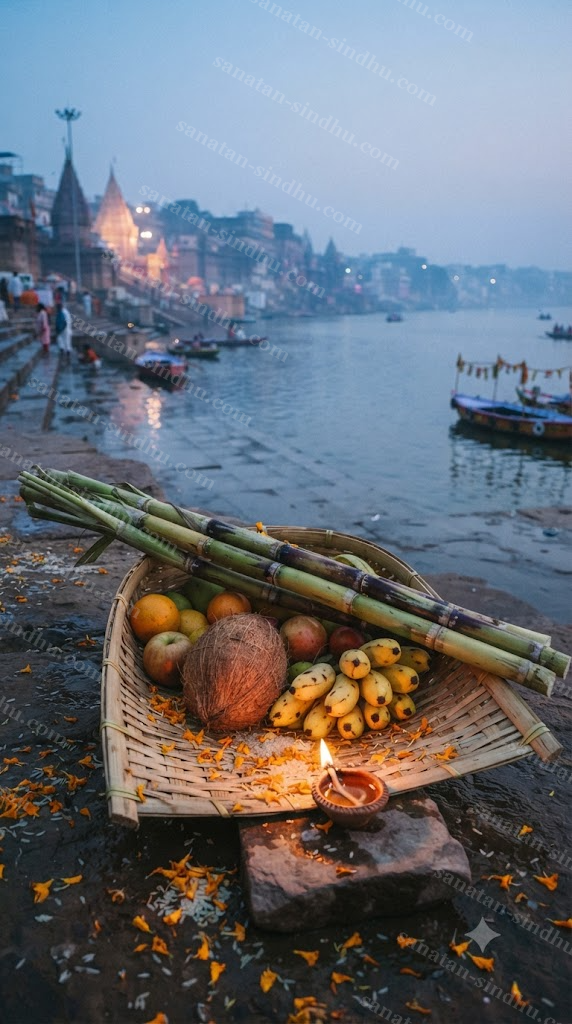
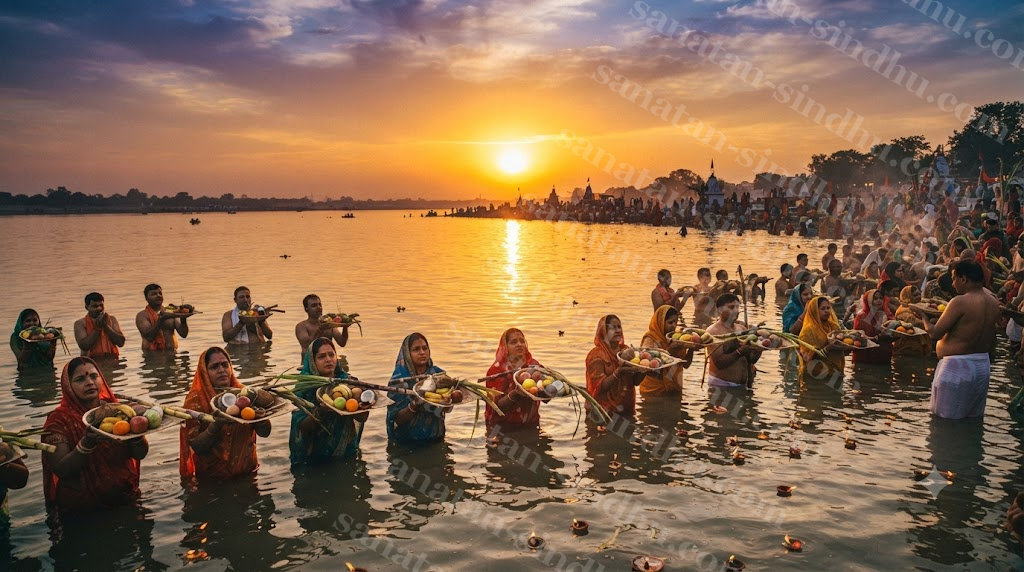
The four days themselves are exact and demanding. Nahāy Khāy (day one) opens with a purifying bath and a single simple meal. Kharnā (day two) closes at sunset with a meal of kheer — the last food or water the observer will take for roughly the next thirty-six hours. Sandhyā Arghyā (day three) is an offering to the setting sun, standing in a river or pond at dusk — unusual among solar worship traditions generally, which more often honour only the sunrise. Uṣā Arghyā (day four) closes the fast at the following dawn, with an offering to the rising sun and the breaking of the vrata, ending a fast stricter in total duration than any other single observance in this series, including Nirjala Ekādaśī.
Not every tradition agrees
The cross-tradition disagreements this series named at length in its first essay — the Sikh Rahit Maryādā's rejection of fasting tied to a fixed calendar day, the Ārya Samāj's critique of Purāṇic-style vrata-and-kathā ritualism, Jainism's and Buddhism's rejection of Purāṇic authority outright — apply here as much as to any other fast in this series, even one as textually thin as Chhaṭh's own Purāṇic footing turns out to be.
Return to What Is a Vrata? — the textual foundations of Hindu fasting, the essay that opened this series, for the fuller cross-tradition treatment this closing piece doesn't repeat.
Sources
- Primary scripture. Ṛgveda hymns to Sūrya, for sun worship's genuine antiquity — named here as background, not as a direct textual source for the Chhaṭh festival specifically, a distinction this essay keeps deliberately visible.
- Itihāsa tradition, not yet independently verified. The Karṇa and Draupadī associations, widely repeated in popular Chhaṭh literature but not traced here to a specific Mahābhārata parva or chapter in a critical edition.
- Living ritual practice. The four-day Nahāy Khāy / Kharnā / Sandhyā Arghyā / Uṣā Arghyā structure and its roughly thirty-six-hour fast, consulted via general festival-documentation sources rather than a single named ethnographic study.
- A note on the Chhaṭhī Maiyā–Uṣas identification. Presented above as a plausible modern reading rather than a verified textual equation — see "Chhaṭhī Maiyā, and a reading worth naming as a reading."