A vrata built around the dark, not the day
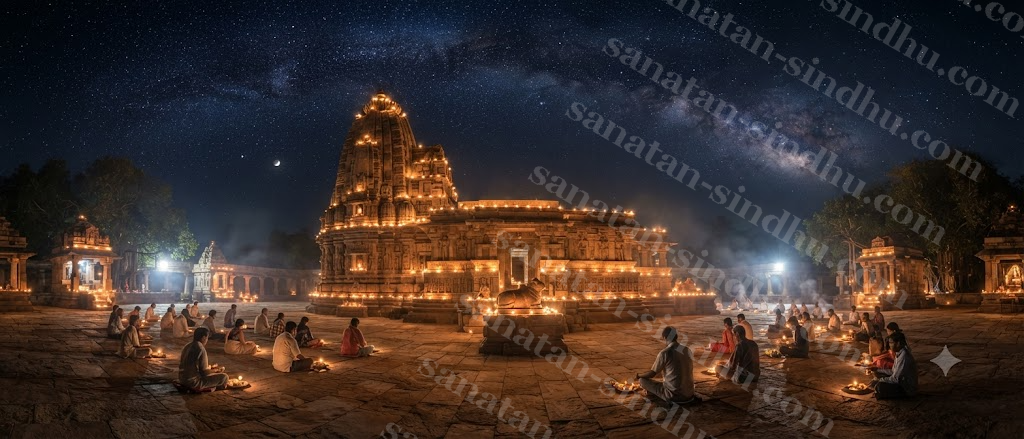
Mahā Śivarātri falls on Kṛṣṇa Caturdaśī — the fourteenth day of the waning moon — of Phālguna by one regional reckoning and Māgha by another, in late winter just before spring. This series' first essay already quoted the Skanda Purāṇa naming Śivarātri "the greatest of all vratas," without elaborating why — this essay is that elaboration. What sets it apart structurally from almost every other fast in this series is that the night itself, not the daylight hours of abstention, is the vrata's centre. Where Ekādaśī or Karva Chauth are organised around what a devotee doesn't eat during the day, Śivarātri is organised around a jāgaraṇa — a vigil, staying awake and in worship through the dark hours rather than sleeping through them.
The hunter who worshipped by accident
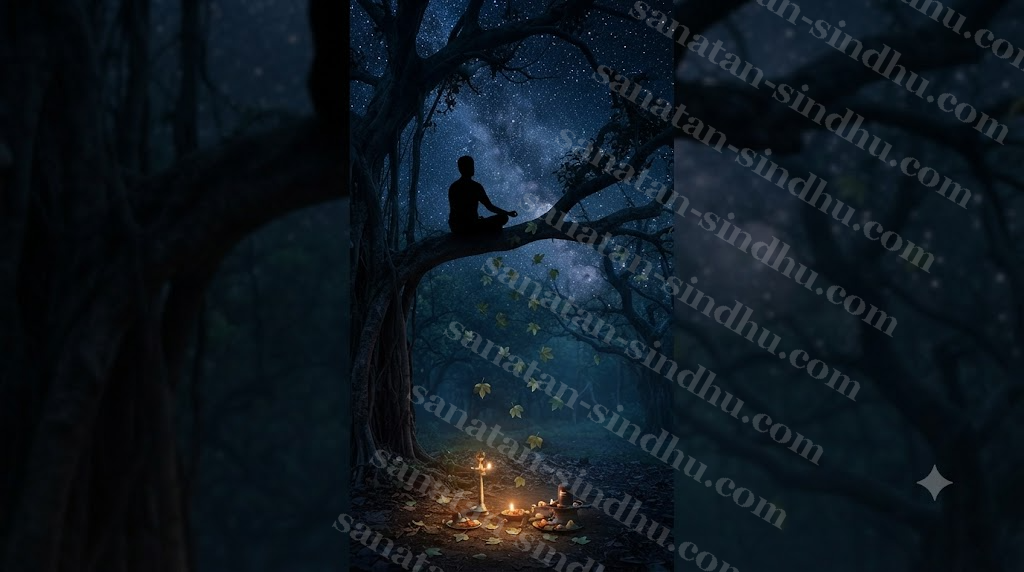
The Śiva Purāṇa tells of a hunter — named Lubdhaka or Guruḍruha depending on the telling — caught out after dark in a forest, pursued by a wild animal, who climbs a bilva (bel) tree to escape it and waits out the night on its branches. To stay awake and steady himself he idly plucks the tree's leaves one by one and drops them below — landing, unknown to him, on a liṅga hidden in the undergrowth at the tree's foot. By dawn he has unknowingly completed a full night's worship: bilva leaves offered to Śiva through every watch of the night, out of nothing more than fear and boredom. Śiva grants him grace regardless of the absence of any devotional intention — a story the tradition reads as a statement about how easily this god's grace is won, not about the hunter's own merit. The story's reach is worth naming concretely: the same Lubdhaka narrative appears in the fifteenth-century Javanese text Śivarātrikalpa (composed 1466–1478), evidence of how far Śivarātri's own foundational story travelled beyond the subcontinent.
Three Purāṇas, three reasons for the same night
Ask why this particular night is sacred and the Purāṇic tradition doesn't converge on one answer — it gives three, and this essay names all three rather than picking a favourite. The Liṅga Purāṇa holds that this is the night Śiva first manifested as Liṅgodbhava — an infinite pillar of light with neither beginning nor end, before which Brahmā and Viṣṇu, searching upward and downward for its two ends, both fail to find one. The Śiva Purāṇa holds it to be the night of Śiva and Pārvatī's wedding. And the Skanda and Bhāgavata Purāṇas anchor it to the same Samudra Manthan and Nīlakaṇṭha episode the previous essay in this series used to explain Śrāvaṇ's month-long Monday fasts — the night, in this reading, marking when Śiva drank the hālāhala poison to save creation. Three different events, three different Purāṇic sources, one shared night of worship: the tradition holds all three without adjudicating between them, and this essay follows that lead rather than manufacturing a false consensus.
The vigil, kept in four watches
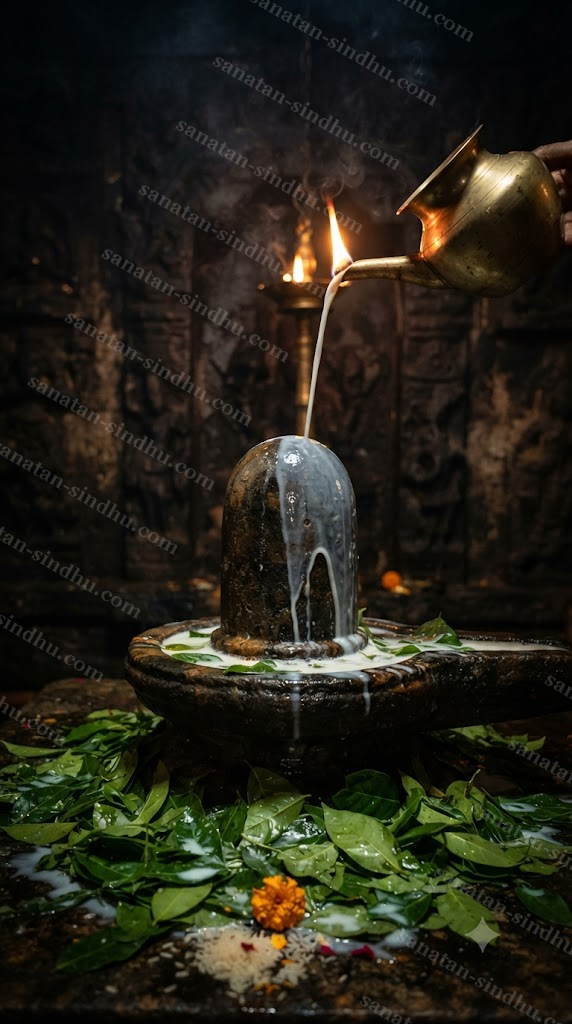
Strict observance is nirjala — without water — for the full day and night. Worship is structured around the night's *four prahara** (watches), each with its own abhiṣeka to the liṅga — commonly milk, then curd, then ghee, then honey across the four watches, though the exact sequence varies by region and household tradition, a variation this essay names rather than flattens into one fixed rule. The bilva leaf, trifoliate and directly tied to the hunter's story above, is the fast's central offering, read by the tradition as representing the three guṇas* or, in some readings, Śiva's own trident. The fast breaks the following morning, after the vigil's four watches are complete — not at moonrise or a fixed clock hour, but at the natural end of a night actually kept awake.
Not every tradition agrees
As with every fast in this series, Śivarātri sits inside the same cross-tradition disagreement named at length in the first essay — the Sikh and Ārya Samāj objections to ritual observance tied to a fixed lunar calendar day, and Jainism's and Buddhism's rejection of Purāṇic authority outright. This essay doesn't repeat that argument fast by fast; it simply doesn't assume Śivarātri as a shared Indic observance rather than a specifically Śaiva Purāṇic one.
Return to What Is a Vrata? — the textual foundations of Hindu fasting for the fuller cross-tradition treatment, and for the rest of the fasting series as each piece is added.
Sources
- Primary scripture. Śiva Purāṇa, for the Lubdhaka/hunter narrative and the wedding-night framing; Liṅga Purāṇa, for the Liṅgodbhava pillar-of-light episode; Skanda Purāṇa and Bhāgavata Purāṇa, for the Samudra Manthan / Nīlakaṇṭha framing — consulted via named secondary summaries rather than critical editions of each Purāṇa, the same limitation flagged elsewhere in this series.
- Cross-cultural literary history. The Javanese Śivarātrikalpa (composed 1466–1478 CE), for the Lubdhaka narrative's attested transmission beyond the subcontinent.
- Folklore and ritual practice. The four-watch abhiṣeka sequence and bilva-leaf offering, consulted via general festival-documentation and vrata-guide sources rather than a single named ethnographic study.