One tradition, several meanings, one honest limit
Sanātana Dharma is not a single ritual system with one uniform explanation for every custom. Its everyday practices emerge from Vedic and Purāṇic material, Sanskrit temple ritual, domestic observance, and regional bhakti traditions — and the same action can carry several meanings at once: reverence, purification, remembrance, embodiment, community, or alignment with a deity's own mythic world.
There is an honest limit worth naming before going further. A traditional text can explain what a ritual means within a religious worldview — what it expresses, what it enacts, what it remembers. It does not, on its own, prove a modern physiological claim about the brain, circulation, eyesight, or "energy." That distinction matters here specifically because several of these practices have picked up popular biomedical explanations in recent decades — a bell that "unifies both hemispheres of the brain," clapping that "activates acupressure points," a forehead mark that "cools the nervous system." The textual, acoustic, and ethnographic sources behind each practice below support something different, and arguably sturdier: a coherent account of attention, symbol, and community that doesn't need to borrow a white coat to be taken seriously.
Pradakṣiṇā — keeping the sacred on the right
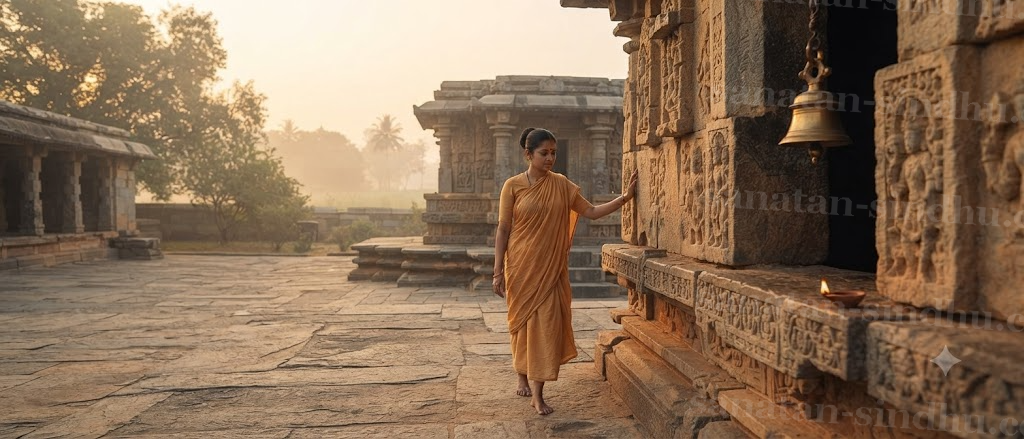
Pradakṣiṇā is circumambulation performed with the revered person, deity, fire, shrine, or sacred landscape kept to one's right. The Sanskrit term itself carries the sense of "right," "auspicious," and "reverential" — a Sanskrit lexicon records it as circumambulation from left to right, and as a reverential salutation in which the right side is turned toward the object of respect.
The practice reaches well past walking around a temple image. It's attested around divine images, trees associated with deities, sacred fire, and the pilgrimage circuit around the Narmadā river. In each case the movement makes the body enact a theological relationship: the sacred isn't merely observed from a fixed spot; it's given the central place around which the practitioner physically moves.
A Purāṇic account describes Śiva and Satī circumambulating the sacred fire during their marriage rite. A later text on solar worship prescribes seven circumambulations of Bhānu, the Sun, accompanied by mantras. Both support the rite's religious and symbolic weight on their own terms — they don't require the further claim that a clockwise walk literally reproduces planetary mechanics.
Ghaṇṭā dhvani — sound at the threshold
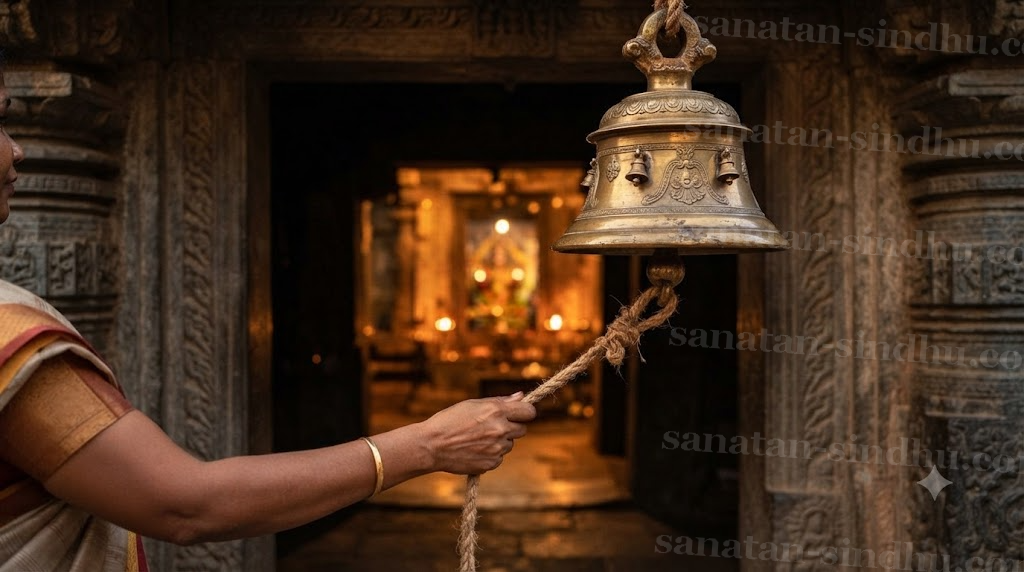
The temple bell, ghaṇṭā, marks a transition. A visitor leaves ordinary conversation and enters a space ordered by image, mantra, gesture, and offering. Traditional interpretation connects the bell with awakening and alertness; temple-acoustics research shows bells, gongs, conches, chanting, and singing together forming one integrated soundscape around the sanctum.
The Sanskrit and Āgamic worlds never treated sound as decoration. Scholarship on Hindu ritual music traces a continuum from Sāma-Vedic chanting and sacrificial recitation through temple worship of Śiva and Viṣṇu to the vernacular poetry of medieval bhakti, naming this whole interweaving of music and worship sonic liturgy.
That gives the bell a precise, defensible meaning: it participates in the sonic order of the shrine, and marks the passage into worship. What it doesn't do, on the evidence of that same acoustics and liturgy scholarship, is "unify both hemispheres of the brain" — a popular claim the sources behind this section simply don't make.
Kīrtana and clapping — devotion made collective
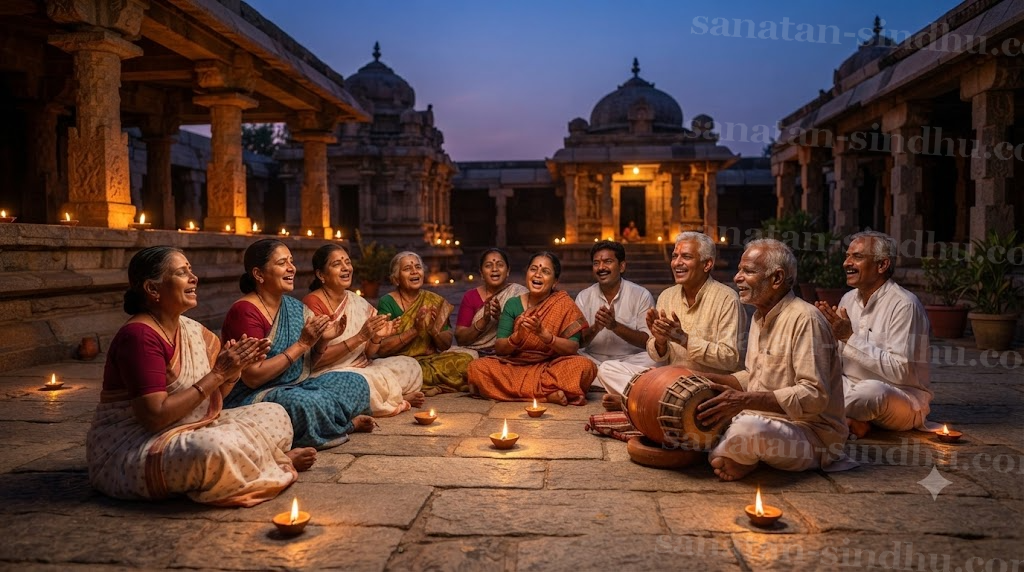
In kīrtana, bhajana, and related devotional singing, voice, breath, rhythm, and memory work together. The practice is genuinely diverse across India: North Indian Vaiṣṇava traditions weave music into formal liturgy, while Marathi rāṣṭrīya kīrtan shows how singing can become a richly embodied regional performance in its own right.
The Bhāgavata Purāṇa gives devotional sound one of its most vivid poetic forms. In the Veṇu-gīta, the rivers hear Kṛṣṇa's flute-song, their currents slow, and their waves are imagined reaching out like arms to embrace his feet and offer lotuses:
"Having heard Mukunda's song, the rivers... hold Murāri's pair of feet with their wave-like arms and offer lotuses." (Bhāgavata Purāṇa 10.21.15)
That verse is poetry, not a laboratory report — its force lies in imagining that nature itself answers divine sound, and it sits comfortably alongside the scholarship on North Indian and Marathi devotional performance. Rhythmic clapping belongs in that same register: participation, pulse, shared timing — not a claim that it triggers specific acupressure points.
Caraṇa sparśa — humility, lineage, and the language of feet
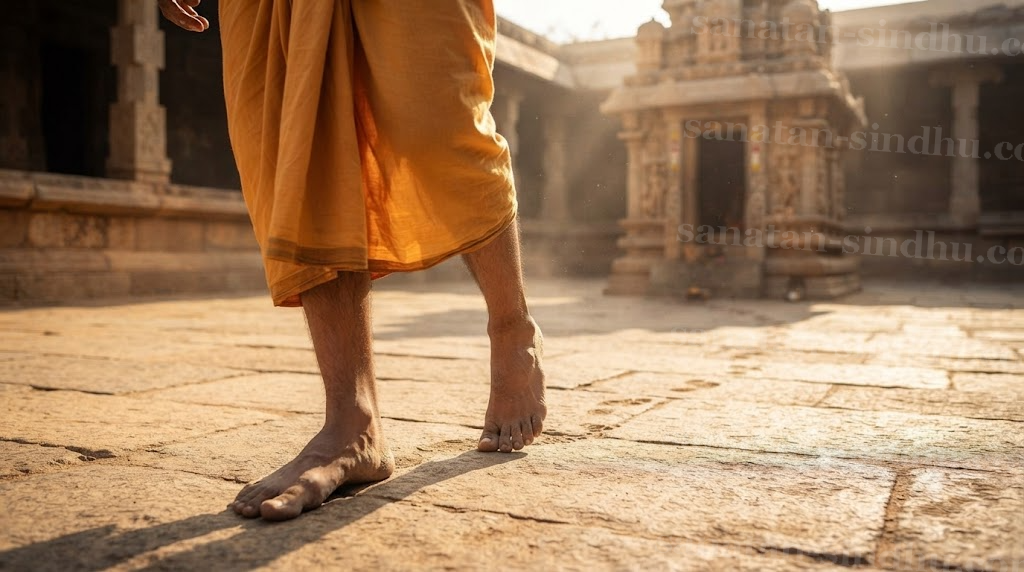
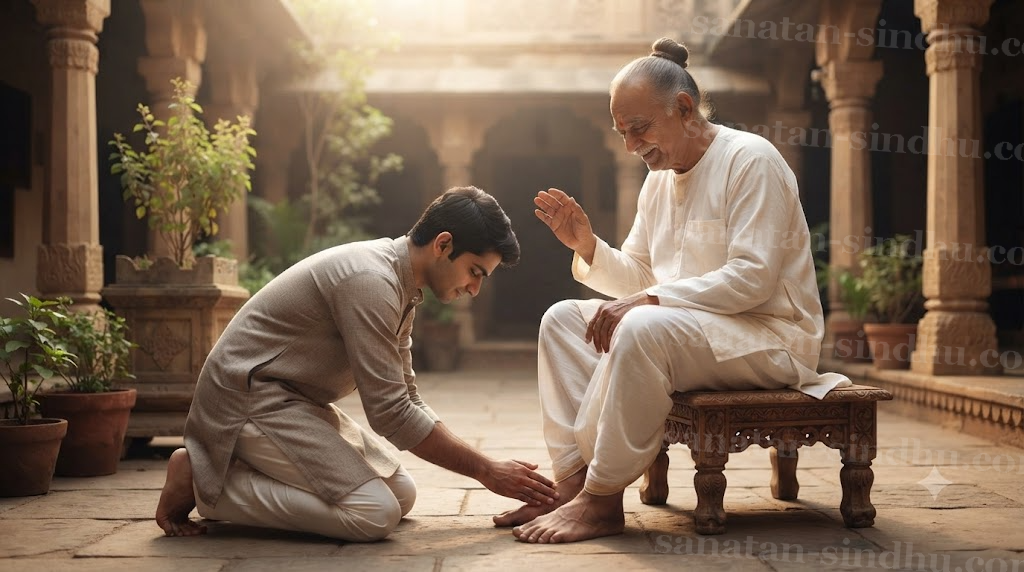
Caraṇa sparśa, touching the feet of elders, teachers, or revered figures, places the body in a posture of humility. The wider symbolism of feet in this tradition is well documented — in studies of sacred ground, divine footprints, and ritualized touch alike.
That symbolism runs in more than one direction at once. Bare feet are required on sacred ground in many settings, and pointing one's feet toward an altar, a teacher, or an elder reads as disrespectful — yet divine feet are themselves central objects of devotion. An ethnographic study of Viṣṇu's footprint at Gayā traces how bodily gesture, regional mythology, textual interpretation, and sacred geography combine there into a single, coherent meaning.
Read this way, caraṇa sparśa is an embodied grammar of respect. The claim sometimes attached to it today — that touching an elder's feet closes a measurable "energetic circuit" running from toes to fingertips — is a modern interpretation layered on top, not a conclusion the scriptural or ethnographic sources themselves establish.
Tilaka — a visible mark of belonging and remembrance
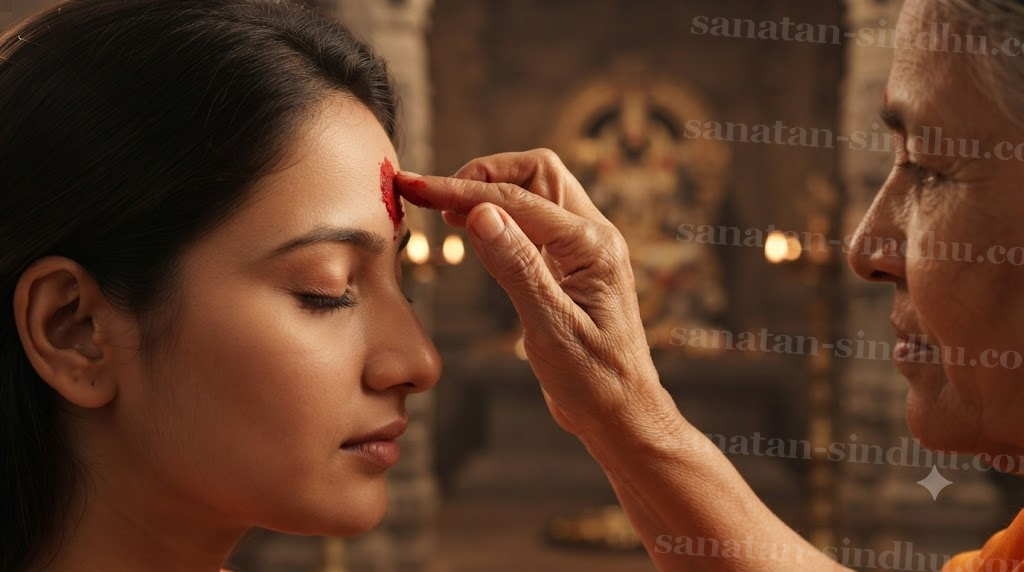
Tilaka is not one single mark. Its materials and designs vary by sect and region, so the honest description is a plural one: a visible sign of devotion, identity, or ritual participation, rather than one universal meaning fitted to every forehead.
The forehead itself is sometimes read through the language of the ājñā-cakra, the "command" or "attention" centre in later yogic and tantric frameworks. That symbolism carries real weight inside those specific traditions — but it's a different claim from saying that applying paste to the forehead "cools the nervous system," or that tilaka proves some biomedical third-eye mechanism. The yogic reading and the biomedical one are not the same kind of statement, and only one of them is what these sources actually support.
Arghya to Sūrya — offering water to the Sun
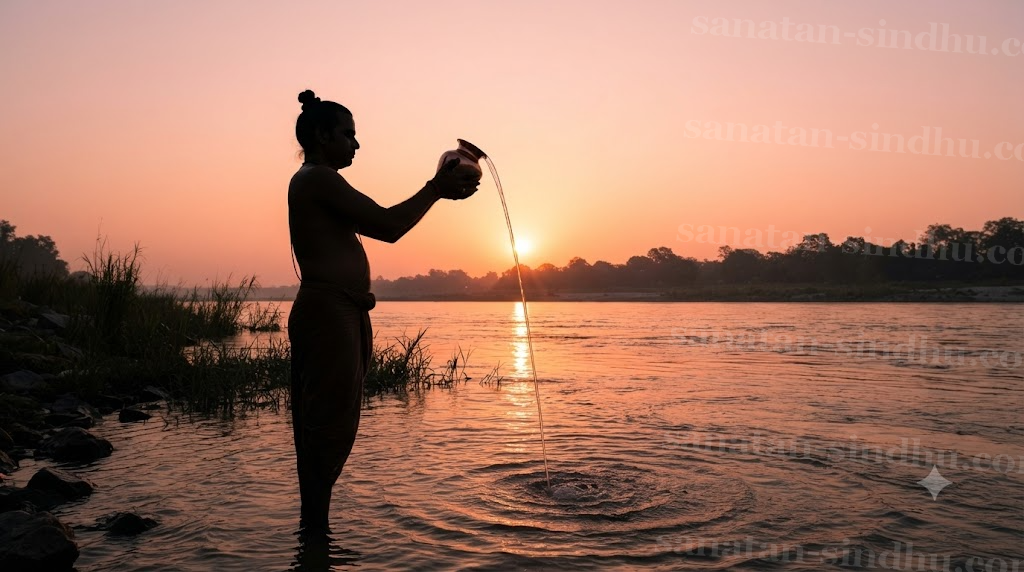
Arghya is a formal water offering. A chapter on Sun-worship in the Skanda Purāṇa has the devotee first perform purification and prayer, then offer water to Bhāskara with joined palms, from a copper vessel holding scented water, flowers, sesame, kuśa grass, and rice — later specifying the arghya offering itself, accompanied by mantra.
The same text prescribes solar worship at set times of day and ties the rite to Vedic mantras, including ud u tyam jātavedasam and the Gāyatrī formula tat savitur vareṇyam. The Saurasaṃhitā, studied as the earliest surviving tantra devoted to Sun-worship, offers another textual line into the same practice, and identifies the Sun with Śiva.
Arghya is best understood, then, as a gesture of offering, purification, disciplined attention, and participation in a solar theology reaching back through these texts. What it isn't, on that same evidence, is an eye-health technique — the familiar claim that the falling stream of water acts as a prism, filtering harmful rays and protecting eyesight, has no support in the scriptural passages behind this section.
A better way to talk about ritual and wellbeing
These six practices support mindfulness in ordinary, non-miraculous ways: they create pauses, structure attention, coordinate breath and movement, draw on memory and sound, and connect a person to family and community. That's not a lesser claim than the biomedical one — it's simply the claim the sources actually carry.
A credible account of Sanātana Dharma doesn't need to borrow scientific vocabulary loosely to feel weighty. It can say, with more precision, that pradakṣiṇā expresses reverence; the temple bell participates in the sonic order of worship; kīrtana makes devotion collective; caraṇa sparśa embodies humility; tilaka makes affiliation and remembrance visible; and arghya places the worshipper before the Sun in a disciplined act of offering. Those meanings are rich enough on their own terms, and they stay faithful to how diverse — Sanskritic, Āgamic, regional, devotional — this tradition's own account of its practices actually is.
Sources
- Primary scripture and liturgical texts. Skanda Purāṇa, chapter on the worship of the Sun-God, for the arghya procedure, the Vedic mantras ud u tyam jātavedasam and the Gāyatrī tat savitur vareṇyam, and the seven circumambulations of Bhānu; Bhāgavata Purāṇa 10.21.15 (the Veṇu-gīta) for the rivers' response to Kṛṣṇa's song.
- Modern scholarship, included with why. Guy L. Beck, Sonic Liturgy: Ritual and Music in Hindu Tradition (2011), for the continuum from Sāma-Vedic chanting to temple and bhakti music this piece calls "sonic liturgy"; Beck, "Prayer and Worship through Music and Liturgy in North Indian Vaiṣṇava Traditions" (2020); Anna Schultz, "Hindu Nationalism, Music, and Embodiment in Marathi Rashtriya Kirtan," Ethnomusicology (2002), for kīrtana's regional diversity; Meera Prasad, "Conch-shells, bells, and gongs in Hindu temples," Journal of the Acoustical Society of America (2015), for the temple soundscape the bell participates in — acoustics, not neurology; Tineke Nugteren, "Bare Feet and Sacred Ground: 'Viṣṇu Was Here,'" Religions (2018), for the ethnography of divine footprints at Gayā; Diwakar Acharya, "The Saurasaṃhitā: The Earliest Surviving Tantra on Sun-Worship," Acta Orientalia (2022); Alfred Hillebrandt, "The Practice of Circumambulation," The Expository Times (1911).
- Reference material. Sanskrit-lexicon entries on pradakṣiṇā and ghaṇṭā (wisdomlib.org), used for the terminology each section opens with.
A note on what this piece leaves out deliberately: the popular claims attached to several of these practices — that a temple bell "unifies both hemispheres of the brain," that clapping activates acupressure points, that touching feet closes a measurable "energetic circuit," that tilaka "cools the nervous system," that arghya's water stream filters ultraviolet light and protects eyesight — aren't supported by the textual, acoustic, or ethnographic sources above, and aren't presented here as established fact.