Deities · Shakti / Mahadevi
Goddess Durga
दुर्गा
Durgā
The supreme warrior form of the Mahadevi, manifested from the combined fiery anger of the gods to defeat the buffalo demon Mahishasura. She embodies invincible Shakti, the force that restores cosmic order when all other powers fail.
Quick facts
- Era
- Eternal / Sanatana
- vahana
- Lion / Tiger
- consort
- Lord Shiva (as Parvati)
- Abode
- Manidvipa
Attributes & symbols
Emblems most often depicted with Goddess Durga. Hover for gloss · click to search.
Epithets
Names and titles by which Goddess Durga is invoked across the śāstras.
Essays
Related essays
What is Dharma — and what is a Hindu?
The words Dharma, Sanātana and Hindu — where they come from, what they actually mean, and how the four great sampradāyas (Vaiṣṇavism, Śaivism, Śāktism, Smārtism) scale the same spiritual mountain from different sides.
Essay · Fasting & VratasFriday Fasts — from Vaibhav Lakshmi to Santoshi Mātā
Friday fasting holds two traditions at once, often in the same household without anyone noticing the gap between them: the older Purāṇic-adjacent vrata for Lakṣmī, and the twentieth-century emergence of Santoshi Mātā — a goddess with almost no textual pedigree before a 1975 film gave her one.
Essay · Fasting & VratasNine Nights of the Goddess — Navrātri and the Navadurgā across India
Navrātri is a fast built around nine forms of one goddess, twice a year in public — Chaitra in spring, Śarad in autumn. Where the nine names of the Navadurgā actually come from, why autumn outgrew spring as the great public occasion, and how Bengal, Tamil Nadu, Gujarat and North India each keep the same nine nights differently.
Essay · PracticeWhy the Mūrti Is Sent Away — the logic of visarjan
Every immersion — a clay Gaṇeśa lowered into a river, a Durgā carried to the Ganges on Vijayādaśamī — looks like the end of a festival. Inside the tradition it's a deliberate, ritually mirrored departure, reversing the rite that opened the festival in the first place. What prāṇa-pratiṣṭhā and its reversal actually claim, kept as three separate kinds of reason rather than one overclaiming story, and where Gaṇeśa Caturthī and Durgā Pūjā's own versions of the rite genuinely diverge.
Essay · Śākta Theology · ŚāstrārthaIs the Goddess Supreme Over the Trimūrti Itself?
Śākta scripture says yes: Brahmā, Viṣṇu and Śiva create, preserve and dissolve only through the power of the Devī. Vaiṣṇava, Śaiva and Advaita teachers answer differently. The texts behind the claim, the strongest replies to it, and what both sides actually agree on.
Essay · Iconography · VāhanaWhy Every God Rides Something — Vāhana Symbolism Across the Pantheon
Gaṇeśa's mouse, Śiva's bull, Durgā's lion, Viṣṇu's Garuḍa, Sarasvatī's swan, Yama's buffalo, Kārtikeya's peacock and Indra's elephant: where each pairing comes from in the texts, how it is usually read, and which readings are later tradition rather than scripture.
Essay · Iconography · VāhanaDurgā's Lion — The Mount Who Fights Beside the Goddess
Durgā rides a lion, and in many homes a tiger. Where the Devī Māhātmya says the lion came from, why it is a fighter and not just a seat, and how lion and tiger came to be shown side by side.
Chālīsā & Bhajan
Recite with Goddess Durga
Related lore
All stories →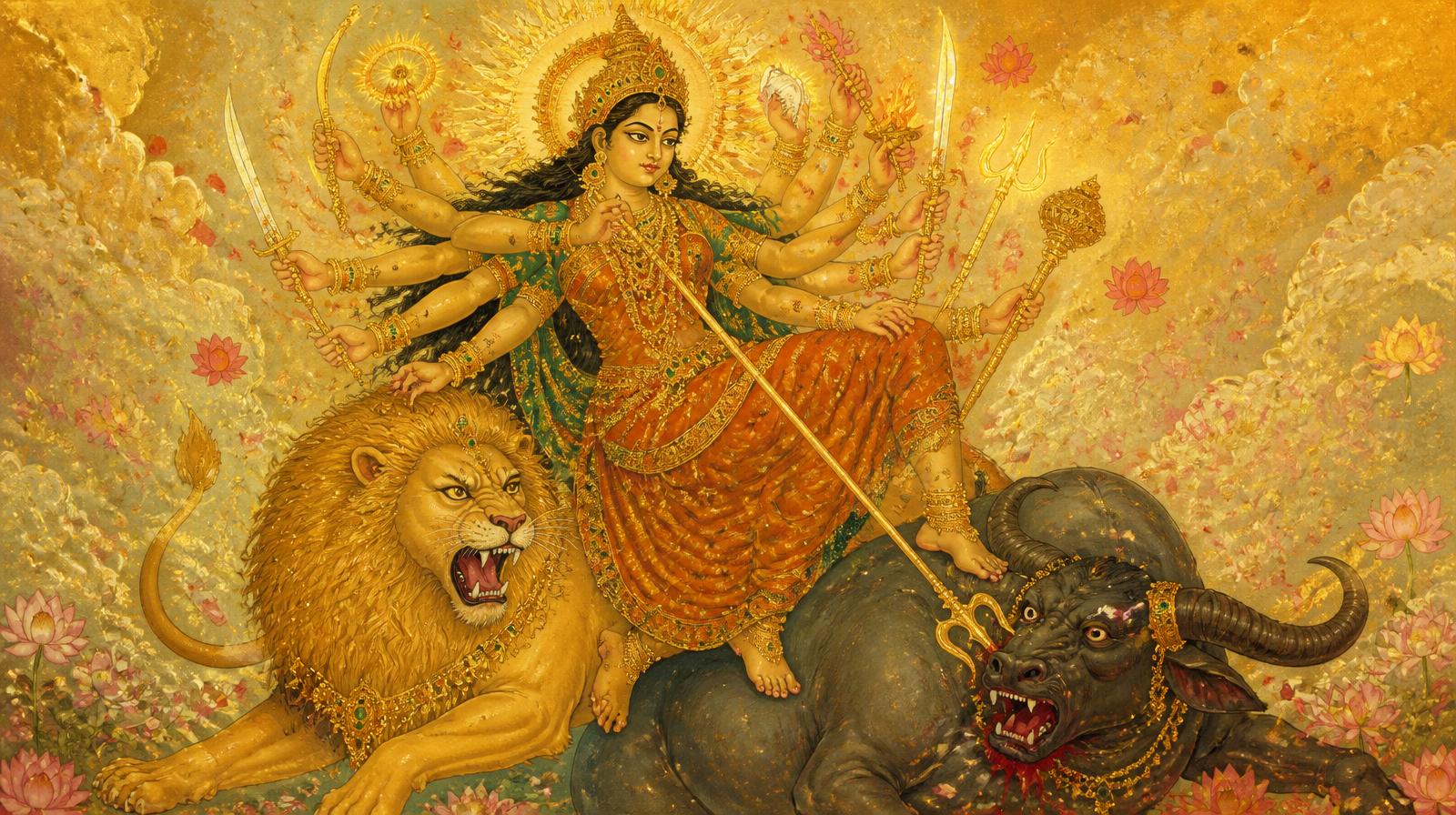
Markandeya Purana, Devi Bhagavata Purana
The Triumph of the Invincible Mother Durga
The spectacular manifestation of Goddess Durga from the combined fiery anger of the gods to defeat the shape-shifting buffalo demon Mahishasura, who held a boon of near-invincibility.
3 chapters · read →
Krittivāsī Rāmāyaṇa (Bengali, c. 15th century); Adbhuta Rāmāyaṇa
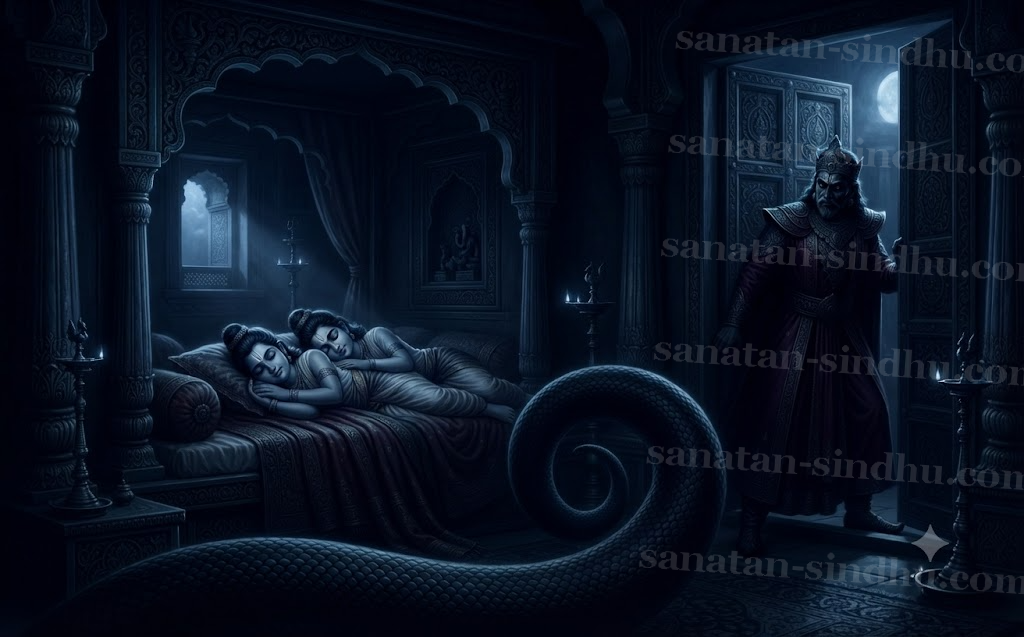
The Fall of the Two Mahīrāvaṇas
Two demons, unrelated to each other, share one name across two different tellings of the Rama story: a Pātāla sorcerer felled by Hanumān's five-faced form, and Rāvaṇa's own hidden elder brother, defeated only when Sītā reveals the Goddess within her. Told here as the Bengali Krittivāsī tradition and the Adbhuta Rāmāyaṇa remember them — one after the other, not as one story.
4 chapters · read →
Devī Māhātmya (Mārkaṇḍeya Purāṇa), Prathama Carita
Madhu-Kaiṭabha: The Sleep the Goddess Left
Before Brahma can begin a new creation, two demons born from Vishnu's own ear-wax rise to kill him — and the only thing standing between them and the Preserver's own mystic sleep is the Goddess herself, worshipped in this, the Devi Mahatmya's opening carita, as Yoganidra: the sleep of Vishnu, who must be asked, not commanded, to leave.
3 chapters · read →