Why every rite begins with him
Before a Vedic homa, a wedding, a new business ledger, or the first note of a classical concert, tradition across nearly every Sanatana lineage insists on one invocation first: Gaṇeśa. He is Vighneśvara — Lord of Obstacles — a title that cuts both ways. He places obstacles in the path of those pursuing selfish or reckless ends, and clears them for those whose intention is sincere. The elephant head, broken tusk and single companion mouse are not decorative — each is read as a working diagram of the discernment (viveka) needed to begin anything well.
The birth story — genuinely different across texts
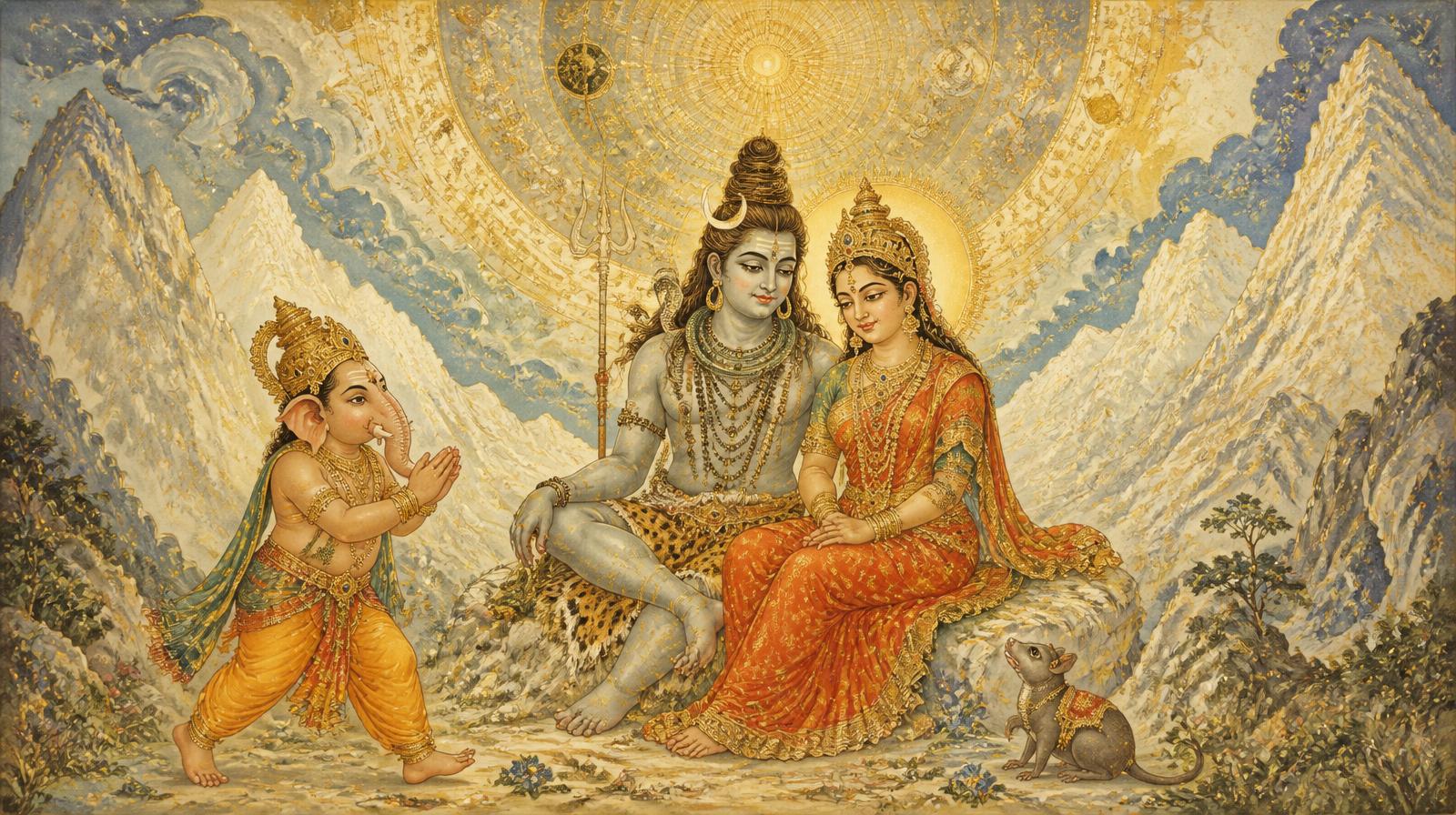
The single most commonly told account comes from the Śiva Purāṇa: Pārvatī, wanting a guard while she bathed, creates a boy from turmeric paste (or the scurf of her own body, in some recensions) and breathes life into him. Śiva returns, is refused entry by a son he has never seen, and beheads him in anger. Pārvatī's grief forces Śiva to restore him — with the head of the first creature found facing north, an elephant. This is the version most widely known and most often illustrated.
It is not the only one. The Brahmavaivarta Purāṇa tells a different story entirely: Gaṇeśa is born to Śiva and Pārvatī in the ordinary way, but Śani (Saturn), cursed to burn whatever his gaze falls on, is persuaded to look at the newborn and incinerates his head; Viṣṇu then fetches an elephant's head to replace it. The Vārāha and Matsya Purāṇas carry still other variants — in one, Śiva creates Gaṇeśa deliberately from his own laughter to obstruct Indra's arrogance.
These are not minor stylistic differences — they disagree on whether Śiva was present at the birth, why the head was lost, and who restored it. Popular retelling has flattened this into one settled story; the textual record has not. Naming that plainly is more honest than picking the most famous version and presenting it as the only one.
Vedic antecedent — Gaṇapati before the elephant head
The Ṛgveda already knows the word Gaṇapati — 'lord of the gaṇas' — as an epithet:
गणानां त्वा गणपतिं हवामहे कविं कवीनामुपमश्रवस्तमम् । ज्येष्ठराजं ब्रह्मणां ब्रह्मणस्पत आ नः शृण्वन्नूतिभिः सीद सादनम् ॥
gaṇānāṃ tvā gaṇapatiṃ havāmahe kaviṃ kavīnām upamaśravastamam | jyeṣṭharājaṃ brahmaṇāṃ brahmaṇas pata ā naḥ śṛṇvann ūtibhiḥ sīda sādanam ||
'We invoke you, Gaṇapati of the gaṇas, most renowned poet among poets, the eldest king of sacred utterances. O Brahmaṇaspati, hear us and take your seat, attending us with your help.'
Worth being precise about what this verse actually is: in its Ṛgvedic context, Gaṇapati here is an epithet of Bṛhaspati (also called Brahmaṇaspati), the priest-deity of sacred speech — not a reference to the elephant-headed deity known today. The Ganapatya tradition reads this hymn as prophetic of Gaṇeśa; that is a traditional theological reading, not a claim that the Ṛgveda depicts an elephant-headed god. The elephant iconography itself appears securely in the archaeological and textual record only considerably later, consolidating through the Purāṇic period. Both facts belong in the same sentence rather than letting one quietly stand in for the other.
The Gaṇapati Atharvaśīrṣa — Gaṇeśa as Brahman
Where the Śvetāśvatara Upaniṣad does this work for Śiva, the Gaṇapati Atharvaśīrṣa — a minor Upaniṣad specific to the Ganapatya tradition — does it for Gaṇeśa, identifying him outright with the Absolute:
त्वं ब्रह्मा त्वं विष्णुस्त्वं रुद्रस्त्वमिन्द्रस्त्वमग्निस्त्वं वायुस्त्वं सूर्यस्त्वं चन्द्रमास्त्वं ब्रह्मभूर्भुवःस्वरोम् ॥
tvaṃ brahmā tvaṃ viṣṇus tvaṃ rudras tvam indras tvam agnis tvaṃ vāyus tvaṃ sūryas tvaṃ candramās tvaṃ brahma bhūr bhuvaḥ svarom ||
'You are Brahmā, you are Viṣṇu, you are Rudra, you are Indra, you are Agni, you are Vāyu, you are Sūrya, you are the Moon; you are Brahman, and the three worlds, and Om itself.'
This is the same theological move Vaiṣṇavas make for Viṣṇu and Śaivas make for Śiva — naming their chosen deity as the ground of all other gods, not a subordinate to them. Read against the popular image of Gaṇeśa as simply 'Śiva's son,' this text is doing something different: making an Iṣṭadevatā argument at the highest philosophical register available to the tradition.
Gāṇapatya — a sixth tradition, not a subordinate one
Classical Sanatana Dharma is often described as having five or six major theistic orientations (Pañcāyatana / Ṣaṇmata): Śaiva, Vaiṣṇava, Śākta, Saura (sun-worship), Smārta, and Gāṇapatya. Gāṇapatya is the tradition that holds Gaṇeśa, not Śiva or Viṣṇu, as the Supreme — its own scriptures, the Gaṇeśa Purāṇa and Mudgala Purāṇa, develop a full cosmology and set of avatāras around him. It is numerically small today compared to Śaivism and Vaiṣṇavism, but it is a genuine, independent doctrinal tradition within Sanatana Dharma, not a devotional footnote to Śaivism. Treating Gaṇeśa as merely 'Śiva's son who everyone likes' undersells the theology a real, still-living tradition holds about him.
Reading the form
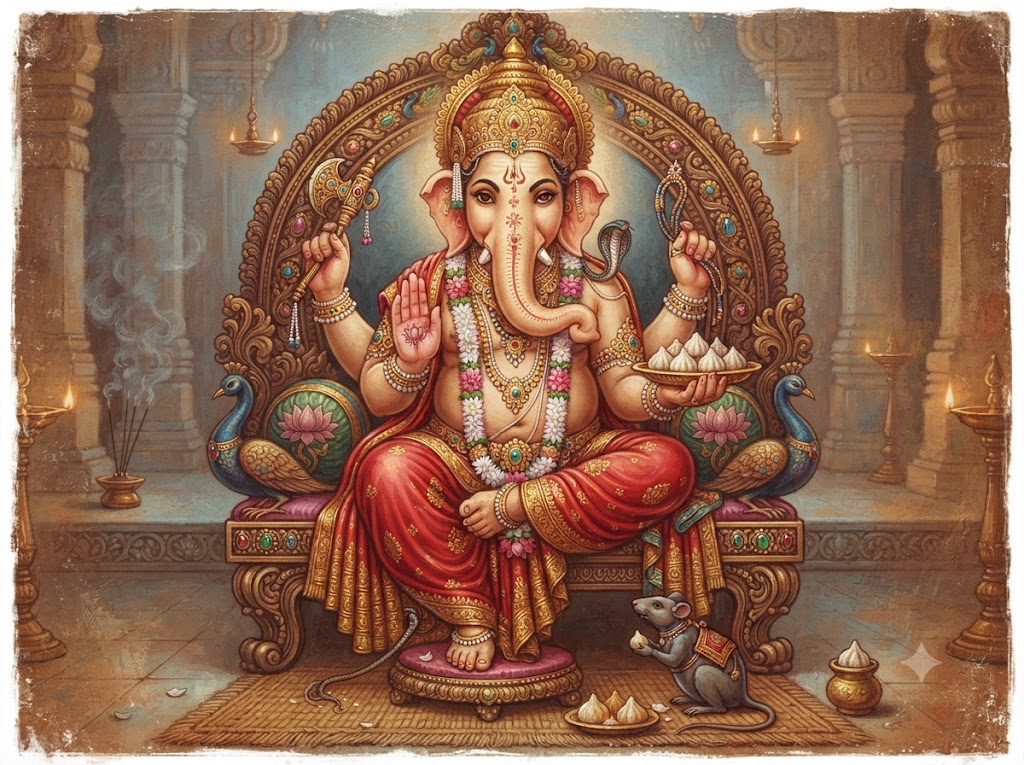
- The large ears — to hear everything, but retain only what matters.
- The small eyes — concentration; seeing deeply rather than broadly.
- The broken tusk (Ekadanta) — in the most common account, he snapped it himself to use as a stylus, taking dictation of the Mahābhārata from Vyāsa on the condition that he never pause; the tradition reads this as intellect (the tusk, a weapon) placed in service of wisdom (the text).
- The large belly — the capacity to digest and hold both the sweetness and difficulty of experience without being destabilised by either.
- Mūṣika, the mouse — a small, relentless creature capable of gnawing through anything given time; ridden by the remover of obstacles, it becomes a symbol of desire and restlessness brought under control rather than indulged or suppressed.
- The modaka (sweet dumpling) in one hand — the reward of spiritual effort, sweet precisely because it was earned.
Word origins — gaṇa and the grammar of multitude
Gaṇa is not primarily a religious word — it is a basic grammatical term. Pāṇini's Aṣṭādhyāyī itself uses gaṇa to mean a listed group or class of words sharing a grammatical property (the Gaṇapāṭha is literally the appendix of such word-lists that accompanies his grammar). In the religious sense, gaṇa names Śiva's attendant hosts — a multitude, a class, a category. Gaṇa + īśa ('lord') gives Gaṇeśa: lord of categories, of multitudes, of the assembled many. That double sense — grammatical classification and divine crowd-master — is not a coincidence worth ignoring: the deity who removes obstacles to right action is named with the same root used to organise language itself into intelligible classes. Order, in both registers, is what clears the way for understanding.
Festival — Gaṇeśa Caturthī
The public festival most people now picture — pandals, processions, mass immersion — is a specific historical layer on top of an older household vrata, not the vrata itself. For the textual roots in Bhādrapada's Vinayaka Caturthī, the documented 1893 transformation into a public festival under Bal Gangadhar Tilak, and the live tension between traditional clay mūrtis and modern Plaster of Paris at immersion, see the essay Gaṇeśa Caturthī Across the Ages.
Further reading
The core primary texts for Gaṇeśa's theology are the Gaṇeśa Purāṇa and Mudgala Purāṇa (Gāṇapatya scripture proper), the Gaṇapati Atharvaśīrṣa (his identification with Brahman), and the birth narratives scattered across the Śiva, Brahmavaivarta, Vārāha and Matsya Purāṇas — read side by side rather than harmonised into one version.