The Text on the Leaves
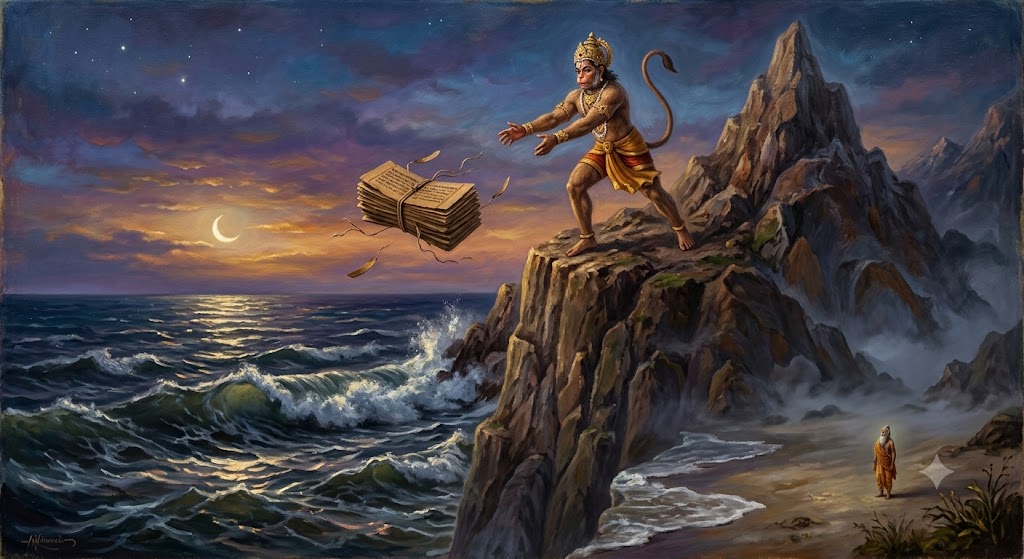
After the great war of Lanka and the coronation of Sri , retired to the deep wilderness of the Himalayas to continue his meditation. In his spare moments, out of pure remembrance of his Lord's deeds, he scratched the entire epic story of the Ramayana onto large, broad banana leaves using his sharp claws. It was a literary masterpiece of flawless poetry, infused with the direct, firsthand vibration of absolute love.
✦ Visual cue — A serene, sun-dappled Himalayan mountain clearing where a peaceful Hanuman sits cross-legged, gently engraving elegant Sanskrit script onto a giant, flat green leaf with his claw.
Related essays
Essay · Hanumān · Śaiva-Vaiṣṇava Synthesis
Sacred Wind, Eternal Devotee — Hanumān's lore and cultural significance
A textual stratigraphy of Hanumān across the Vālmīki Rāmāyaṇa, the Śiva Purāṇa, the Adhyātma and Ānanda Rāmāyaṇas, and Tulsīdās's Rāmcharitmānas — plus the Upaniṣadic anchors that place Him as a premier Vedic scholar, the Pañchamukhī rescue in Pātāla Loka, the pact with Śani, the origin of the sindūr offering, the Hanumad Rāmāyaṇa, and the metaphysics of cyclical time.
Essay · Greater India · Art & architecture
Shadows of the Rāmāyaṇa and stones of the gods
Wayang Kulit shadow theatre, the volcanic Trimūrti spires of Prambanan, and Angkor Wat's 49-metre Churning of the Ocean — how Southeast Asia carved and projected the epics into forms entirely its own.
Essay · Greater India · Living practice
The living flame — Bali's Hinduism and the sacred dance
Why an island in the world's largest Muslim-majority nation remains over eighty per cent Hindu — the empty stone throne of Acintya, the daily canang sari, the instrument-free Kecak chant, and the hyperextended royal postures of Khon and Robam Preah Ream.
Essay · Greater India · Language
Sanskrit tides — the language and legends of Southeast Asia
How Lakṣmaṇa became a naval admiral, Hanumān a reconnaissance codeword and Garuḍa a national emblem — and how mantrī, pradhāna, bhāṣā and nagarī still run through the constitutions and everyday speech of Malaysia, Indonesia and Thailand.
Essay · Dharma & Governance
Rāma Rājya — the making of an ideal, and what it cost
The coronation at Ayodhyā, the twenty-odd verses that describe the reign, and how a short passage at the close of the Rāmāyaṇa became the standard by which Indian political thought has judged governments ever since — including the price the same book records.