Deities · Vaishnava (Rama bhakta)
Lord Hanuman
हनुमान्
Hanumān
Son of Vayu and the supreme devotee of Rama, whose strength, humility, and unbroken devotion are the pattern for bhakti itself. He flew across the ocean to find Sita and carried an entire mountain to revive Lakshmana.
Quick facts
- Era
- Treta Yuga
- vahana
- None — self-flying Vayu-putra
- consort
- Brahmachari (Celibate)
- Abode
- Kishkindha / Eternal on Earth (Chiranjivi)
Attributes & symbols
Emblems most often depicted with Lord Hanuman. Hover for gloss · click to search.
Epithets
Names and titles by which Lord Hanuman is invoked across the śāstras.
Essays
Related essays
The Infinite Forms of the Formless — Śiva's descents and cosmic purpose
Unlike Viṣṇu's ten physical Dashāvatāras, Śiva's descents are Anśāvatāras and Rudras — instantaneous manifestations that dissolve ego, transmit Yoga, and restore Dharma. A tour of the 19 Primary Avatars, the 11 Rudras, the 28 Yogeśvaras, the Pañchabrahma, and the Śaiva-Vaiṣṇava synthesis of Hanumān as the 11th Rudra — anchored to the Mathurā Pillar Inscription of 380 CE.
Essay · Hanumān · Śaiva-Vaiṣṇava SynthesisSacred Wind, Eternal Devotee — Hanumān's lore and cultural significance
A textual stratigraphy of Hanumān across the Vālmīki Rāmāyaṇa, the Śiva Purāṇa, the Adhyātma and Ānanda Rāmāyaṇas, and Tulsīdās's Rāmcharitmānas — plus the Upaniṣadic anchors that place Him as a premier Vedic scholar, the Pañchamukhī rescue in Pātāla Loka, the pact with Śani, the origin of the sindūr offering, the Hanumad Rāmāyaṇa, and the metaphysics of cyclical time.
Essay · Astronomy & ScriptureMeasuring the Heavens — the speed of light and the distance to the Sun
Sāyaṇa's 14th-century commentary on a Ṛgvedic hymn to Sūrya states a velocity for sunlight that lands within one percent of the modern value for c — and the 18th verse of the Hanumān Cālīsā carries an orbital distance to the Sun. Two cases of hard astronomy preserved inside devotional text.
Essay · Greater India · AnchorAcross the Cosmic Milk — Sanātana Dharma in Southeast Asia
For centuries the Indian Ocean was a highway, not a barrier. This anchor essay traces how the epics, philosophy and vocabulary of Sanātana Dharma crossed to Śrīvijaya, Majapahit, Angkor and Ayutthaya — and opens onto three deeper studies: stone and shadow, the living flame of Bali, and the Sanskrit still spoken in ASEAN parliaments.
Essay · Greater India · Living practiceThe living flame — Bali's Hinduism and the sacred dance
Why an island in the world's largest Muslim-majority nation remains over eighty per cent Hindu — the empty stone throne of Acintya, the daily canang sari, the instrument-free Kecak chant, and the hyperextended royal postures of Khon and Robam Preah Ream.
Essay · Greater India · LanguageSanskrit tides — the language and legends of Southeast Asia
How Lakṣmaṇa became a naval admiral, Hanumān a reconnaissance codeword and Garuḍa a national emblem — and how mantrī, pradhāna, bhāṣā and nagarī still run through the constitutions and everyday speech of Malaysia, Indonesia and Thailand.
Essay · Fasting & VratasHanumān's Days — the Tuesday and Saturday Vratas
One devotion, two weekly claims on it: Tuesday for Mars's courage, which Hanumān embodies, and Saturday for a debt Śani Dev himself is said to owe him. Not two vratas but one fast a devotee keeps on whichever day — or both — speaks to them.
Essay · Dharma & GovernanceRāma Rājya — the making of an ideal, and what it cost
The coronation at Ayodhyā, the twenty-odd verses that describe the reign, and how a short passage at the close of the Rāmāyaṇa became the standard by which Indian political thought has judged governments ever since — including the price the same book records.
Chālīsā & Bhajan
Recite with Lord Hanuman
Related lore
All stories →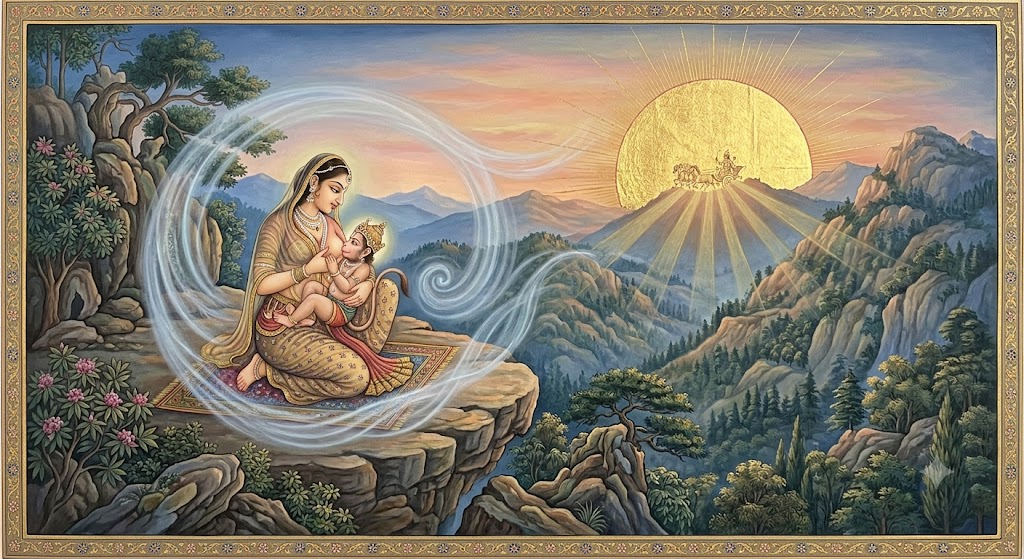
Valmiki Ramayana (Kishkindha Kanda), Shiva Purana (Shatarudra Samhita)
The Infinite Fruit: Birth and the Cosmic Leap
The divine birth of Hanuman as the Eleventh Rudra and son of Vayu, and his spectacular childhood leap toward the morning sun, which resulted in unmatched celestial boons from the gods.
3 chapters · read →
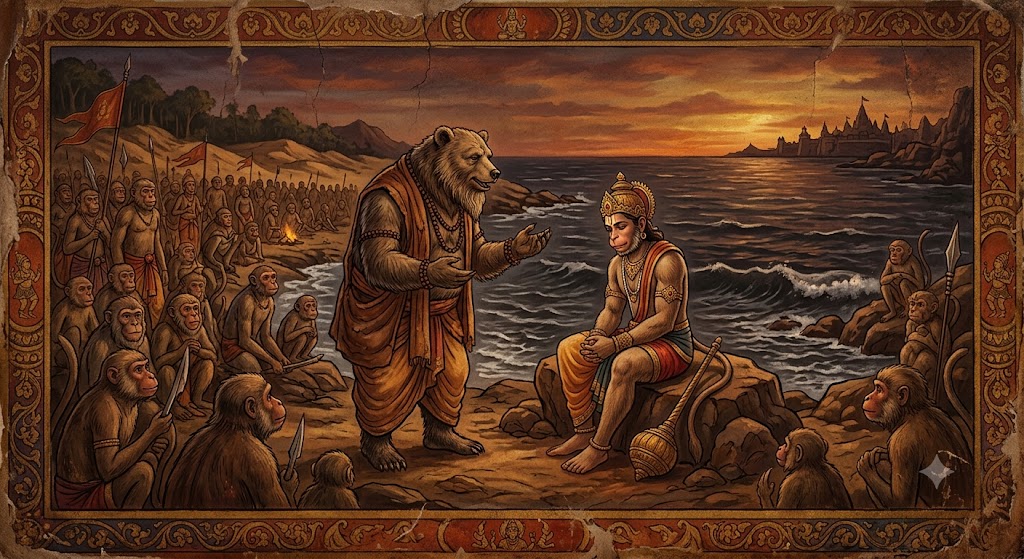
Valmiki Ramayana (Kishkindha Kanda, Sarga 66-67)
The Sleeping Giant: The Curse of Forgetfulness
How a playful childhood curse made Hanuman forget his immense powers until the wise bear-king Jambavan awakened his dormant strength at the edge of the roaring southern ocean.
3 chapters · read →
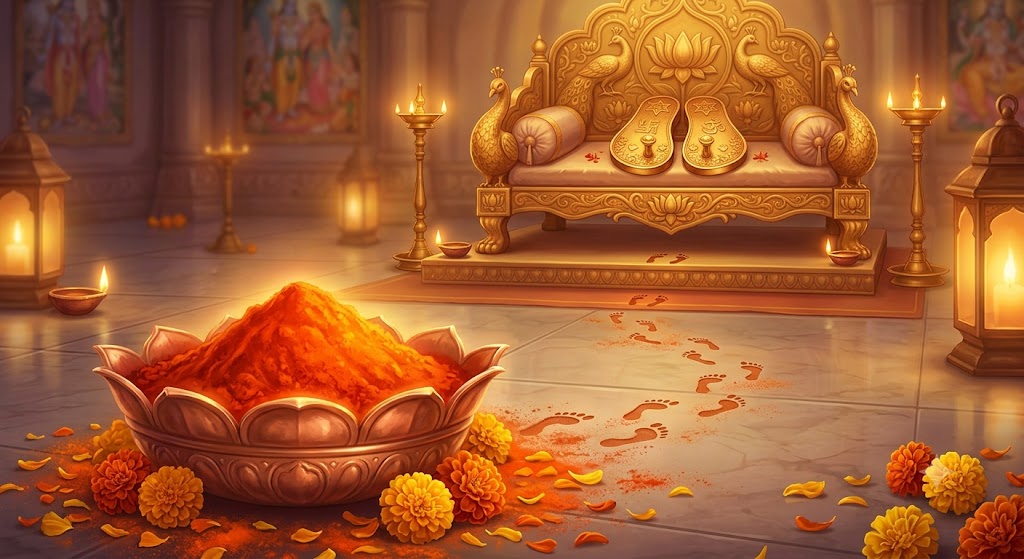
Sri Ramcharitmanas, Tulsi Prasanga
The Orange-Red Blessing of Love: The Origin of Sindoor
The charming and profound story of Hanuman coating his entire body in orange vermilion out of innocent, pure devotion to ensure the long life and prosperity of his master, Sri Rama.
3 chapters · read →
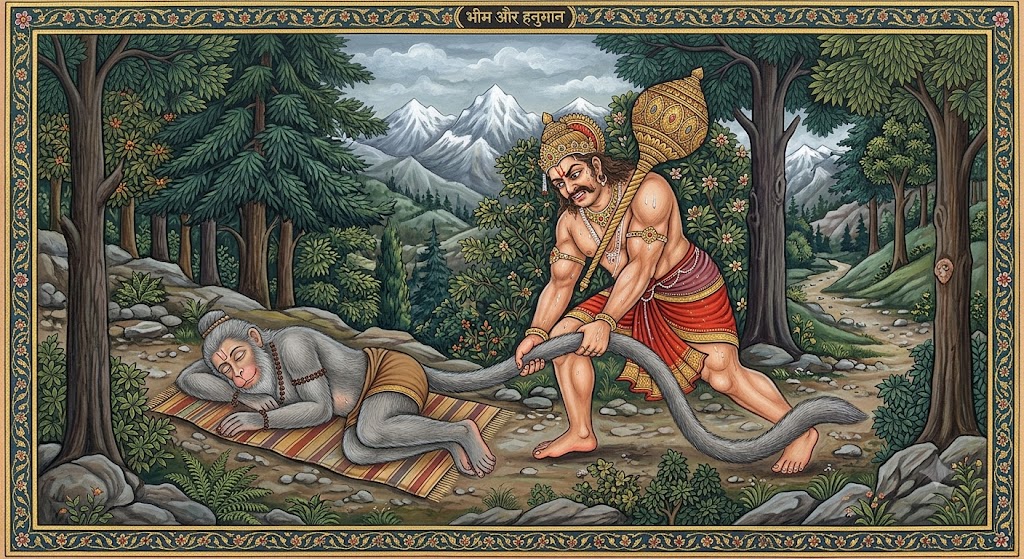
Mahabharata (Vana Parva, Chapters 146-151)
The Old Monkey and the Mighty Prince
Centuries after the Treta Yuga, the immortal Hanuman encounters his spiritual brother, the Pandava prince Bhima, on a mountain path in the Himalayas, teaching him a profound lesson in humility.
3 chapters · read →
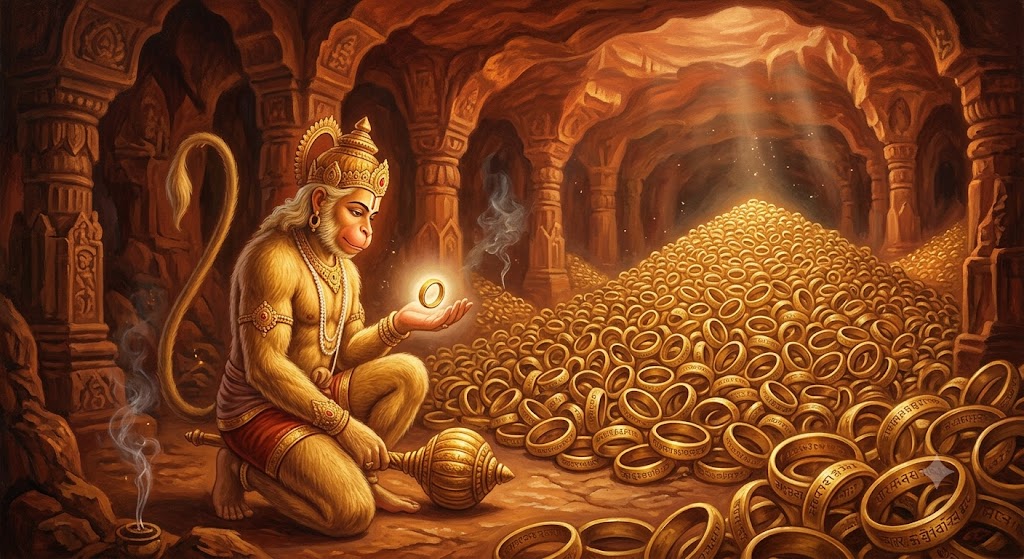
Ananda Ramayana, Puranic Oral Lore
The Secret of the Golden Rings: The Cyclical Nature of Time
A profound metaphysical tale where Sri Rama drops his ring into a crack on Earth, sending Hanuman to the underworld of Naga Loka to discover a mountain of identical rings, revealing the infinite, cyclical nature of cosmic time.
3 chapters · read →
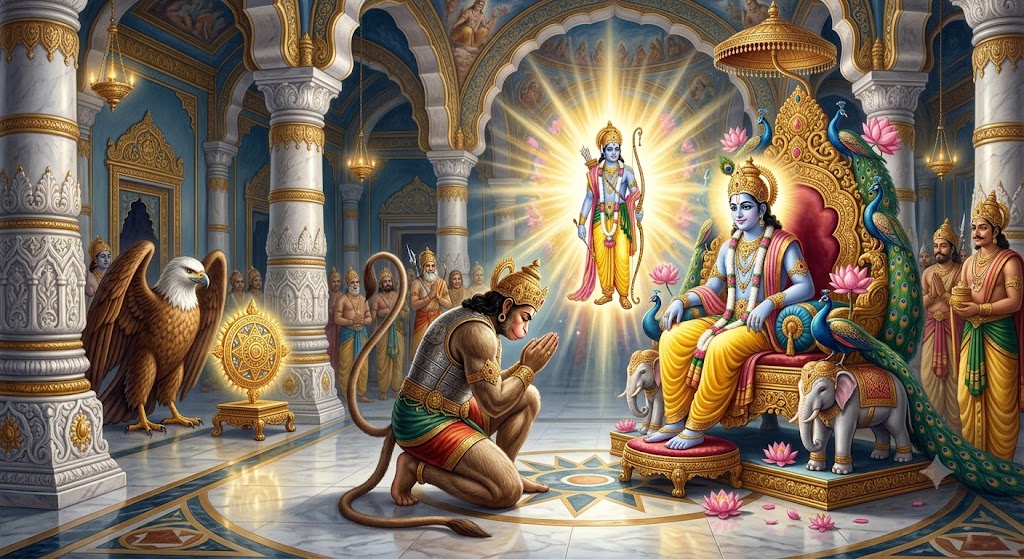
Skanda Purana, Dvapara Upakhyan
The Day Dwarka Learned Humility
Lord Krishna utilizes the pure, unshakeable devotion of the immortal Hanuman to gently correct the subtle spiritual pride residing in his queen Satyabhama, his mount Garuda, and his cosmic weapon Sudarshana Chakra.
3 chapters · read →
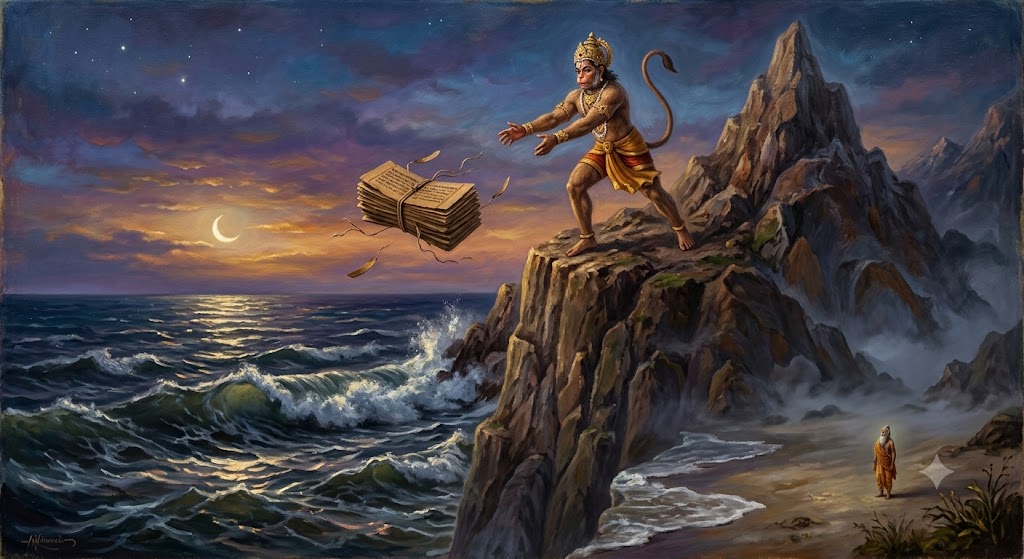
Ananda Ramayana, Puranic Literary Lore
The Masterpiece Thrown to the Waves
The touching and spiritually deep account of the Hanumad Ramayana, written by Hanuman on banana leaves using his claws, and why he deliberately sacrificed his own masterpiece to preserve Sage Valmiki's peace of mind.
3 chapters · read →

Krittivāsī Rāmāyaṇa (Bengali, c. 15th century); Adbhuta Rāmāyaṇa
The Fall of the Two Mahīrāvaṇas
Two demons, unrelated to each other, share one name across two different tellings of the Rama story: a Pātāla sorcerer felled by Hanumān's five-faced form, and Rāvaṇa's own hidden elder brother, defeated only when Sītā reveals the Goddess within her. Told here as the Bengali Krittivāsī tradition and the Adbhuta Rāmāyaṇa remember them — one after the other, not as one story.
4 chapters · read →
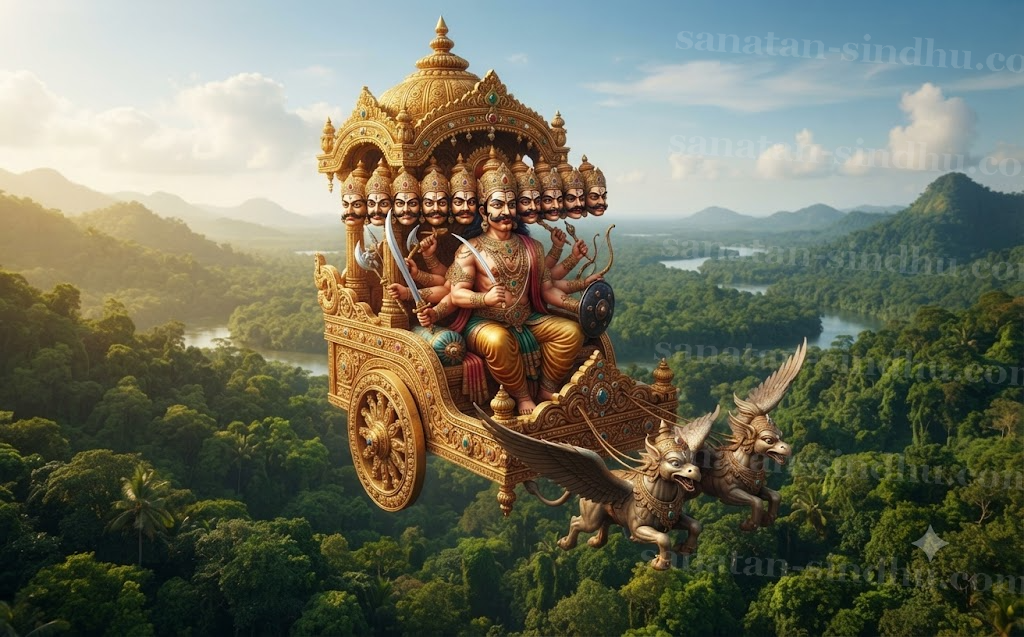
Vālmīki Rāmāyaṇa, Uttara Kāṇḍa (sarga 34), with Kiṣkindhā Kāṇḍa
The Vānara King Who Humbled Rāvaṇa
Before the war, Rāvaṇa went looking for one more king to defeat and found a monkey at his evening prayers. What happened next is the strangest humiliation in the Rāmāyaṇa — and it tells you who Vāli really was.
5 chapters · read →