Nyāya — the logical foundation
Founded by Sage Akṣapāda Gautama, the Nyāya school argues that human suffering is a direct consequence of false knowledge (mithyā-jñāna), which can only be destroyed through the rigorous standardisation of right knowledge (pramā). To achieve this, Nyāya establishes four valid means of obtaining knowledge (pramāṇas): direct perception (pratyakṣa), logical inference (anumāna), comparison (upamāna), and reliable verbal testimony (śabda). Its inquiry is organised around sixteen categories (padārthas), including doubt (saṁśaya), purpose (prayojana) and fallacies (hetvābhāsa).
Aristotle vs. the Pañcāvayava
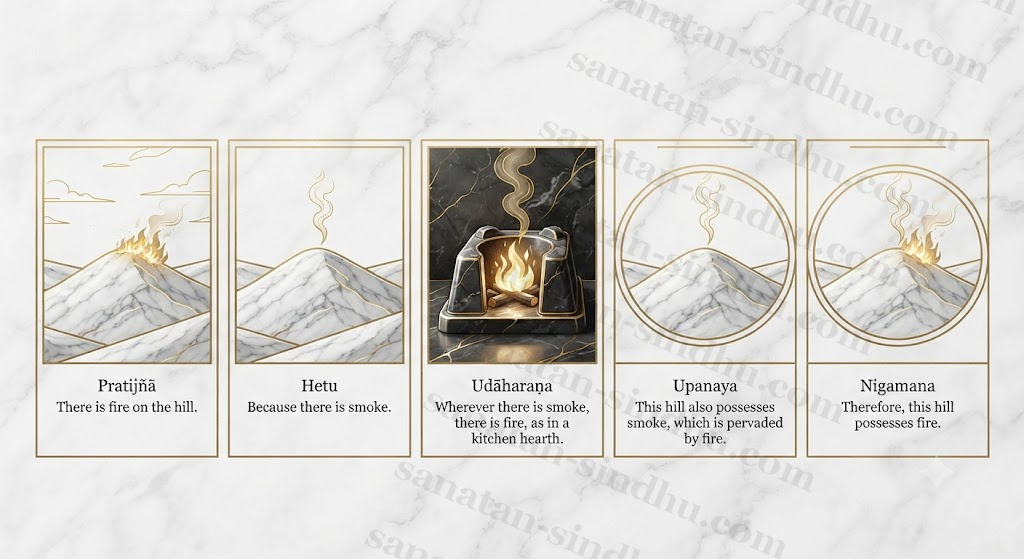
Unlike the three-step deductive syllogism of Aristotelian logic — which operates entirely in the abstract — the Nyāya Pañcāvayava requires that every logical inference be anchored by an empirical, real-world example. This structure keeps reasoning grounded in physical reality.
Aristotelian
Abstract / deductive
Major Premise → Minor Premise → Conclusion
Lacks mandatory physical verification.
Nyāya Pañcāvayava
Empirical / inductive-deductive
Pratijñā → Hetu → Udāharaṇa → Upanaya → Nigamana
Universal rule must be supported by an observed instance.
| Limb (Avayava) | Definition | Classical example | Modern research analogy |
|---|---|---|---|
| 1. Pratijñā | The initial proposition or hypothesis (sādhya). | “There is fire on the hill.” | “This water sample contains dissolved mercury.” |
| 2. Hetu | The reason or middle term — the sign (liṅga). | “Because there is smoke on the hill.” | “Because it colours with diphenylcarbazide reagent.” |
| 3. Udāharaṇa | Universal concomitance (vyāpti) with an observed instance. | “Wherever there is smoke, there is fire — as in a kitchen.” | “Mercury in water always forms a violet complex with the reagent, per lab controls.” |
| 4. Upanaya | Application of the universal rule to the subject (pakṣa). | “This hill has smoke, invariably accompanied by fire.” | “This sample has formed the violet complex.” |
| 5. Nigamana | The final conclusion, proving the proposition. | “Therefore, there is fire on the hill.” | “Therefore, this sample contains mercury.” |