Reading the Naṭarāja
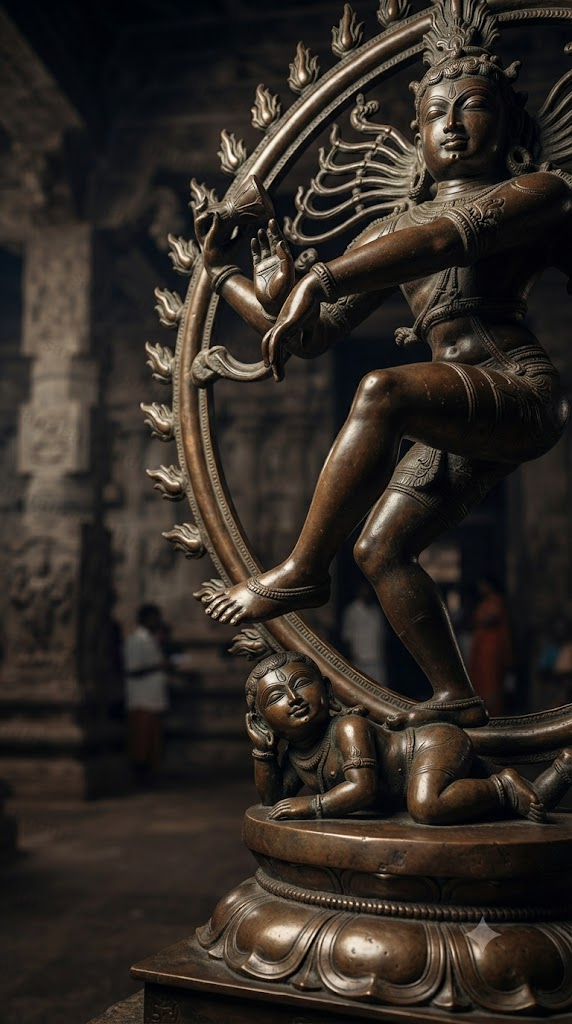
Upper Left Hand (agni) ──→ Flame of universal destruction
Lower Right Hand (abhaya) ──→ Gesture allaying fear / protection
Lower Left Hand (gajahasta) ──→ Points to raised left foot (liberation)
Right Foot (trampling) ──→ Subduing Apasmāra (ignorance / ego)
At the base of the icon, Śiva's right foot stands upon — and subdues — the dwarflike demon Apasmāra Puruṣa. Apasmāra personifies spiritual ignorance, ego and the cosmic forgetfulness (avismaraṇa) of one's real nature. Crucially, Śiva does not kill Apasmāra but merely subdues him: to kill ignorance entirely would disrupt the cosmic play of manifestation, which requires both knowledge and illusion as eternal companions.
Anatomical proportions of the Śilpa Śāstras
The visual metaphor is translated into precise mathematical and anatomical proportions to convey the idealised, divine body prized in Indian art:
Ideal female torso ∝ an hourglass-shaped ḍamaru drum
Ideal arms ∝ graceful, elongated bamboo stems
Ideal eyes ∝ almonds or lotus leaves
Pañcaloha — the five-metal alloy
Traditionally cast using the direct lost-wax technique, these bronzes are composed of a specialised alloy called pañcaloha — gold, silver, copper, brass and lead — which correspond to the five physical elements: earth, water, fire, air and space. The material composition itself reinforces the connection between physical sculpture and cosmic structure.
Explore the bronze
Click a point on the photograph, or its label opposite, to open that gesture's reading.
Close-up studio photograph of a Chola-style bronze Naṭarāja against a plain ground, lit clearly enough to make out all four hands, the raised left foot and the right foot pressing on Apasmāra.
This slot is waiting for a photo — upload one at /admin/uploads and five numbered points will appear directly on it. The readings opposite already work without it.
ḍamaru — upper right hand
Primordial sound
Creation
The small hourglass drum beaten in Śiva's upper right hand is the first sound of manifestation — the pulse the universe keeps time to. In the Śilpa Śāstras this same drum-shape becomes the measured proportion for the ideal female torso: the instrument of creation doubles as creation's own unit of measure.
Upper hand on the viewer's left (Śiva's own right)Read all five at once (plain list, no clicking required)
- ḍamaru — Primordial sound (Creation)
- The small hourglass drum beaten in Śiva's upper right hand is the first sound of manifestation — the pulse the universe keeps time to. In the Śilpa Śāstras this same drum-shape becomes the measured proportion for the ideal female torso: the instrument of creation doubles as creation's own unit of measure.
- agni — Flame of destruction (Dissolution)
- Held in the upper left hand, this flame doesn't oppose the drum's creation — it completes it. Dissolution clears the ground for the next cycle to begin. Creation and destruction are shown as one continuous gesture here, not a contest between two forces.
- abhaya — Fear not (Protection)
- The lower right palm faces outward, fingers raised, in abhaya mudrā — one of the oldest gestures of reassurance in Indian art. Amid the cosmic violence pictured in the other three hands, this one hand promises the devotee has nothing to fear.
- gajahasta — Pointing toward liberation (Mokṣa)
- The lower left hand crosses the body like an elephant's trunk (gajahasta) and points down toward Śiva's own raised foot — mokṣa, liberation, held up and out of the endless cycle of creation and destruction playing out in the other three hands.
- Apasmāra — Subdued, not slain (Ignorance and ego)
- Śiva's right foot presses down on Apasmāra Puruṣa, the dwarf-demon of forgetfulness and ego — but does not kill him. Ending ignorance outright would end the cosmic dance itself, which needs both knowledge and forgetting as permanent partners.