
An encyclopedia of Sanātana Dharma
Sanatan Sindhu emblemSanatan Sindhu

Purāṇas

Encyclopedias of Cosmic History

The 18 Mahāpurāṇas are vast encyclopedic texts that record five essential topics (pañcalakṣaṇa): primary creation (sarga), secondary creation (pratisarga), royal genealogies (vaṁśa), cosmic cycles of Manu (manvantara) and the histories of dynasties (vaṁśānucarita).

Grand cosmic hall inside an ancient Indian stone temple — walls carved with the Sūrya-vaṁśa and Candra-vaṁśa genealogies; a translucent holographic sphere at centre shows the rotating earth with planetary orbits and zodiacal constellations.

Send: scripture-puranas-cosmic-hall.jpg

Slot ID: scripture-puranas-cosmic-hall

The temporal anchors

The portal foregrounds the Vāyu Purāṇa and Matsya Purāṇa as critical temporal anchors. Both state that Bhagavān Rāma appeared at the end of the 24th Tretā Yuga of the Vaivasvata Manvantara — a chronology that challenges linear, Eurocentric assumptions and prompts a radical shift in how human antiquity is perceived.

Sarga

Primary creation of the cosmos.

Pratisarga

Secondary creation and re-creation.

Vaṁśa

Royal genealogies — solar and lunar dynasties.

Manvantara

Cosmic cycles under each Manu.

Vaṁśānucarita

Histories and deeds of the dynasties.
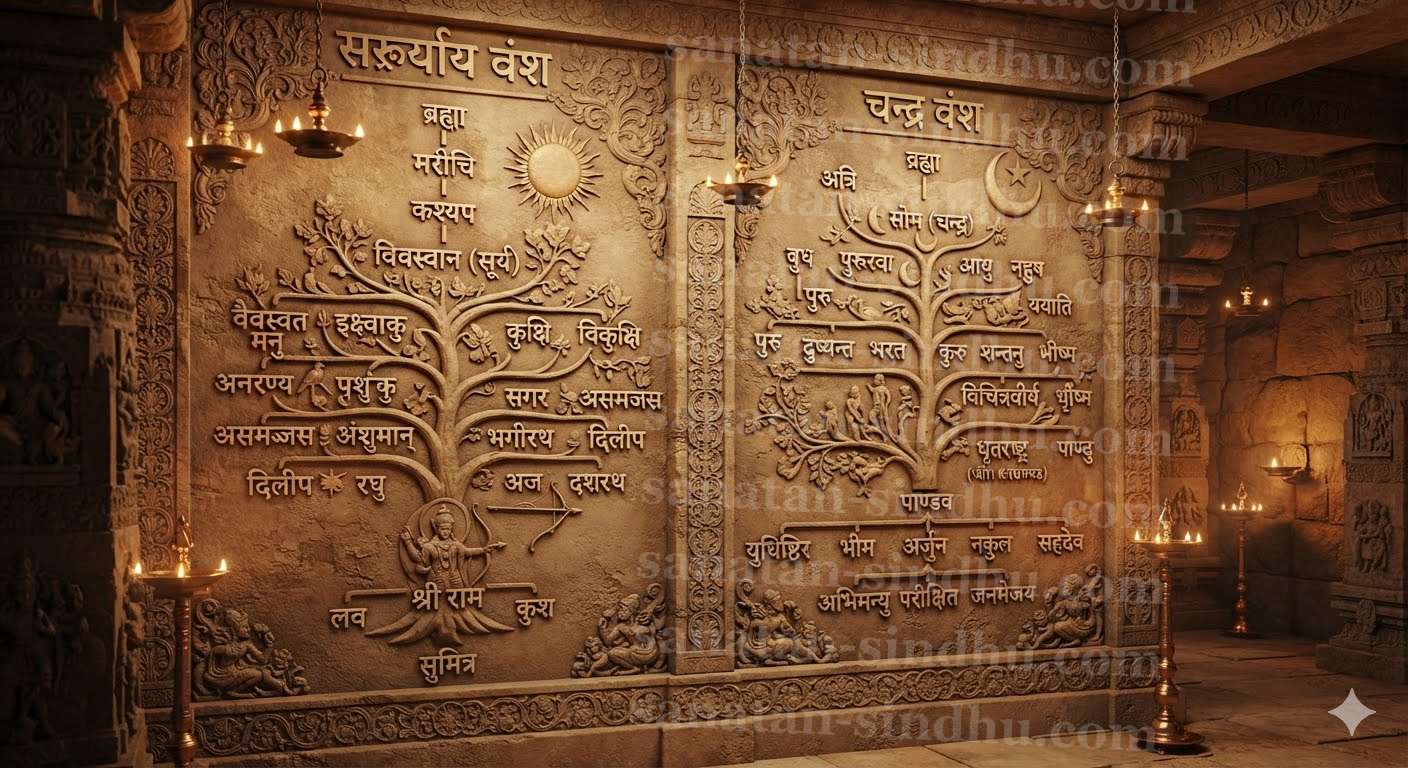
Detailed diagram of the Sūrya-vaṁśa and Candra-vaṁśa dynastic trees carved in stone, warm bronze lighting, elegant Devanāgarī labels.

Send: scripture-puranas-vamsha-tree.jpg

Slot ID: scripture-puranas-vamsha-tree
Animated temporal timelines track moral-decay metrics and celestial alignments across the yugas.

Historical and scientific precision

Beyond cosmology, the Purāṇas contain detailed accounts of geological transformations, climatic shifts and royal successions — a scientific memory embedded inside devotional narrative. This sub-section highlights those layers for readers who want history as well as bhakti.
Essays on this material

Essay · Cosmogony

Trimūrti — Scriptural Origins

A comparative study of Brahmā, Viṣṇu and Śiva — Vedic antecedents, Upanishadic identifications, Purāṇic narratives, and the non-dual paradigm of Kashmiri Trika Shaivism.

Essay · Śaiva Cosmology

The Infinite Forms of the Formless — Śiva's descents and cosmic purpose

Unlike Viṣṇu's ten physical Dashāvatāras, Śiva's descents are Anśāvatāras and Rudras — instantaneous manifestations that dissolve ego, transmit Yoga, and restore Dharma. A tour of the 19 Primary Avatars, the 11 Rudras, the 28 Yogeśvaras, the Pañchabrahma, and the Śaiva-Vaiṣṇava synthesis of Hanumān as the 11th Rudra — anchored to the Mathurā Pillar Inscription of 380 CE.

Essay · Hanumān · Śaiva-Vaiṣṇava Synthesis

Sacred Wind, Eternal Devotee — Hanumān's lore and cultural significance

A textual stratigraphy of Hanumān across the Vālmīki Rāmāyaṇa, the Śiva Purāṇa, the Adhyātma and Ānanda Rāmāyaṇas, and Tulsīdās's Rāmcharitmānas — plus the Upaniṣadic anchors that place Him as a premier Vedic scholar, the Pañchamukhī rescue in Pātāla Loka, the pact with Śani, the origin of the sindūr offering, the Hanumad Rāmāyaṇa, and the metaphysics of cyclical time.

Essay · Vaiṣṇava Cosmology

The Ten Descents — Daśāvatāra and the awakening of consciousness

Viṣṇu's ten avatāras read as a parallel to biological and social evolution — from Matsya the fish to Kalki the future rider — with the Vedāntic twist that the Lord *descends* (avatāra) so the soul (jīva) can *ascend* (pariṇāma).

Essay · Vaiṣṇava Theology

Two traditions on the Eighth — Kṛṣṇa, Balarāma and the question of who the avatāra is

Two authoritative streams disagree about the eighth Daśāvatāra: one names Kṛṣṇa the avatāra with Balarāma as Ādi-Śeṣa, the other (Gauḍīya) names Kṛṣṇa Svayam Bhagavān with Balarāma as the eighth. Both are read side by side.

Browse all essays →