
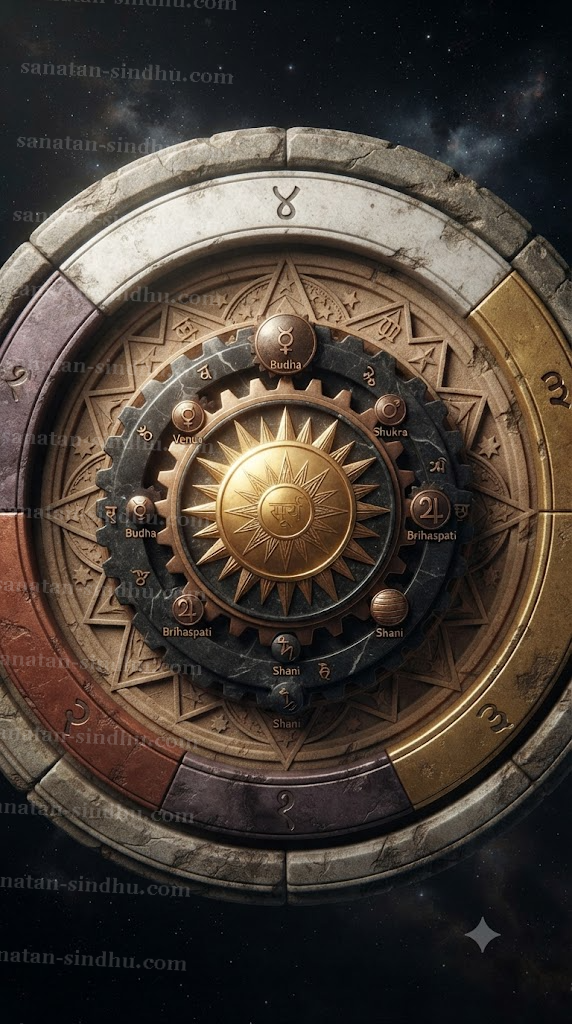
The Mahāyuga
A single Mahāyuga (or Caturyuga) consists of exactly 4,320,000 solar years — 12,000 divine years, where one divine year equals 360 human years. The four world ages within a Mahāyuga decay in the precise ratio 4 : 3 : 2 : 1, mirroring the gradual loss of the four legs of the sacred bull of Dharma.
Satya Yuga = 4 × 432,000 = 1,728,000 years (4,800 divine years)
Tretā Yuga = 3 × 432,000 = 1,296,000 years (3,600 divine years)
Dvāpara Yuga = 2 × 432,000 = 864,000 years (2,400 divine years)
Kali Yuga = 1 × 432,000 = 432,000 years (1,200 divine years)
Mahāyuga total = 4,320,000 years
This structure is not arbitrary: the Sūrya Siddhānta uses 4.32 million solar years because it is the lowest common multiple that allows the orbital revolutions of every visible planet — including the Moon's nodes and apogees — to resolve into perfect whole-number integers. At the transition of each Mahāyuga, all celestial bodies return to a perfect zero-point conjunction in Aries (meṣa rāśi).
Level: Mahāyuga cycle (4:3:2:1)
Interactive chronological wheel
Sūrya Siddhānta Cosmos
Complete cosmic cycle ratio: 4 : 3 : 2 : 1
The foundational astronomical text detailing planetary motion, time cycles (kalpa, mahāyuga) and their precise mathematical ratios.
Drag to rotate • scroll over the wheel to change scale • tap the sun to reset
The Kalpa and the Manvantara
On a larger scale, a single day of Brahmā — a kalpa — lasts exactly 1,000 Mahāyugas, or 4.32 billion human years. This duration closely parallels modern scientific estimates for the age of the Earth and the Solar System. Within each kalpa there are 14 manvantaras (reigns of individual Manus), each lasting 71 Mahāyugas plus transitional junctures (sandhya) equal to a Satya Yuga.
1 Manvantara = 71 Mahāyugas ≈ 306,720,000 years
From truṭi to kalpa
To convert these vast cycles into daily practice, traditional calendars use ahargaṇa — the total count of days elapsed from a fixed epoch. Āryabhaṭa places the start of the current Kali Yuga at 18 February 3102 BCE.
└─ 1 Prāṇa (~4 seconds)
└─ 1 Ahorātra (1 solar day)
└─ 1 Varṣa (1 human year)
└─ 1 Mahāyuga (4,320,000 years)
└─ 1 Manvantara (306,720,000 years)
└─ 1 Kalpa (4,320,000,000 years)
The 5-year Vedāṅga Jyotiṣa yuga
In contrast to these macro-cosmic cycles, the auxiliary astronomical manual Vedāṅga Jyotiṣa outlines a practical, localised five-year civil calendar cycle (yuga) to regulate agricultural and sacrificial schedules — tracking the intersection of solar and lunar movements: